Word problems involving fractions (Fractions)
Watch this topic in 60 seconds
Free preview · Lesson 1
Understanding Word problems involving fractions (Fractions)
Mastering Word Problems with Fractions: A Foundational Journey
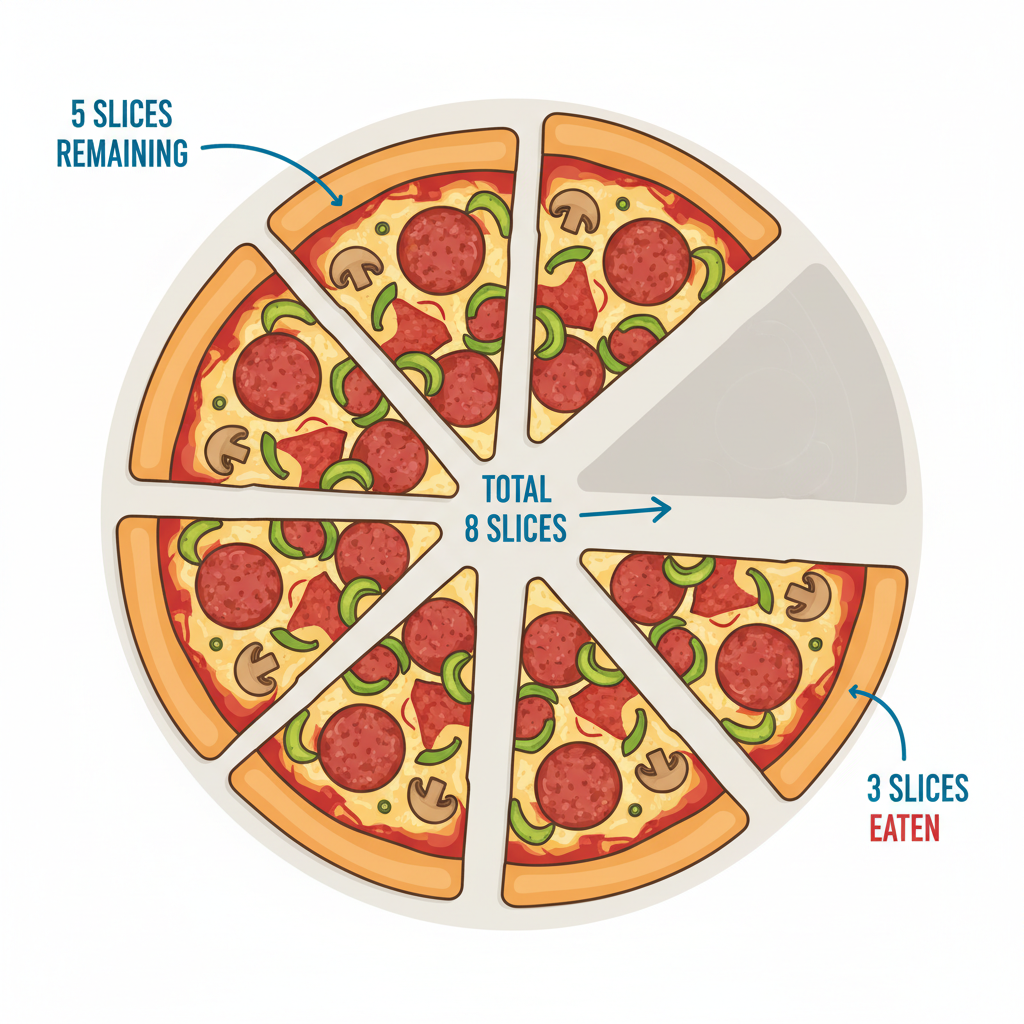
Welcome, young mathematicians, to a super exciting adventure into the world of fractions! Don't let the word 'fractions' scare you. Think of them like slices of a pizza or pieces of a cake – we see them all the time! Today, we're going to become experts at solving word problems that use these yummy pieces. We'll make sure everything is super clear, using simple terms and lots of fun examples.
What is a Fraction? Let's Break it Down!
Imagine you have a delicious chocolate bar. If you break it into 4 equal pieces, and you eat 1 of those pieces, you've eaten one-fourth of the chocolate bar. That's a fraction! A fraction tells us about a part of a whole thing.
A fraction has two important numbers:
- The Numerator: This is the top number. It tells us how many pieces we have or are talking about. In our chocolate bar example, if you ate 1 piece, the numerator is 1.
- The Denominator: This is the bottom number. It tells us how many equal pieces the whole thing is divided into. For our chocolate bar broken into 4 pieces, the denominator is 4.
So, the fraction representing the part of the chocolate bar you ate is 1/4.
Analogy Time! Think of a fraction like a team. The denominator is the total number of players on the team (how many possible positions there are). The numerator is the number of players currently on the field (how many we're focusing on).
Why Are Fractions Important in Word Problems?
Word problems are like little stories that ask us to use our math skills to find an answer. Fractions pop up in these stories all the time:
- Sharing food: "Sarah ate 1/2 of the pizza."
- Measuring ingredients: "Add 3/4 cup of flour to the bowl."
- Time: "The movie is 1 and 1/2 hours long."
- Distance: "He lives 2/3 of a mile away."
By understanding fractions, we can understand and solve these real-life situations!
Adding and Subtracting Fractions: Putting Pieces Together and Taking Them Away
When we add or subtract fractions, we're usually dealing with pieces of the same whole thing. This is super important!
When Denominators are the Same (Easy Peasy!)
If the denominator is the same, it means all the pieces are the same size. So, we just add or subtract the numerators!
Example 1 (Addition): Maria has a ribbon that is 2/5 meters long. She gets another piece that is 1/5 meters long. How long is her ribbon now?
Since both pieces are measured in fifths (the denominator is 5 for both), we can just add the lengths:
2/5 + 1/5 = (2+1)/5 = 3/5 meters.
Analogy: Imagine you have 2 red apples and you get 1 more red apple. You now have 3 red apples. The 'color' (denominator) stays the same, you just add the 'number of apples' (numerators).
Example 2 (Subtraction): A baker used 3/4 of a bag of sugar for a cake. He has 1/4 of the bag left. How much sugar did he use?
Here, the whole bag is divided into fourths. He used 3/4 and has 1/4 left. This means he started with 4/4 (the whole bag). How much did he use? That's the total minus what's left:
4/4 - 1/4 = (4-1)/4 = 3/4 of the bag.
Analogy: You have 5 cookies (denominator = 5). You eat 2 of them (numerator = 2). How many are left? 5 - 2 = 3 cookies left. The type of cookie (denominator) doesn't change.
When Denominators are Different (A Little More Work!)
If the denominators are different, it means the pieces are different sizes. We can't just add or subtract them directly. We need to make the pieces the same size first. We do this by finding a common denominator.
A common denominator is a number that both of the original denominators can divide into evenly. Often, we can find it by multiplying the two denominators together, or by finding the smallest number that is a multiple of both.
Example 3 (Addition): John drinks 1/2 a glass of milk, and later he drinks 1/3 of a glass. How much milk did he drink in total?
We can't add 1/2 and 1/3 directly because the pieces (halves and thirds) are different sizes. We need to find a common denominator for 2 and 3. The smallest number that both 2 and 3 go into is 6.
To change 1/2 into a fraction with a denominator of 6, we ask: "What do I multiply 2 by to get 6?" The answer is 3. So, we multiply both the numerator and the denominator by 3:
1/2 = (1 * 3) / (2 * 3) = 3/6
Now, to change 1/3 into a fraction with a denominator of 6, we ask: "What do I multiply 3 by to get 6?" The answer is 2. So, we multiply both the numerator and the denominator by 2:
1/3 = (1 * 2) / (3 * 2) = 2/6
Now that our fractions have the same denominator (6), we can add them:
3/6 + 2/6 = (3 + 2) / 6 = 5/6 of a glass.
Analogy: Imagine you have half a pizza (1/2) and your friend has a third of a pizza (1/3). To compare or combine them fairly, you need to cut all the slices into the same smaller size. If you cut everything into sixths, your half becomes three sixths (3/6), and your friend's third becomes two sixths (2/6). Now you can easily see you have five sixths (5/6) in total!
Example 4 (Subtraction): A recipe calls for 2/3 cup of flour. You only have 1/4 cup of flour. How much more flour do you need?
We need to find the difference between 2/3 and 1/4. The denominators are 3 and 4. The smallest common denominator is 12 (since 3 * 4 = 12, and 12 is the smallest multiple of both 3 and 4).
Change 2/3 to twelfths:
2/3 = (2 * 4) / (3 * 4) = 8/12
Change 1/4 to twelfths:
1/4 = (1 * 3) / (4 * 3) = 3/12
Now subtract:
8/12 - 3/12 = (8 - 3) / 12 = 5/12 cup.
So, you need 5/12 more cup of flour.
Putting it all Together: Solving Word Problems!
Let's combine what we've learned to solve some word problems. The key is to read carefully, identify the numbers and what they represent, and then decide if you need to add or subtract.
Step 1: Understand the Story
Read the problem slowly. What is happening? What information are you given?
Step 2: Identify the Fractions and the Operation
What fractions are mentioned? Does the problem ask you to combine amounts (add) or find the difference between amounts (subtract)?
Step 3: Make Denominators the Same (If Needed)
If the denominators are different, find a common denominator.
Step 4: Perform the Operation
Add or subtract the numerators.
Step 5: Write Your Answer Clearly
Make sure your answer makes sense in the context of the story!
Word Problem Example:
Rani had 7/8 of a pizza. She ate 1/4 of the pizza for lunch. What fraction of the pizza does she have left?
Step 1 & 2: We start with 7/8 of a pizza and 'eat' or remove 1/4. This means we need to subtract.
Step 3: The denominators are 8 and 4. We need a common denominator. The smallest common denominator is 8, because 4 can go into 8.
Convert 1/4 to eighths:
1/4 = (1 * 2) / (4 * 2) = 2/8
Step 4: Now subtract the fractions:
7/8 - 2/8 = (7 - 2) / 8 = 5/8
Step 5: Rani has 5/8 of the pizza left.
Isn't that neat? You just solved a word problem using fractions!
Let's look at one more!
A recipe for cookies requires 1/2 cup of sugar and 1/3 cup of butter. How much more sugar than butter is needed?
Step 1 & 2: We are comparing sugar (1/2 cup) and butter (1/3 cup) to see how much 'more' sugar there is. This means subtraction.
Step 3: Denominators are 2 and 3. Common denominator is 6.
Convert 1/2 to sixths:
1/2 = (1 * 3) / (2 * 3) = 3/6
Convert 1/3 to sixths:
1/3 = (1 * 2) / (3 * 2) = 2/6
Step 4: Subtract:
3/6 - 2/6 = (3 - 2) / 6 = 1/6
Step 5: 1/6 cup more sugar than butter is needed.
You're doing great! Remember, fractions are just parts of a whole, and word problems are just stories that help us practice using those parts.
Keep practicing, and you'll become a fraction word problem wizard in no time!
Keep learning, free
Create a free Syllabax account to unlock practice questions and games for this topic.
Visual Learning Enhanced! 🚀
To help you master this topic, we use Advanced Syllabax AI to generate detailed diagrams and visual models.
Note on Visuals: The AI sometimes makes spelling errors in image labels. Please refer to the lesson text for the correct terminology.