Learning Journey
Watch this topic in 60 seconds
Free preview · Lesson 1
Understanding Indicators (litmus, turmeric, china rose) [CHEMISTRY]
Understanding Indicators: Nature's Color-Changing Detectives!
Welcome, young scientists, to the fascinating world of indicators! Imagine you're a detective, and you need to figure out if a mystery substance is like a zesty lemon or a soapy cleaner. How can you tell without tasting or smelling everything? That's where our special helpers, the indicators, come in! They are like nature's own mood rings for chemicals, changing their colors to tell us a secret story about the substances they meet.
What is an Indicator?
In chemistry, an indicator is a substance that changes color when it comes into contact with an acid or a base. Think of it like a traffic light. A red light means 'stop', a green light means 'go'. Similarly, an indicator's color tells us if a substance is acidic or basic. Most indicators are themselves weak acids or weak bases, and their special ability comes from how their molecules are built – they absorb and reflect light differently depending on whether they are in an acidic or basic environment.
Acids and Bases: The Yin and Yang of Chemistry
Before we dive deeper into indicators, let's quickly understand what acids and bases are.
Acids: The Sour Bunch
Acids are substances that usually taste sour (but don't taste unknown chemicals!), feel a bit sharp, and can make things like metals corrode. Think of the sourness of a lemon or vinegar. These everyday items contain acids!
- Examples: Lemon juice (citric acid), vinegar (acetic acid), stomach acid (hydrochloric acid).
- Analogy: Acids are like energetic puppies! They're a bit wild, can be sharp and sometimes cause a little 'mess' (corrosion), but they're also common and useful.
Bases: The Bitter and Slippery Crew
Bases (also called alkalis when dissolved in water) usually taste bitter (again, don't taste them!), feel slippery like soap, and can be quite strong. They are the opposite of acids.
- Examples: Baking soda, soap, toothpaste, ammonia.
- Analogy: Bases are like soft, fluffy pillows. They are often smooth and can feel 'slippery' to the touch, and they counteract the 'sharpness' of acids, just like a pillow can cushion something hard.
Meet Our Color-Changing Detectives!
Now, let's introduce our main characters: Litmus, Turmeric, and China Rose. These are all natural indicators, meaning they come from plants!
1. Litmus: The Classic Detective
Litmus is probably the most famous indicator. It's made from a type of lichen (a plant that grows on rocks and trees). Litmus paper is the most common form we see in labs. It comes in two colors: blue litmus paper and red litmus paper.
- How it works:
- If you dip blue litmus paper into an acidic solution, it turns red. (Think: Acid turns Blue litmus Red).
- If you dip red litmus paper into a basic solution, it turns blue. (Think: Base turns Red litmus Blue).
- If you dip either in a neutral substance (neither acidic nor basic, like pure water), the color doesn't change. Blue stays blue, and red stays red.
- Analogy: Litmus paper is like a 'yes' or 'no' sign for acids and bases. Blue paper says 'YES, acid!' by turning red. Red paper says 'YES, base!' by turning blue. If nothing happens, it's a 'NO' to both, meaning it's neutral.
2. Turmeric: The Kitchen Chemist
Turmeric is that bright yellow spice you find in your kitchen! It's amazing because it can also act as an indicator. Turmeric itself is yellow.
- How it works:
- When turmeric encounters a base, it undergoes a magical transformation and turns a rusty, reddish-brown color.
- In acidic or neutral solutions, turmeric stays its usual bright yellow.
- Analogy: Turmeric is like a shy artist. In most situations (acids and neutrals), it keeps its bright yellow color. But when it meets a base, it blushes a deep reddish-brown to show its surprise!
- Real-life test: Ever notice yellow curry stains on your white shirt? If you wash it with soap (which is basic), the stain might turn more reddish-brown.
3. China Rose (Hibiscus): The Flower's Secret
The beautiful China rose flower, also known as hibiscus, holds a colorful secret within its petals. By boiling the petals in water, we can extract a reddish-pink colored liquid that acts as a fantastic indicator.
- How it works:
- When this China rose extract meets an acid, it turns a vibrant deep red or magenta color.
- When it meets a base, it turns a lovely green color.
- In neutral substances, it remains its original pinkish-red color.
- Analogy: The China rose indicator is like a chameleon artist. In acidic environments, it proudly displays a bold red. In basic environments, it cleverly camouflages itself into a calming green. In neutral settings, it just shows its natural, pretty pink.
Why are Indicators Important?
Indicators are super useful for many reasons:
- Safety: They help us identify strong acids and bases, which can be dangerous.
- Science Experiments: They are essential tools in laboratories for various tests and reactions.
- Everyday Life: Understanding how things like soap (base) react with stains or how acidic foods are helps us make informed choices.
Neutral Substances: The Unchanged Ones
What about things that are neither acidic nor basic? These are called neutral substances. Pure water is the best example. When indicators meet neutral substances, they don't change color. Litmus stays the same, turmeric stays yellow, and the China rose extract keeps its original pinkish-red hue. They are like the calm observers who don't react to the excitement around them.
Putting It All Together
So, the next time you encounter a mystery substance, remember our color-changing detectives! They help us uncover the hidden acidic or basic nature of things, making chemistry a little less mysterious and a lot more colorful!
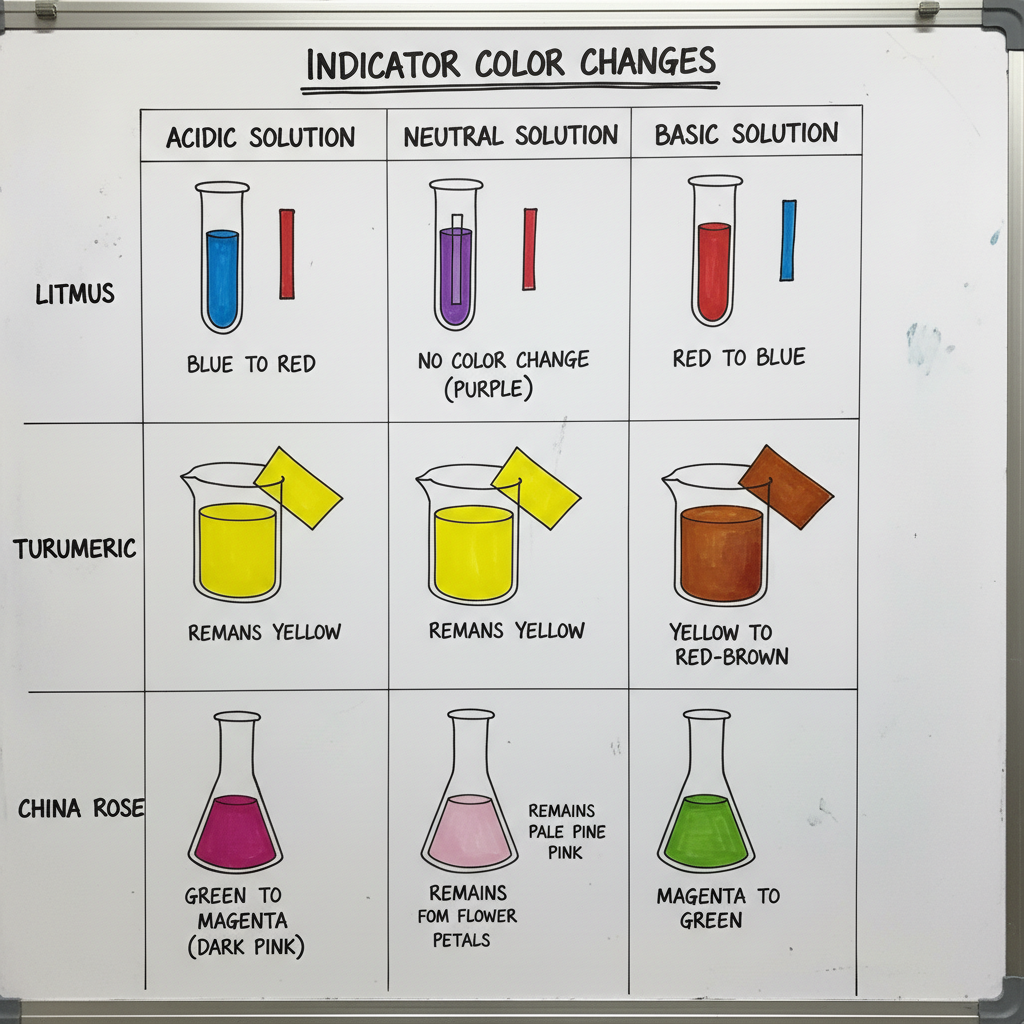 ⚠️ This picture may have spelling mistakes. Trust the words in the lesson.
Keep learning, free
Create a free Syllabax account to unlock practice questions and games for this topic.
Visual Learning Enhanced! 🚀
To help you master this topic, we use Advanced Syllabax AI to generate detailed diagrams and visual models.
Note on Visuals: The AI sometimes makes spelling errors in image labels. Please refer to the lesson text for the correct terminology.