Different types of sounds (Sound )
Watch this topic in 60 seconds
Free preview · Lesson 1
Understanding Different types of sounds (Sound )
Exploring the Wonderful World of Sounds!
Hello, young explorers! Get ready to open your ears and discover the amazing world of sounds all around us. Just like there are many different colors to see and many different tastes to try, there are also many different kinds of sounds to hear!
What is Sound? (It's All About Vibrations!)
Before we talk about different types of sounds, let's understand what sound actually is. Sound is made when something vibrates. What's a vibration? It's a super-fast wiggle or a shake!
- Think about a rubber band. If you pluck it, it wiggles back and forth very quickly. That wiggle makes a sound!
- Think about your throat. If you put your hand on your throat and talk, you can feel it vibrate.
- When something vibrates, it makes the air around it vibrate too, and these air vibrations travel to your ears. Your ears catch these vibrations, and your brain tells you what sound it is! It's like sending tiny invisible waves through the air that your ears can 'catch'.
1. Loud vs. Soft Sounds (Volume)
Have you ever heard someone whisper a secret? Or heard a big drum being hit very hard? Those are examples of soft and loud sounds!
-
Loud Sounds: These sounds have a lot of energy. They are like a big splash in a puddle. You can hear them from far away. A loud sound is like someone shouting with all their might!
Analogies:- Imagine stomping your foot really hard – that's a loud sound.
- A roaring lion makes a very loud sound!
- A fire truck's siren is very loud so everyone can hear it coming.
-
Soft Sounds: These sounds have less energy. They are like a tiny raindrop falling into a puddle. You usually have to be closer to hear them. A soft sound is like someone whispering a secret or tiptoeing quietly.
Analogies:- Imagine gently tapping your finger on a table – that's a soft sound.
- A mouse's tiny squeak is a soft sound.
- The gentle rustle of leaves in the wind is a soft sound.
We measure how loud or soft a sound is with something called 'volume'. You can turn the volume up to make something louder, or turn it down to make it softer!
 ⚠️ This picture may have spelling mistakes. Trust the words in the lesson.
2. High vs. Low Sounds (Pitch)
Have you ever heard a tiny bird sing? Or a big, booming tuba play? These are examples of high and low sounds!
-
High Sounds: These sounds are made by very fast vibrations. Think of a very thin rubber band or a small bell. When something vibrates quickly, it makes a high sound, like a tiny squeak or a whistle.
Analogies:- If you stretch a rubber band tight and pluck it, it makes a high sound.
- A little bird's chirp is a high sound.
- A small flute plays high, clear notes.
-
Low Sounds: These sounds are made by slower vibrations. Think of a thick rubber band or a big drum. When something vibrates slowly, it makes a low, deep sound, like a rumble or a boom.
Analogies:- If you have a loose, thick rubber band and pluck it, it makes a low sound.
- An elephant's trumpet is a low, deep sound.
- A big tuba plays low, booming notes.
We call how high or low a sound is 'pitch'. Girls and boys often have different pitches in their voices – children usually have higher-pitched voices than many adults!
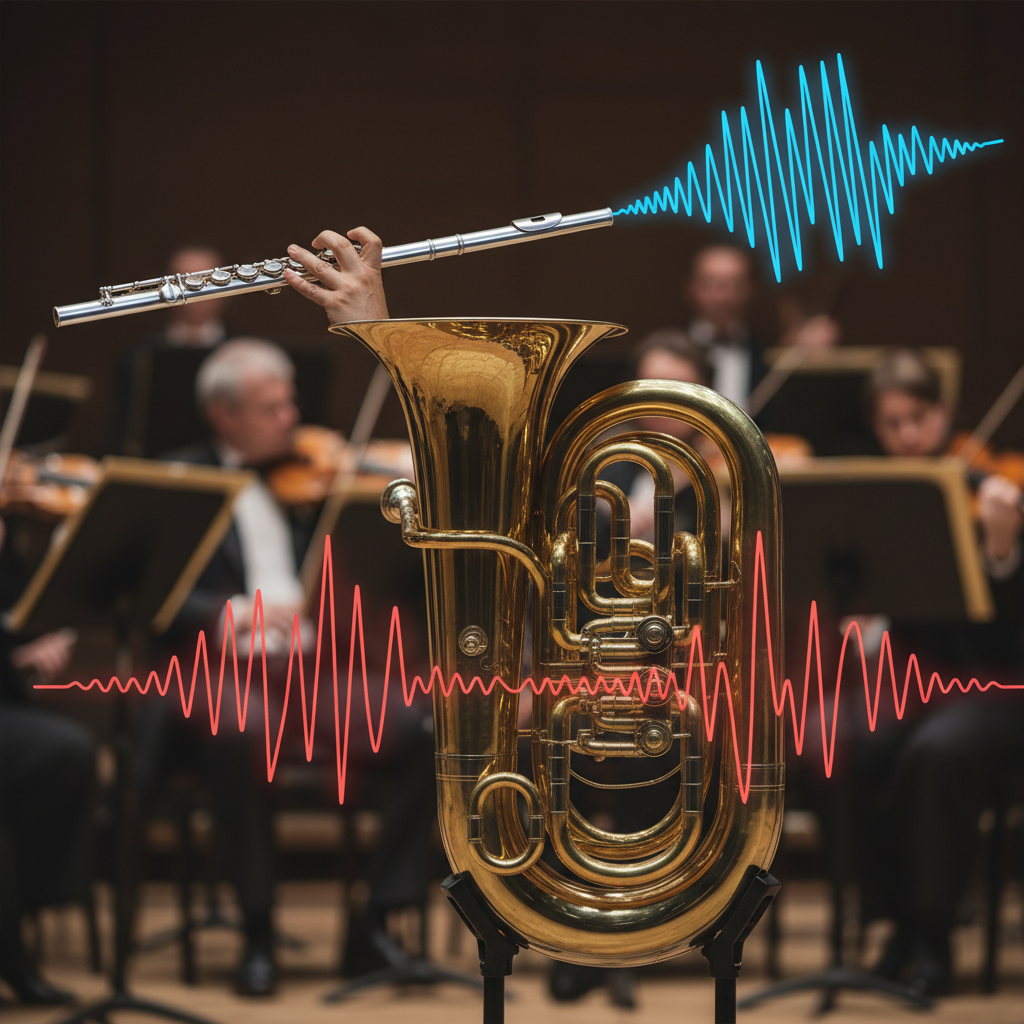 ⚠️ This picture may have spelling mistakes. Trust the words in the lesson.
3. Pleasant vs. Unpleasant Sounds (Music vs. Noise)
Some sounds make us feel happy and want to dance, while others might make us want to cover our ears!
-
Pleasant Sounds (Music): These are sounds that usually have a pattern or rhythm. They are organized and sound nice to our ears. Music is a great example!
Examples:- The beautiful singing of a choir.
- Your favorite song on the radio.
- The gentle strumming of a guitar.
-
Unpleasant Sounds (Noise): These are often disorganized, harsh, or sounds that we don't like to hear. They can sometimes be too loud or just not sound good together.
Examples:- The loud, grinding sound of a construction jackhammer.
- Many people talking loudly at the same time in a crowded room, making it hard to hear anyone.
- The screech of brakes when a car stops suddenly.
4. Sounds from Nature vs. Man-Made Sounds
Where do sounds come from? They can come from the world around us, or from things that people create!
-
Natural Sounds: These are sounds that come from nature, without people making them.
Examples:- The gentle patter of rain.
- The strong boom of thunder.
- The rustling of leaves in the wind.
- The chirping of crickets at night or birds singing in the morning.
- The waves crashing on the beach.
-
Man-Made Sounds: These are sounds that are created by people, or by machines and things that people have built.
Examples:- The honking horn of a car or bus.
- The ringtone of a telephone.
- Music played on a speaker.
- A child laughing or talking.
- A clock ticking.
Let's Review!
Isn't it amazing how many different kinds of sounds there are? Remember, all sounds start with vibrations. And we can describe sounds in many ways:
- Are they loud or soft? (Volume)
- Are they high or low? (Pitch)
- Are they pleasant (music) or unpleasant (noise)?
- Do they come from nature or from people (man-made)?
Now that you know all about different sounds, listen carefully throughout your day and see how many different types of sounds you can identify! Your ears are incredible tools for exploring the world!
Keep learning, free
Create a free Syllabax account to unlock practice questions and games for this topic.
Visual Learning Enhanced! 🚀
To help you master this topic, we use Advanced Syllabax AI to generate detailed diagrams and visual models.
Note on Visuals: The AI sometimes makes spelling errors in image labels. Please refer to the lesson text for the correct terminology.