Learning Journey
Watch this topic in 60 seconds
Free preview · Lesson 1
Understanding Standard form & discriminant (Quadratic Equations)
Understanding Quadratic Equations: Standard Form and the Discriminant
Welcome, 10th-grade learners! Today, we're going to unlock some secrets of quadratic equations – those special equations that have an x² term. Don't worry if they seem intimidating; we'll break them down into simple, easy-to-understand parts, just like taking apart a complex LEGO set piece by piece.
Part 1: The Standard Form of a Quadratic Equation – The Universal Blueprint!
Imagine you're baking a cake. Most recipes start with a standard list of ingredients: flour, sugar, eggs, etc. A quadratic equation also has a 'standard recipe' or a 'universal blueprint' that helps us understand it better. This blueprint is called the Standard Form.
What is Standard Form?
The standard form of a quadratic equation is always written like this:
ax² + bx + c = 0
Let's break down each part:
a: This is the number (or coefficient) that's multiplied by the x² term. It's super important because if 'a' were 0, the x² term would disappear, and it wouldn't be a quadratic equation anymore! Think of 'a' as the 'engine' of your quadratic car. It determines its basic power.b: This is the number (or coefficient) that's multiplied by the x term. It helps shape the parabola (the U-shaped graph of a quadratic equation). You can think of 'b' as the 'steering wheel' – it influences the direction and tilt of your quadratic car.c: This is a constant number, meaning it doesn't have an 'x' attached to it. It's often called the 'constant term'. It tells us where the parabola crosses the y-axis. You can think of 'c' as the 'gas tank' – it's just a value, independent of speed or direction.= 0: This is crucial! For an equation to be in standard form (and to easily solve it), it must be set equal to zero. This is like saying, 'We've reached the finish line and want to know where the car stops.'
Analogies to Grasp Standard Form:
- The House Address: Just like every house has a unique address (e.g., 123 Main Street), every quadratic equation has a unique identity when written in standard form. It allows everyone to find and work with it consistently.
- The Robot Assembly Manual: If you're building a robot, the manual tells you where each part goes: 'engine here,' 'arm here,' 'power button here.' Standard form is the manual for quadratic equations, telling you exactly where 'a', 'b', and 'c' are located.
Putting it into Practice (Identifying a, b, and c):
Let's look at some examples:
- Example 1:
2x² + 5x + 3 = 0
Here,a = 2,b = 5,c = 3. (Simple, right?) - Example 2:
x² - 4x + 7 = 0
Remember, if there's no number in front of x², it's actually 1! So,a = 1,b = -4(don't forget the negative sign!),c = 7. - Example 3:
3x² + 9 = 0
What's missing? The 'bx' term! If a term is missing, its coefficient is 0. So,a = 3,b = 0,c = 9. - Example 4:
-x² + 6x = 0
Here,a = -1,b = 6,c = 0(the constant term is missing). - Example 5:
2x² = 7x - 5
Uh oh! This isn't set to zero. We need to move everything to one side to make it= 0.
Subtract7xfrom both sides:2x² - 7x = -5
Add5to both sides:2x² - 7x + 5 = 0
Now we have:a = 2,b = -7,c = 5.
The goal is always to rearrange the equation so it looks like ax² + bx + c = 0. This is your first superpower in dealing with quadratics!
Part 2: The Discriminant – The Fortune Teller of Quadratic Equations!
Now that we know how to identify 'a', 'b', and 'c', we can use them to predict something amazing about our quadratic equation: how many times its graph will cross the x-axis, or in other words, how many 'solutions' (also called 'roots') it has!
Think of the discriminant as a 'fortune teller' or a 'crystal ball' for your quadratic equation. It can tell you a lot about the 'fate' of its solutions without actually solving the whole equation.
What is the Discriminant?
The discriminant is a small but mighty part of the quadratic formula. It's calculated using the formula:
Discriminant = b² - 4ac
Notice it only uses 'a', 'b', and 'c' – the values we just learned to identify!
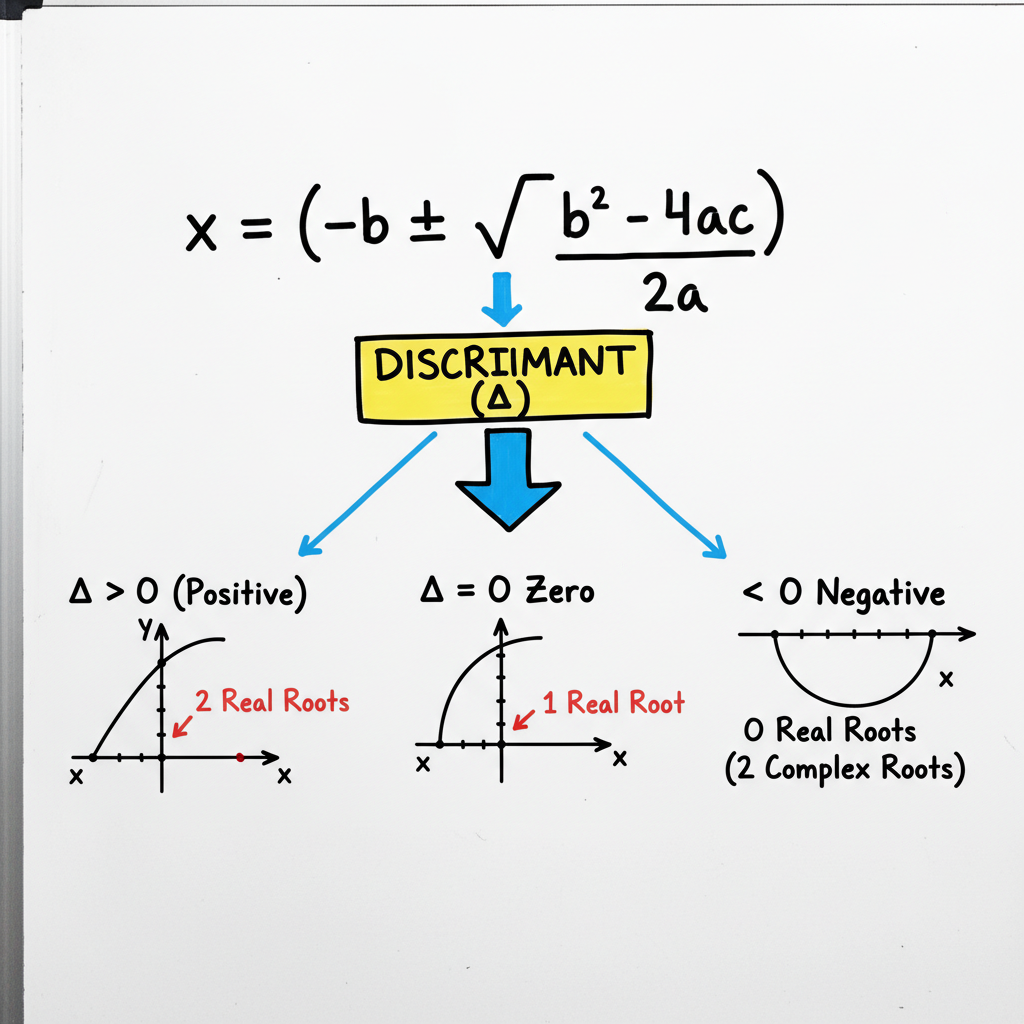 ⚠️ This picture may have spelling mistakes. Trust the words in the lesson.
What Does the Discriminant Tell Us? (The Fortune Teller's Predictions)
The value of b² - 4ac will fall into one of three categories, and each category tells us something different about the solutions (roots) of the quadratic equation:
Case 1: If b² - 4ac > 0 (The Discriminant is Positive)
- The Fortune Teller Says: "This equation has two different real solutions!"
- What it Means: The parabola (the U-shaped graph) will cross the x-axis at two distinct points. Think of it like throwing a ball that lands in two different spots on a long line.
- Analogy: Imagine a bridge crossing a river. If the discriminant is positive, the bridge has two distinct ramps where it touches the ground on either side.
Case 2: If b² - 4ac = 0 (The Discriminant is Zero)
- The Fortune Teller Says: "This equation has exactly one real solution! (Sometimes called a 'repeated root' or 'double root')."
- What it Means: The parabola just 'touches' the x-axis at exactly one point, like a bicycle tire briefly touching the road.
- Analogy: Imagine that same bridge, but this time it's built so perfectly that its lowest point just barely touches the river at one single spot. It has one connection point to the water.
Case 3: If b² - 4ac < 0 (The Discriminant is Negative)
- The Fortune Teller Says: "This equation has no real solutions! (It has two 'complex' or 'imaginary' solutions, but we won't worry about those in detail at this foundational level)."
- What it Means: The parabola does not touch or cross the x-axis at all. It either stays entirely above the x-axis or entirely below it.
- Analogy: This time, our bridge is built so high that it never touches the river at all. There are no 'real' connection points to the ground level of the river.
Putting the Discriminant into Practice:
Let's use our examples from before and calculate their discriminants:
- Example A:
2x² + 5x + 3 = 0(Here, a=2, b=5, c=3)
Discriminant =b² - 4ac=(5)² - 4(2)(3)=25 - 24=1
Since1 > 0, this equation has two different real solutions. - Example B:
x² - 4x + 4 = 0(Here, a=1, b=-4, c=4)
Discriminant =b² - 4ac=(-4)² - 4(1)(4)=16 - 16=0
Since0 = 0, this equation has exactly one real solution. - Example C:
x² + 2x + 5 = 0(Here, a=1, b=2, c=5)
Discriminant =b² - 4ac=(2)² - 4(1)(5)=4 - 20=-16
Since-16 < 0, this equation has no real solutions.
Putting it all Together:
Understanding standard form is like learning the alphabet – it's the fundamental structure. The discriminant is like learning to read simple sentences – it allows you to get meaningful information from that structure. Together, they give you powerful tools to analyze quadratic equations even before you try to solve them!
Keep practicing identifying 'a', 'b', and 'c', and then calculating the discriminant. You'll soon become a master fortune teller of quadratic equations!
Keep learning, free
Create a free Syllabax account to unlock practice questions and games for this topic.
Visual Learning Enhanced! 🚀
To help you master this topic, we use Advanced Syllabax AI to generate detailed diagrams and visual models.
Note on Visuals: The AI sometimes makes spelling errors in image labels. Please refer to the lesson text for the correct terminology.