Angle sum property (Triangle Properties)
Watch this topic in 60 seconds
Free preview · Lesson 1
Understanding Angle sum property (Triangle Properties)
Understanding the Angle Sum Property of Triangles
Welcome, young mathematicians! Today, we're going on an exciting adventure to discover a fundamental secret about triangles. This secret is called the **Angle Sum Property**, and it's like a magic rule that all triangles follow, no matter their shape or size.
What is a Triangle?
Before we dive into the magic rule, let's quickly remind ourselves what a triangle is. A triangle is a shape with three straight sides and three corners, which we call angles. Think of a slice of pizza, a yield sign, or the roof of a small house – these are all examples of triangles!
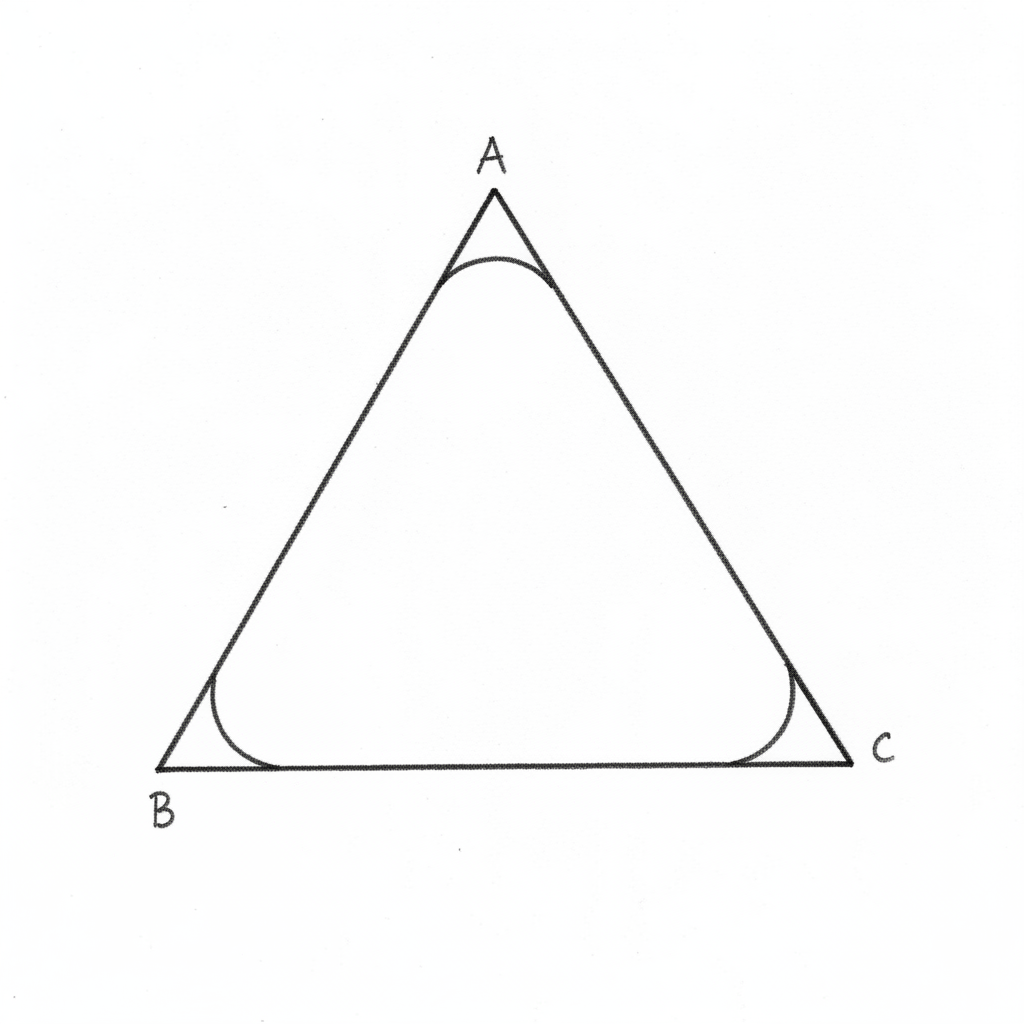 ⚠️ This picture may have spelling mistakes. Trust the words in the lesson.
What are Angles?
An angle is formed when two straight lines meet at a point. In a triangle, the corners are where the sides meet, and these corners are our angles. We often measure angles in degrees, using a special tool called a protractor. Imagine angles as how much of a turn you make when you reach a corner. A small angle is like a gentle turn, and a big angle is like a sharp turn.
Types of Angles (A Quick Peek!)
- Acute Angle: Smaller than a right angle (like a sharp corner).
- Right Angle: Exactly like the corner of a square (looks like an 'L').
- Obtuse Angle: Bigger than a right angle but smaller than a straight line (a wide, open corner).
The Magic Rule: The Angle Sum Property
Now for the star of our lesson! The Angle Sum Property states that the sum of the measures of the three interior angles of any triangle is always 180 degrees.
Think of it like this:
Analogy 1: The Pizza Slice Puzzle
Imagine you have a whole pizza, which represents a straight line (180 degrees). If you cut that pizza into three slices (your triangle's angles), and then you put those three slices together side-by-side along a straight edge, they would perfectly form that original straight line again. No matter how you cut your pizza (as long as you get three pieces that make a triangle), the total amount of pizza you have is always the same – 180 degrees worth!
Analogy 2: The Three Friends Walking
Imagine three friends, Alex, Ben, and Clara, walking around a triangular park. Alex walks along the first side, turns at a corner (Angle A). Then Ben walks along the second side and turns at the next corner (Angle B). Finally, Clara walks along the third side and turns at the last corner (Angle C) to meet Alex again. If you could measure the 'turn' each friend made at their corner, and add up all those turns, the total amount of turning they did to complete the triangle is exactly 180 degrees. It's like they made one and a half full turns around a point (a full turn is 360, so 180 is half a turn).
Analogy 3: Building Blocks
Think of degrees as special building blocks. You have a big box of 180 building blocks. To build any triangle, you need to use blocks to represent the three angles. The rule is: you must use up exactly 180 blocks in total to make the three angles of your triangle. You can use 60 blocks for one angle, 60 for another, and 60 for the third (an equilateral triangle). Or you could use 90 blocks for one, 45 for another, and 45 for the third (a right-angled isosceles triangle). As long as the total number of blocks used for the three angles adds up to 180, you have a valid triangle!
Why is this important?
This property is super useful! If you know the measures of two angles in a triangle, you can always figure out the measure of the third angle. It’s like having a secret code-breaker for triangles!
How to Use the Property
Let's say you have a triangle, and you know two of its angles are 50 degrees and 70 degrees.
- Add the known angles: 50 degrees + 70 degrees = 120 degrees.
- Subtract from 180: 180 degrees - 120 degrees = 60 degrees.
So, the third angle must be 60 degrees! See? You just used the magic rule!
Types of Triangles and the Angle Sum Property
Does this rule change for different types of triangles?
- Equilateral Triangle: All sides are equal, and all angles are equal. Since the total is 180 degrees, each angle must be 180 / 3 = 60 degrees.
- Isosceles Triangle: Two sides are equal, and the two angles opposite those sides are also equal.
- Scalene Triangle: All sides are different lengths, and all angles are different measures.
- Right-Angled Triangle: One angle is exactly 90 degrees. The other two angles must add up to 90 degrees (180 - 90 = 90).
- Acute Triangle: All three angles are less than 90 degrees.
- Obtuse Triangle: One angle is greater than 90 degrees.
No matter what type of triangle it is, the sum of its interior angles will always be 180 degrees. It's a universal law for triangles!
Let's Summarize!
We've learned a very important rule today. Remember:
- A triangle has 3 sides and 3 angles.
- Angles measure the 'turn' at a corner.
- The sum of the three angles inside any triangle is always 180 degrees.
- If you know two angles, you can find the third!
Keep practicing, and you'll become a triangle expert in no time!
Keep learning, free
Create a free Syllabax account to unlock practice questions and games for this topic.
Visual Learning Enhanced! 🚀
To help you master this topic, we use Advanced Syllabax AI to generate detailed diagrams and visual models.
Note on Visuals: The AI sometimes makes spelling errors in image labels. Please refer to the lesson text for the correct terminology.