Buoyancy & Archimedes’ principle[PHYSICS]
Watch this topic in 60 seconds
Free preview · Lesson 1
Understanding Buoyancy & Archimedes’ principle[PHYSICS]
Buoyancy & Archimedes' Principle
Welcome to the fascinating world of buoyancy! Have you ever wondered why some things float while others sink? It's all thanks to an invisible force called buoyancy and a brilliant principle discovered by the ancient Greek mathematician and inventor, Archimedes.
What is Buoyancy?
Imagine you're in a swimming pool. When you try to push a beach ball underwater, it feels like something is pushing it back up. That upward push is buoyancy! Buoyancy is the upward force exerted by a fluid (like water or air) that opposes the weight of an immersed object. Think of it as the fluid trying to lift the object up.
Analogy: The Helpful Hand
Imagine the fluid is like a crowd of people. When you try to push an object into the crowd, the people on all sides push back. But in a fluid, it's a special kind of push – it's always directed upwards, against gravity. This upward push is what we call the buoyant force.
Why Do Some Things Float and Others Sink?
The reason objects float or sink depends on a comparison between two forces:
- The object's weight: This is the downward force due to gravity pulling the object down.
- The buoyant force: This is the upward force exerted by the fluid.
If the buoyant force is greater than or equal to the object's weight, the object will float. If the object's weight is greater than the buoyant force, it will sink.
Analogy: The Tug-of-War
Think of it as a tug-of-war. The object's weight is one team pulling downwards, and the buoyant force is the other team pulling upwards. If the upward team (buoyant force) is stronger, the object stays up (floats). If the downward team (weight) is stronger, the object goes down (sinks).
Density: The Secret Ingredient
An object's density plays a huge role. Density is a measure of how much 'stuff' (mass) is packed into a certain amount of space (volume). An object floats if its density is less than the density of the fluid it's in. An object sinks if its density is greater than the fluid's density.
Analogy: Packing a Suitcase
Imagine you have two suitcases of the same size. One is packed with fluffy sweaters, and the other is packed with heavy books. The suitcase with books is denser – more mass in the same volume. If you tried to float these suitcases in a pool, the book-filled suitcase would sink much faster than the sweater-filled one.
So, a small, dense object might sink, while a large, less dense object might float. That's why a tiny pebble sinks in water, but a huge ship made of steel floats!
Archimedes' Principle
Now, let's introduce Archimedes! He was a brilliant scientist who lived in ancient Greece. He discovered a fundamental principle about buoyancy that still helps us understand it today.
Archimedes' Principle states: An object wholly or partially immersed in a fluid is buoyed up by a force equal to the weight of the fluid displaced by the object.
Let's break that down:
- Displaced Fluid: When you put an object into water, the water level rises. The water that is pushed out of the way (displaced) by the object is the displaced fluid.
- Weight of Displaced Fluid: Archimedes discovered that the upward buoyant force acting on the object is *exactly* equal to the weight of this displaced fluid.
Analogy: The Overflowing Bathtub
Legend has it that Archimedes discovered this principle while trying to figure out if a crown was made of pure gold. He got into his bathtub, and the water overflowed. He realized that the volume of water that overflowed was equal to the volume of his body submerged in the water. The weight of that overflowed water was key!
So, if you put an object in water, and it pushes aside 1 kilogram of water, the buoyant force pushing up on that object is equal to the weight of 1 kilogram of water.
Putting it all Together: Why Ships Float
A huge steel ship is very heavy, and steel is much denser than water. So, why doesn't it sink?
It's all about the shape! Ships are designed with a large, hollow hull. This shape displaces a massive amount of water. Even though the steel itself is dense, the overall average density of the ship (including all the air inside its hull) is less than the density of water. Because it displaces so much water, the weight of that displaced water (the buoyant force) is greater than the ship's total weight, allowing it to float.
Analogy: A Bowl vs. A Ball of Clay
Imagine you have a ball of clay. If you drop it in water, it sinks because it's dense and displaces only a small amount of water relative to its weight. Now, take the same amount of clay and shape it into a hollow bowl. When you place this bowl on the water, it spreads out and displaces a much larger volume of water. The weight of this larger volume of displaced water is greater, so the clay bowl floats!
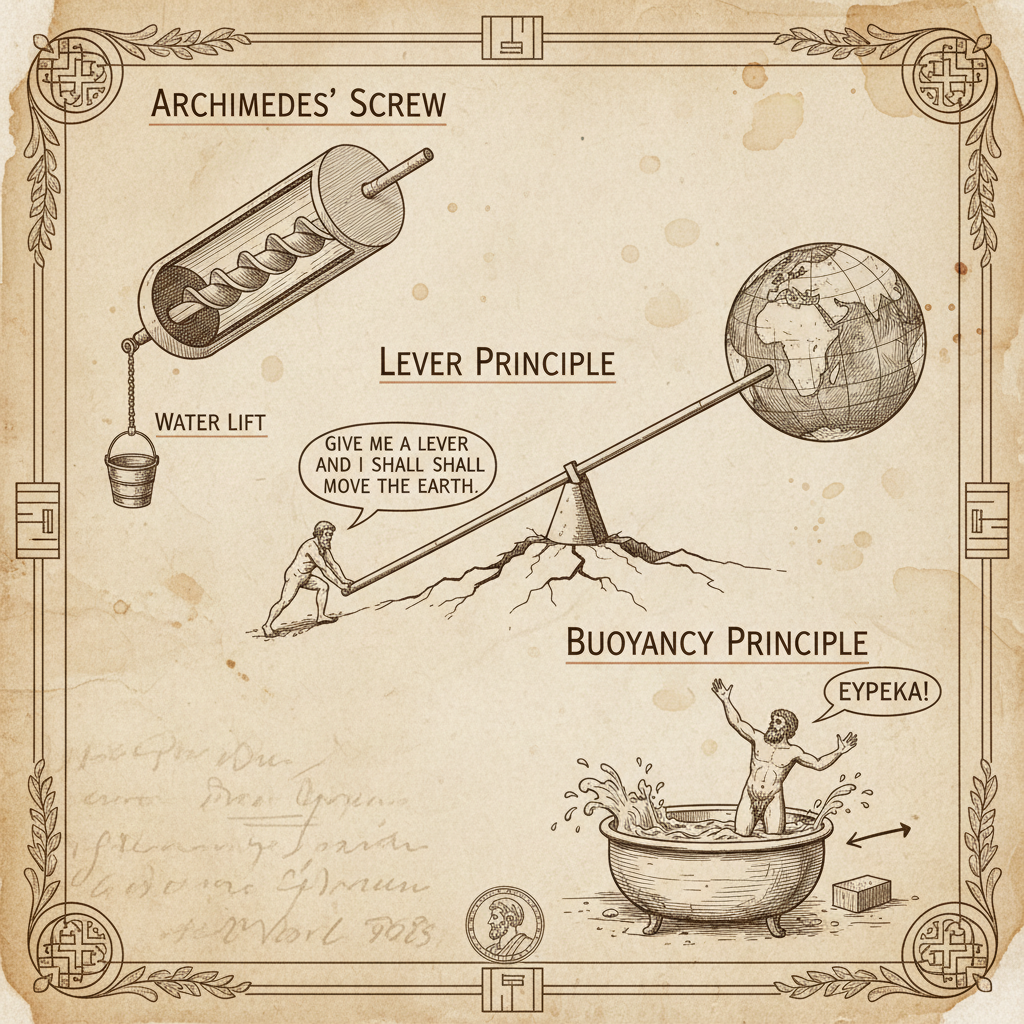 ⚠️ This picture may have spelling mistakes. Trust the words in the lesson.
Key Concepts Recap
- Buoyancy: The upward force exerted by a fluid on an immersed object.
- Floating vs. Sinking: Depends on the comparison between the object's weight and the buoyant force, or the object's density compared to the fluid's density.
- Density: Mass per unit volume. Objects less dense than the fluid float.
- Archimedes' Principle: The buoyant force on an object is equal to the weight of the fluid it displaces.
Keep learning, free
Create a free Syllabax account to unlock practice questions and games for this topic.
Visual Learning Enhanced! 🚀
To help you master this topic, we use Advanced Syllabax AI to generate detailed diagrams and visual models.
Note on Visuals: The AI sometimes makes spelling errors in image labels. Please refer to the lesson text for the correct terminology.