Learning Journey
Watch this topic in 60 seconds
Free preview · Lesson 1
Understanding Thermoplastics vs thermosetting plastics[CHEMISTRY]
Thermoplastics vs. Thermosetting Plastics: A Material Science Adventure!
Welcome, future material scientists and chemists! Today, we're diving into the fascinating world of plastics. Plastics are all around us, from the water bottle you drink from to the keyboard you type on. But did you know that not all plastics are created equal? They have different personalities, especially when it comes to how they behave when heated.
What are Plastics Anyway?
Before we compare our two main types, let's understand what plastics are at their core. Plastics are a type of polymer. Think of a polymer like a long, long chain made up of many small, repeating building blocks called monomers. Imagine a giant necklace made of identical beads – the necklace is the polymer, and each bead is a monomer.
These long chains give plastics their unique properties, like flexibility, strength, and lightness. The way these chains are arranged and how they interact with each other determines whether a plastic is a thermoplastic or a thermosetting plastic.
Meet the Thermoplastics: The "Re-moldable" Recyclers
Let's start with thermoplastics. The name itself gives us a big clue: "thermo" means heat, and "plastic" means moldable. So, thermoplastics are plastics that become soft and moldable when heated and harden when cooled.
The Chain Structure: Loose and Flowy
The secret to thermoplastics' behavior lies in their molecular structure. Imagine those long polymer chains as strands of spaghetti. In thermoplastics, these spaghetti strands are not strongly connected to each other. They can slide past each other relatively easily when you apply heat. Think of a bowl of cooked spaghetti – you can stir it around, and the strands move freely. When it cools down, the spaghetti strands just settle next to each other, but they aren't glued together.
This means that if you heat a thermoplastic, the chains get enough energy to wiggle and slide. They can flow like a thick liquid, allowing you to reshape the plastic. When you cool it down, the chains slow down and settle into a new shape, but they can be heated and reshaped again and again!
Key Characteristics of Thermoplastics:
- Re-moldable: They can be repeatedly heated, softened, and reshaped without significant degradation.
- Recyclable: Because they can be melted and reformed, many thermoplastics are recyclable.
- Softer when Heated: They become pliable and can flow when exposed to heat.
- Harder when Cooled: They return to a solid state upon cooling.
Everyday Examples of Thermoplastics:
You encounter thermoplastics every day! Here are a few:
- Polyethylene Terephthalate (PET): Found in water bottles and food containers. It's clear and lightweight.
- High-Density Polyethylene (HDPE): Used for milk jugs, detergent bottles, and pipes. It's strong and durable.
- Polyvinyl Chloride (PVC): Common in pipes, window frames, and even some clothing.
- Polypropylene (PP): Used in car parts, food packaging (like yogurt cups), and reusable containers.
- Polystyrene (PS): The material used in foam cups (Styrofoam) and disposable cutlery.
- Nylon: Used in fabrics, ropes, and toothbrushes.
- Acrylic: Often used as a lightweight glass alternative (plexiglass).
Meet the Thermosetting Plastics: The "Set-in-Stone" Stalwarts
Now, let's meet the other type: thermosetting plastics (often called thermosets). These plastics have a very different approach to heat.
The Chain Structure: Cross-Linked and Sturdy
Unlike the independent spaghetti strands of thermoplastics, thermosetting plastics have polymer chains that are permanently connected to each other. Imagine those spaghetti strands being welded or glued together at multiple points, forming a strong, rigid network. This process is called cross-linking.
Think of a fisherman's net. The ropes (polymer chains) are all tied together (cross-linked) to form a strong, solid structure. If you try to heat this net, the ropes themselves might get a bit soft, but they can't slide past each other because they are all tied down. Trying to break the net would require breaking those strong connections.
Because of this cross-linking, once a thermosetting plastic is formed, it's essentially set. If you try to heat it too much, it doesn't just soften and flow; it starts to break down chemically, often charring or burning. It cannot be easily melted and reshaped.
Key Characteristics of Thermosetting Plastics:
- Cannot be Re-molded: Once cured (formed), they cannot be softened and reshaped by heating. Applying heat will cause them to degrade or decompose.
- Not Easily Recyclable: Their inability to be melted and reformed makes traditional recycling difficult.
- Rigid and Strong: The cross-linked structure gives them excellent strength, heat resistance, and rigidity.
- Permanent Shape: They hold their shape very well, even at higher temperatures.
Everyday Examples of Thermosetting Plastics:
You'll find thermosetting plastics in places where strength and heat resistance are crucial:
- Bakelite: One of the first synthetic plastics, used in old radio casings and electrical insulators.
- Epoxy Resins: Used in strong adhesives, coatings, and composite materials (like in airplanes and boats).
- Vulcanized Rubber: Used in tires. The vulcanization process cross-links the rubber molecules, making them much stronger and more durable.
- Melamine Formaldehyde: Used in durable tableware (like picnic plates) and laminates (like countertops).
- Polyurethane Foams: Found in insulation and cushioning.
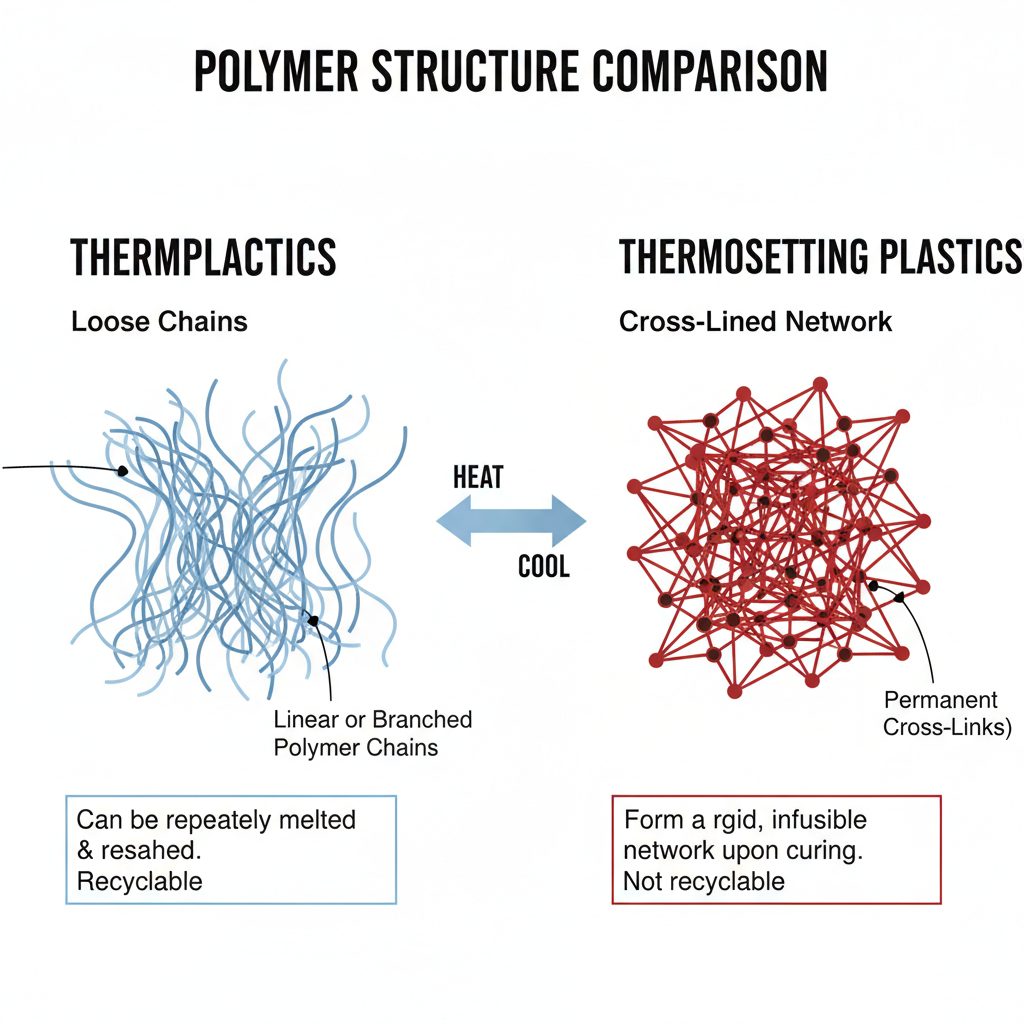 ⚠️ This picture may have spelling mistakes. Trust the words in the lesson.
Summary: The Big Differences
Let's put it all together in a simple comparison:
| Feature | Thermoplastics | Thermosetting Plastics |
|---|---|---|
| Heating Behavior | Soften and become moldable | Do not soften; degrade if overheated |
| Molecular Structure | Long, unlinked chains | Cross-linked network of chains |
| Re-moldability | Can be repeatedly molded | Cannot be molded after initial setting |
| Recyclability | Generally recyclable | Difficult to recycle traditionally |
| Strength/Rigidity | Varies, can be flexible or rigid | Generally very strong and rigid |
| Analogy | Bowl of cooked spaghetti | A strong fishing net |
Understanding the difference between thermoplastics and thermosetting plastics helps us appreciate why certain materials are chosen for specific jobs. It's all about how their molecular structure reacts to heat and stress!
Keep learning, free
Create a free Syllabax account to unlock practice questions and games for this topic.
Visual Learning Enhanced! 🚀
To help you master this topic, we use Advanced Syllabax AI to generate detailed diagrams and visual models.
Note on Visuals: The AI sometimes makes spelling errors in image labels. Please refer to the lesson text for the correct terminology.