Integer properties (commutative, associative, distributive) (Integers)
Watch this topic in 60 seconds
Free preview · Lesson 1
Understanding Integer properties (commutative, associative, distributive) (Integers)
Understanding Integer Properties: The Building Blocks of Math!
Welcome, mathematicians! Today, we're diving into the amazing world of integers and some super important rules that govern how we work with them. Integers are whole numbers, both positive and negative, including zero. Think of them like steps on a staircase: positive numbers go up, negative numbers go down, and zero is the landing.
What are Integers?
Let's get a clear picture of what integers are. They are the set of numbers that includes all the counting numbers (1, 2, 3, ...), their negative counterparts (-1, -2, -3, ...), and zero (0).
- Positive Integers: These are the numbers greater than zero (1, 2, 3, 4, ...). They represent things you have, like 5 apples or a temperature of 20 degrees.
- Negative Integers: These are the numbers less than zero (-1, -2, -3, -4, ...). They often represent debt, temperatures below freezing, or going down in elevation. For example, owing $3 means you have -3 dollars.
- Zero: This is a special integer. It's neither positive nor negative. It's the point where positive and negative numbers meet.
The Magic Properties of Integers
Just like there are rules for playing a game, there are rules for how we add and multiply integers. These rules make our calculations predictable and much easier! We'll explore three key properties:
1. The Commutative Property: Order Doesn't Matter!
Imagine you have two favorite toys, a superhero action figure and a race car. It doesn't matter if you pick up the superhero first and then the car, or the car first and then the superhero. You end up with the same two toys! The Commutative Property works the same way for addition and multiplication of integers.
For Addition:
The commutative property for addition means that you can swap the order of the numbers you are adding, and the answer (the sum) will stay the same.
Think of it like this: If you add 5 apples and 3 oranges, you have 8 pieces of fruit. If you add 3 oranges and 5 apples, you still have 8 pieces of fruit. The order you count them in doesn't change the total.
In math terms, for any two integers 'a' and 'b':
a + b = b + a
Example:
- Let a = 5 and b = 3. Then 5 + 3 = 8. Also, 3 + 5 = 8. See? The answer is the same!
- Let a = -2 and b = 7. Then -2 + 7 = 5. And 7 + (-2) = 5.
- Let a = -4 and b = -6. Then -4 + (-6) = -10. And -6 + (-4) = -10.
For Multiplication:
The commutative property also applies to multiplication. You can swap the order of the numbers you are multiplying, and the answer (the product) will be the same.
Imagine you have 4 rows of chairs with 6 chairs in each row. That's 4 groups of 6. If you think of it as 6 rows of chairs with 4 chairs in each row, you still have the same total number of chairs.
In math terms, for any two integers 'a' and 'b':
a * b = b * a
Example:
- Let a = 6 and b = 7. Then 6 * 7 = 42. Also, 7 * 6 = 42.
- Let a = -3 and b = 5. Then -3 * 5 = -15. And 5 * (-3) = -15.
- Let a = -2 and b = -8. Then -2 * (-8) = 16. And -8 * (-2) = 16.
Key Idea: When adding or multiplying, you can rearrange the numbers however you like!
2. The Associative Property: Grouping Doesn't Matter!
This property is about how we group numbers when we have three or more of them in a row, connected by addition or multiplication. Think about packing your backpack for school. You might put your lunch bag first, then your books, then your pencil case. Or you might put your books first, then your pencil case, then your lunch bag. The order you pack them (or group them) doesn't change what's inside your backpack. The Associative Property says that the grouping of numbers in addition or multiplication doesn't affect the final result.
For Addition:
When you are adding three or more integers, it doesn't matter which pair you add first. The sum will be the same.
Imagine you have three piles of candies. You want to combine them. You can combine the first two piles and then add the third, or combine the last two piles and then add the first. The total number of candies you have at the end is the same.
In math terms, for any three integers 'a', 'b', and 'c':
(a + b) + c = a + (b + c)
The parentheses tell us which operation to do first. The associative property says we can change where the parentheses go!
Example:
- Let a = 2, b = 3, and c = 4.
- (2 + 3) + 4 = 5 + 4 = 9
- 2 + (3 + 4) = 2 + 7 = 9. The answer is the same!
- Let a = -1, b = 5, and c = -3.
- (-1 + 5) + (-3) = 4 + (-3) = 1
- -1 + (5 + (-3)) = -1 + 2 = 1.
For Multiplication:
Similarly, when multiplying three or more integers, the way you group them doesn't change the product.
Think about baking cookies. If you have 3 trays, and each tray has 4 rows of 5 cookies, you can calculate the total cookies by (3 trays * 4 rows/tray) * 5 cookies/row, or 3 trays * (4 rows/tray * 5 cookies/row). The total number of delicious cookies remains the same!
In math terms, for any three integers 'a', 'b', and 'c':
(a * b) * c = a * (b * c)
Example:
- Let a = 2, b = 3, and c = 5.
- (2 * 3) * 5 = 6 * 5 = 30
- 2 * (3 * 5) = 2 * 15 = 30.
- Let a = -2, b = 3, and c = -4.
- (-2 * 3) * (-4) = (-6) * (-4) = 24
- -2 * (3 * (-4)) = -2 * (-12) = 24.
Key Idea: When adding or multiplying a string of numbers, you can group them in any way you please!
3. The Distributive Property: Spreading the Love (and Multiplication)!
This is where things get a little more interesting, as it combines both addition and multiplication. The Distributive Property allows you to 'distribute' or 'pass out' a multiplier to each term inside parentheses.
Imagine you're distributing party favors. You have a bag of 3 different types of candy to give to each of your 2 friends. You can either put all the candies for friend 1 in a bag, then all for friend 2, OR you can take one type of candy and give it to friend 1 and friend 2, then take the next type and give it to friend 1 and friend 2, and so on. The total number of candies given out will be the same.
In math terms, for any three integers 'a', 'b', and 'c':
a * (b + c) = (a * b) + (a * c)
This means you can multiply 'a' by the sum of 'b' and 'c', OR you can multiply 'a' by 'b', multiply 'a' by 'c', and then add those two results together. Both ways give you the same answer!
Example:
- Let a = 2, b = 3, and c = 4.
- Method 1: Multiply first, then add
- 2 * (3 + 4) = 2 * 7 = 14
- Method 2: Distribute and then add
- (2 * 3) + (2 * 4) = 6 + 8 = 14. It matches!
- Let a = -3, b = 5, and c = -2.
- Method 1:
- -3 * (5 + (-2)) = -3 * 3 = -9
- Method 2:
- (-3 * 5) + (-3 * (-2)) = -15 + 6 = -9. It matches!
The distributive property can also work in reverse, where you 'factor out' a common factor:
(a * b) + (a * c) = a * (b + c)
This is like finding the common type of candy and grouping it together before distributing.
Key Idea: You can multiply a number by a sum, or multiply it by each part of the sum separately and then add the results.
Here's a visual to help solidify these concepts:
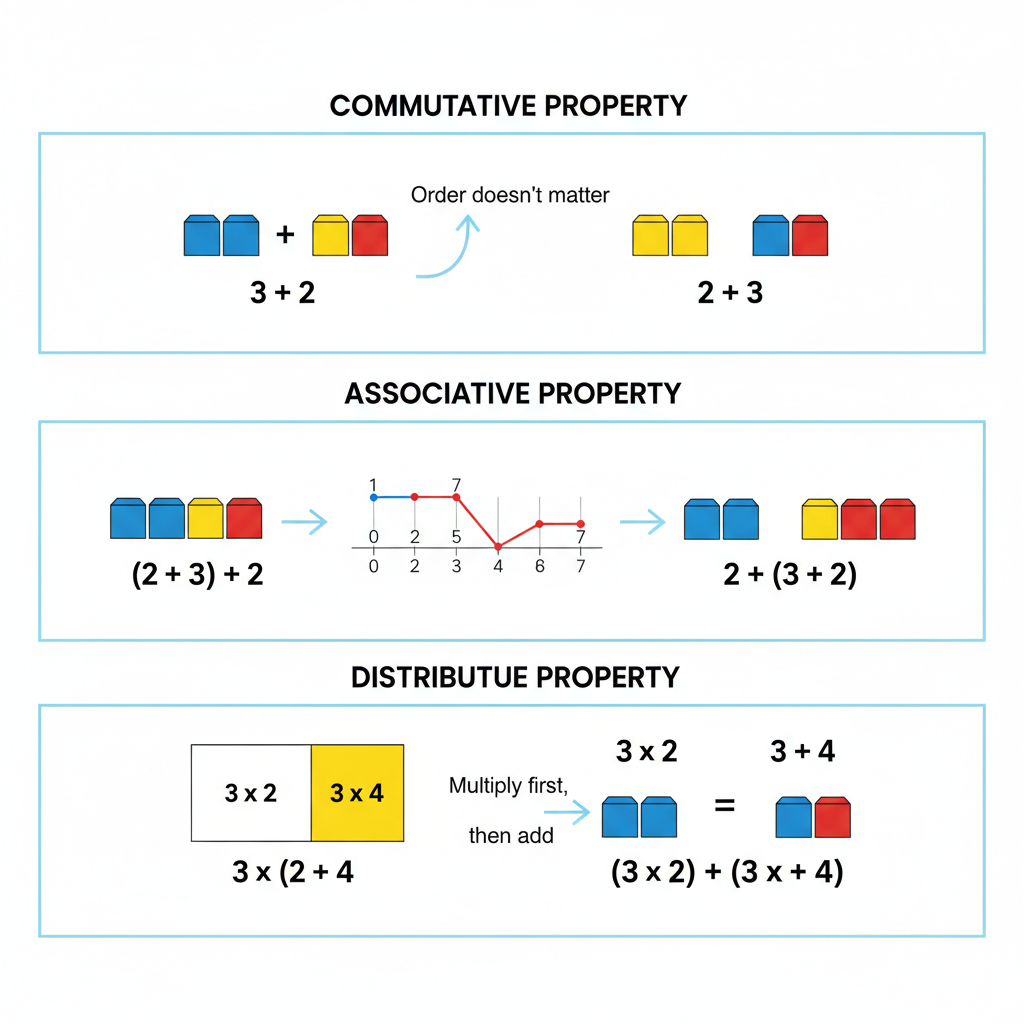 ⚠️ This picture may have spelling mistakes. Trust the words in the lesson.
Why Are These Properties Important?
These properties are the bedrock of arithmetic and algebra. They allow us to:
- Simplify calculations: We can choose the easiest way to group or order numbers to get the answer quickly.
- Solve equations: When you get to algebra, these properties are essential for manipulating equations and finding unknown values.
- Understand number patterns: They help us see how numbers behave and predict outcomes.
Mastering these fundamental properties will make your journey through mathematics much smoother and more enjoyable!
Keep learning, free
Create a free Syllabax account to unlock practice questions and games for this topic.
Visual Learning Enhanced! 🚀
To help you master this topic, we use Advanced Syllabax AI to generate detailed diagrams and visual models.
Note on Visuals: The AI sometimes makes spelling errors in image labels. Please refer to the lesson text for the correct terminology.