Rationalization (Real Numbers)
Watch this topic in 60 seconds
Free preview · Lesson 1
Understanding Rationalization (Real Numbers)
Understanding Rationalization: Making Sense of Square Roots (Grade 9 Foundational)
Welcome to the fascinating world of Real Numbers! You've likely encountered numbers like 2, 5, 1/2, and even decimals like 0.75. These are all rational numbers. But what about numbers like √2 or π? These are called irrational numbers because they can't be expressed as a simple fraction (a/b where b ≠ 0).
In mathematics, especially when working with fractions, we often prefer our denominators (the bottom part of a fraction) to be 'neat' and 'tidy'. Imagine you're building a tower of blocks. Would you rather have a smooth, flat block as the base, or a wobbly, uneven rock? Most likely, the flat block! This 'tidying up' process in fractions, particularly when the denominator has an irrational number like a square root, is what we call Rationalization.
What is Rationalization? The Core Idea
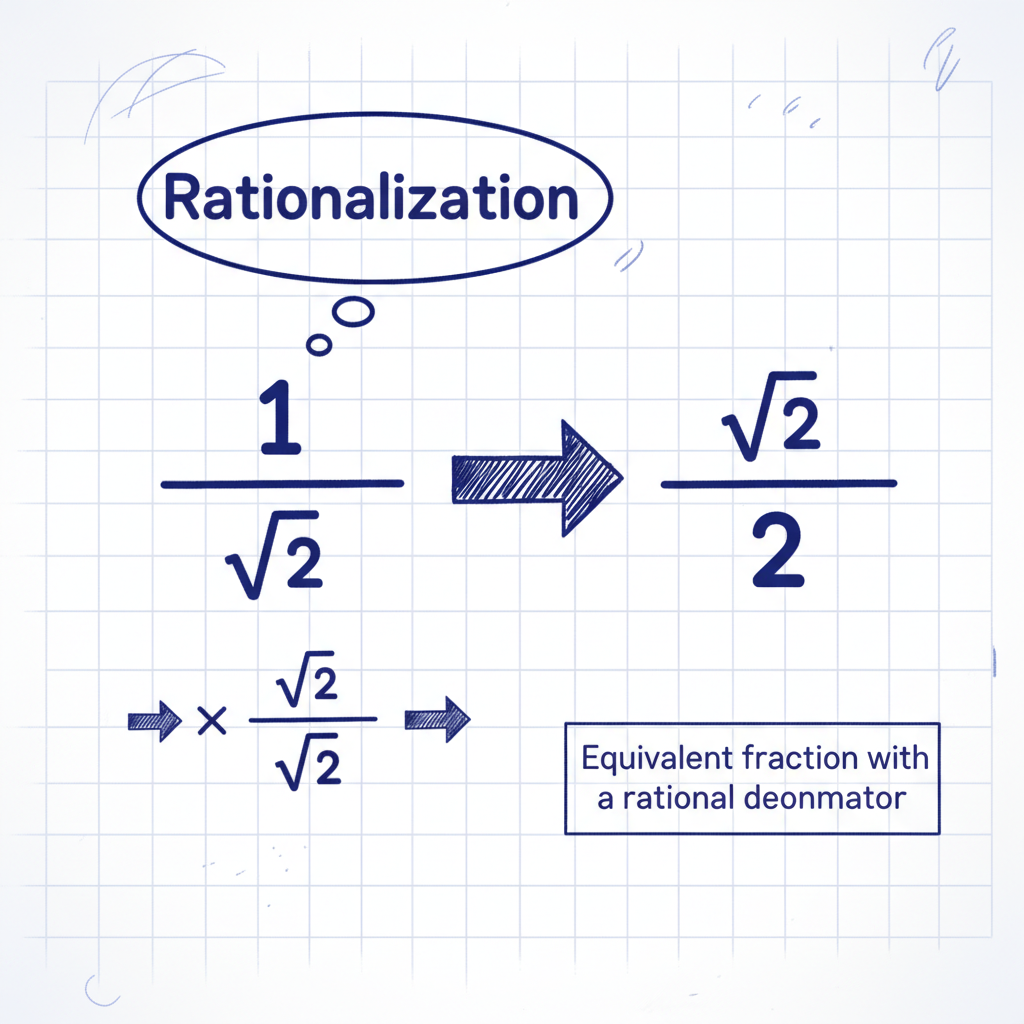
Simply put, rationalization is the process of eliminating square roots (or other irrational numbers) from the denominator of a fraction. Our goal is to transform a fraction like 1/√2 into an equivalent fraction where the denominator is a rational number (like a whole number or a simple fraction without roots).
Why Do We Rationalize?
- Easier Calculations: It's generally easier to perform operations (addition, subtraction, multiplication, division) when denominators are rational. Try to approximate 1/√2 without a calculator. Now try √2/2. The latter is often simpler to estimate.
- Standard Form: Rationalizing helps express numbers in a standard, simplified form, making it easier to compare and work with them. It's like having a universally accepted way to write a phone number – it just makes communication clearer.
- Removes Ambiguity: For instance, √8 can be simplified to 2√2. We prefer the simplified form. Similarly, having roots in the denominator is considered unsimplified.
Analogy: Think of rationalization like cleaning up a messy backyard. If your backyard has a big, thorny bush (the irrational root) right at the entrance (the denominator), it's hard to get in or out. Rationalization is like carefully moving that bush to the side, maybe planting it somewhere else (the numerator), so your entrance is clear and easy to navigate.
 ⚠️ This picture may have spelling mistakes. Trust the words in the lesson.
How Do We Rationalize? Two Main Scenarios
Scenario 1: Denominator is a Single Term with a Square Root (Monomial)
This is the simplest case. If you have a fraction like 1/√a, where 'a' is a number, you need to get rid of √a from the denominator. How do we do that?
Remember that √a × √a = a. This is our key! To maintain the value of the fraction, whatever we multiply the denominator by, we must also multiply the numerator by the same amount. This is like multiplying by 1 (e.g., √a/√a = 1).
Example 1: Rationalize 1/√2
- Identify the irrational part: The denominator is √2.
- Multiply by itself: We need to multiply √2 by √2 to get 2 (a rational number).
- Apply to both numerator and denominator:
1 / √2 × √2 / √2
- Perform the multiplication:
(1 × √2) / (√2 × √2) = √2 / 2
So, 1/√2 is equivalent to √2/2. The denominator is now a rational number (2)!
Analogy: Imagine you have a "slippery fish" (the square root) at the bottom of your fish tank (the denominator). To make it easier to grab, you add another identical "slippery fish" to the bottom, and magically, they combine into a "solid rock" (a rational number)! But to keep the tank balanced, you also have to add an identical "slippery fish" to the top part (the numerator).
Example 2: Rationalize 5 / √7
- Identify: Denominator is √7.
- Multiply by √7/√7:
5 / √7 × √7 / √7
- Calculate:
(5 × √7) / (√7 × √7) = 5√7 / 7
Scenario 2: Denominator is a Binomial with a Square Root (Two Terms)
What if your denominator looks like (a + √b) or (a - √b)? For example, 1 / (2 + √3). Simply multiplying by √3 won't work perfectly:
(2 + √3) × √3 = 2√3 + (√3 × √3) = 2√3 + 3. Still has a root!
Here, we use a special trick involving something called a conjugate. For an expression like (a + √b), its conjugate is (a - √b). If the original expression is (a - √b), its conjugate is (a + √b).
The magic of conjugates lies in the "difference of squares" formula: (x + y)(x - y) = x² - y².
If we multiply (a + √b) by its conjugate (a - √b):
(a + √b)(a - √b) = a² - (√b)² = a² - b
Notice that a² - b is a rational number! No more square roots!
Analogy: Think of the original denominator (e.g., 2 + √3) as a locked box with two different keys on it, one of which is "fuzzy" (√3). The conjugate (2 - √3) is the perfect "master key" that, when combined with the original, unlocks the box and reveals a simple, clear, rational number inside!
Example 3: Rationalize 1 / (2 + √3)
- Identify the denominator: It's (2 + √3).
- Find its conjugate: The conjugate of (2 + √3) is (2 - √3).
- Multiply by the conjugate / conjugate:
1 / (2 + √3) × (2 - √3) / (2 - √3)
- Perform multiplication (Numerator first):
Numerator: 1 × (2 - √3) = 2 - √3
- Perform multiplication (Denominator using difference of squares):
Denominator: (2 + √3)(2 - √3) = 2² - (√3)² = 4 - 3 = 1
- Combine:
(2 - √3) / 1 = 2 - √3
So, 1 / (2 + √3) is equivalent to 2 - √3. The denominator is now 1 (rational)!
Example 4: Rationalize √5 / (√7 - √2)
- Denominator: (√7 - √2).
- Conjugate: (√7 + √2).
- Multiply:
√5 / (√7 - √2) × (√7 + √2) / (√7 + √2)
- Numerator:
√5 × (√7 + √2) = (√5 × √7) + (√5 × √2) = √35 + √10
- Denominator:
(√7 - √2)(√7 + √2) = (√7)² - (√2)² = 7 - 2 = 5
- Combine:
(√35 + √10) / 5
Putting It All Together
Rationalization is a fundamental skill in algebra that ensures our expressions are in their simplest and most workable form. By understanding when and how to remove irrational numbers from the denominator, you're not just solving a math problem; you're making numbers easier to understand and use, much like tidying up a room makes it more functional!
Practice these techniques, and you'll find that handling square roots in fractions becomes second nature. Remember, the goal is always a rational, 'clean' denominator!
Keep learning, free
Create a free Syllabax account to unlock practice questions and games for this topic.
Visual Learning Enhanced! 🚀
To help you master this topic, we use Advanced Syllabax AI to generate detailed diagrams and visual models.
Note on Visuals: The AI sometimes makes spelling errors in image labels. Please refer to the lesson text for the correct terminology.