Unitary method (Ratio & Proportion)
Watch this topic in 60 seconds
Free preview · Lesson 1
Understanding Unitary method (Ratio & Proportion)
Unitary Method: Finding the Value of One to Know the Value of Many!
Welcome, future mathematicians! Today, we're diving into a super useful tool in math called the Unitary Method. Don't let the fancy name scare you! It's all about figuring out the price or quantity of just ONE item, so we can then easily figure out the price or quantity of MANY items. Think of it like being a super detective who finds one clue to solve a whole mystery!
What is the Unitary Method?
The word "unitary" comes from "unit," which means "one." So, the unitary method is a technique where we first find the value or measure of a single unit (like one pen, one apple, one hour, one kilometer) and then use that value to find the value or measure of a desired number of units.
Imagine you're at a candy store. You see a sign that says "3 chocolates for ₹60." You want to know how much just ONE chocolate costs. That's where the unitary method comes in handy!
Step 1: Find the Value of ONE Unit
To find the cost of one chocolate, you would divide the total cost by the number of chocolates:
Cost of 3 chocolates = ₹60
Cost of 1 chocolate = Total Cost / Number of Chocolates
Cost of 1 chocolate = ₹60 / 3 = ₹20
So, one chocolate costs ₹20. We've found the value of our "unit"!
Step 2: Find the Value of the Desired Number of Units
Now that you know one chocolate costs ₹20, you can easily figure out how much any number of chocolates will cost. Let's say you want to buy 5 chocolates. You simply multiply the cost of one chocolate by the number of chocolates you want:
Cost of 1 chocolate = ₹20
Cost of 5 chocolates = Cost of 1 chocolate × Number of chocolates
Cost of 5 chocolates = ₹20 × 5 = ₹100
See? By finding the value of ONE, we could easily find the value of FIVE!
Analogies to Understand the Unitary Method
Let's make this even clearer with some fun analogies:
- Baking Cookies: If a recipe needs 2 cups of flour to make 12 cookies, how much flour do you need for 1 cookie? First, find the flour per cookie (2 cups / 12 cookies = 1/6 cup per cookie). Then, if you want to make 36 cookies, you'd multiply (1/6 cup/cookie * 36 cookies = 6 cups of flour).
- Painting a Fence: If Sarah can paint 5 meters of a fence in 1 hour, how much can she paint in 3 hours? First, we know she paints 5 meters per hour (that's the "unit"). So, in 3 hours, she can paint 5 meters/hour * 3 hours = 15 meters.
- Running Laps: If a runner completes 4 laps in 8 minutes, how many laps can they complete in 16 minutes? The "unit" here is laps per minute. They run 4 laps / 8 minutes = 0.5 laps per minute. In 16 minutes, they would run 0.5 laps/minute * 16 minutes = 8 laps.
- Filling Water Bottles: If a tap fills 10 liters of water in 2 minutes, how much water will it fill in 5 minutes? The rate is 10 liters / 2 minutes = 5 liters per minute. In 5 minutes, it will fill 5 liters/minute * 5 minutes = 25 liters.
The Link to Ratio and Proportion
The unitary method is closely related to the concepts of ratio and proportion. A ratio compares two quantities (like the number of chocolates to the total cost). A proportion is an equation stating that two ratios are equal.
In our chocolate example:
- The ratio of chocolates to cost is 3:60.
- We found the unit rate (ratio) of 1 chocolate to ₹20 (or 1:20).
- We then used this unit rate to set up a proportion to find the cost of 5 chocolates:
1 chocolate / ₹20 = 5 chocolates / x rupees
Here, we are essentially saying the ratio of '1 chocolate to its cost' is the same as the ratio of '5 chocolates to their unknown cost'. Solving this proportion (1 * x = 20 * 5) gives us x = ₹100.
The unitary method helps us find that fundamental "unit ratio" which makes solving proportion problems much simpler.
When Do We Use the Unitary Method?
We use it in everyday life much more than you might think!
- Shopping: Comparing prices to find the best deal (e.g., which pack of cereal is cheaper per gram?).
- Cooking: Adjusting recipes for more or fewer people.
- Travel: Calculating travel time based on speed or distance.
- Work: Figuring out how long a job will take if more people help.
It's a fundamental skill for understanding rates and making comparisons.
Let's Visualize!
Imagine you have a machine that makes toy cars. If it takes 10 minutes to make 2 toy cars, how long does it take to make 1 toy car? You'd divide the time by the number of cars: 10 minutes / 2 cars = 5 minutes per car. So, the "unit" time to make one car is 5 minutes.
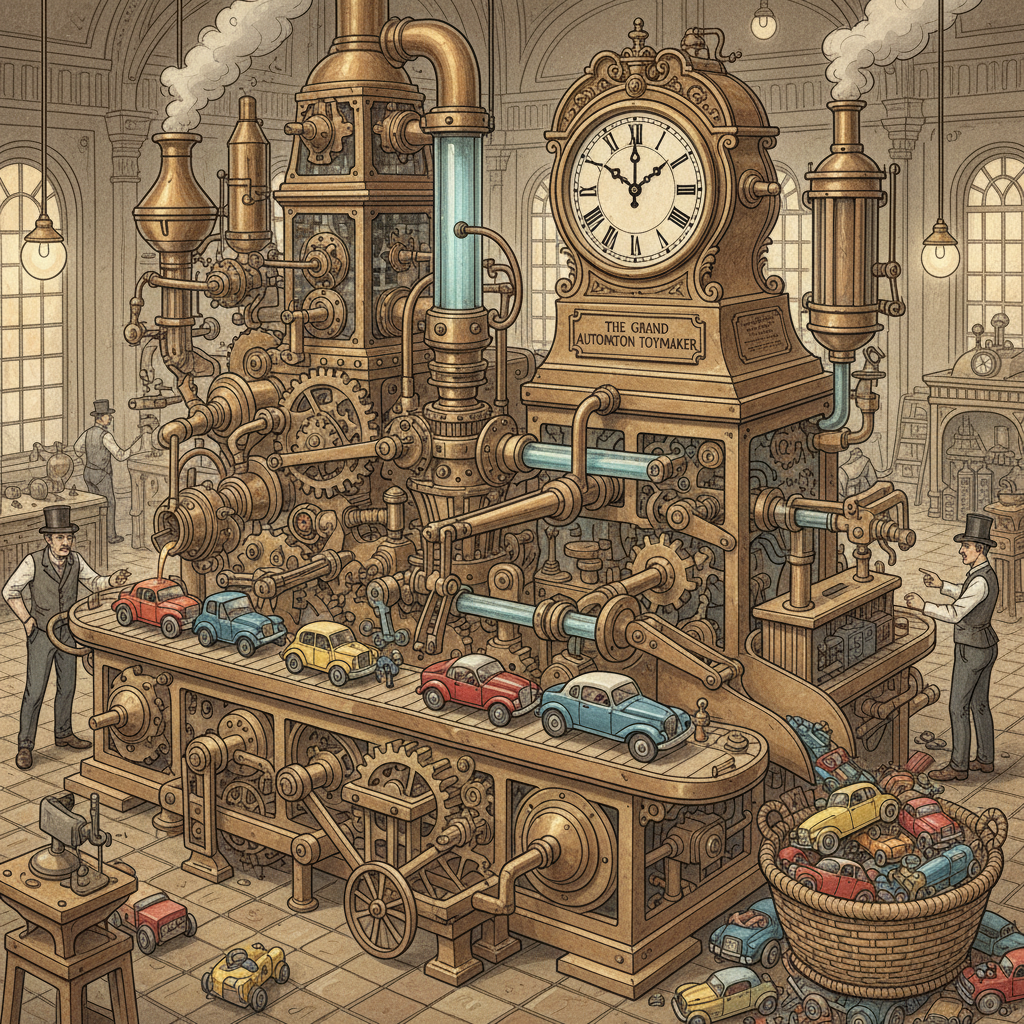
Now, if you want to know how long it takes to make 6 toy cars, you multiply the time per car by 6: 5 minutes/car * 6 cars = 30 minutes. The unitary method helps us break down problems into manageable steps!
Key Things to Remember:
- The goal is always to find the value of ONE unit first.
- If you know the value of 'many' and want to find the value of 'one', you DIVIDE.
- If you know the value of 'one' and want to find the value of 'many', you MULTIPLY.
Keep practicing, and you'll become a master of the unitary method in no time!
Keep learning, free
Create a free Syllabax account to unlock practice questions and games for this topic.
Visual Learning Enhanced! 🚀
To help you master this topic, we use Advanced Syllabax AI to generate detailed diagrams and visual models.
Note on Visuals: The AI sometimes makes spelling errors in image labels. Please refer to the lesson text for the correct terminology.