Designing Simple Surveys
Watch this topic in 60 seconds
Free preview · Lesson 1
Understanding Designing Simple Surveys
Becoming a Data Detective: Designing Simple Surveys
Have you ever wondered what your classmates think about a new school rule, or what kind of pizza they want for a class party? How do you find out for sure, without just guessing? You ask them! But asking in a smart, organized way is the key. That smart, organized way is called designing a survey!
What Exactly is a Survey?
Imagine you're a super-sleuth detective trying to gather clues (information) from a group of people to answer a specific question. A survey is exactly like that! It's a method you use to collect information from many people about their opinions, behaviors, or preferences. It helps you understand what a group of people thinks or does.
Analogy: Think of it like a chef wanting to know which new dish is most popular. They don't just guess which one people will like; they ask their customers for their feedback! A survey is their way of asking.
Why Do We Do Surveys? (The Power of Asking!)
Surveys are incredibly useful tools for many reasons:
- To Make Informed Decisions: Should our class watch a comedy or an adventure movie? A survey can help us decide based on what most people prefer.
- To Understand People Better: What kind of games are most popular at recess? A survey can reveal trends.
- To Solve Problems: If kids aren't using the new playground equipment, a survey might help us understand why.
- To Gather Opinions: What do students think about homework? Surveys give everyone a chance to share their voice.
Step 1: Know Your Mission (What's Your Goal?)
Before you even think about asking a single question, you need to know what you want to find out. This is your main goal or the big question you're trying to answer with your survey. Without a clear goal, your survey will be like a ship without a compass – you won't know where you're going!
- Good Goal Examples: "What is the favorite type of book among 6th graders?" or "Do students prefer recess before or after lunch?"
- Bad Goal Example: "Ask about school." (Too vague! What about school?)
Analogy: It's like deciding what kind of treasure you want to find before you even start digging! If you don't know if you're looking for gold coins or ancient pottery, how will you know where to dig or what tools to use?
Step 2: Who Are You Asking? (Your Audience)
You can't ask everyone in the world. You need to pick the right group of people who can give you the information you need. This group is called your audience or your sample. If you ask the wrong people, you'll get answers that don't help you with your goal!
- Example: If your goal is to know about 6th-grade book preferences, you wouldn't ask kindergarteners. Their answers wouldn't help you understand 6th graders! You'd ask only 6th graders.
- Another Example: If you want to know about parents' opinions on school uniforms, you would ask parents, not just students.
Analogy: If you're selling dog treats, you'd talk to dog owners, not cat owners! They are the right audience for your product, just like the right audience is important for your survey.
Step 3: Crafting Your Questions (The Heart of Your Survey!)
This is where the real detective work begins! Designing good questions is the trickiest part, but it's super important because good questions get good answers. Bad questions can confuse people or give you misleading information.
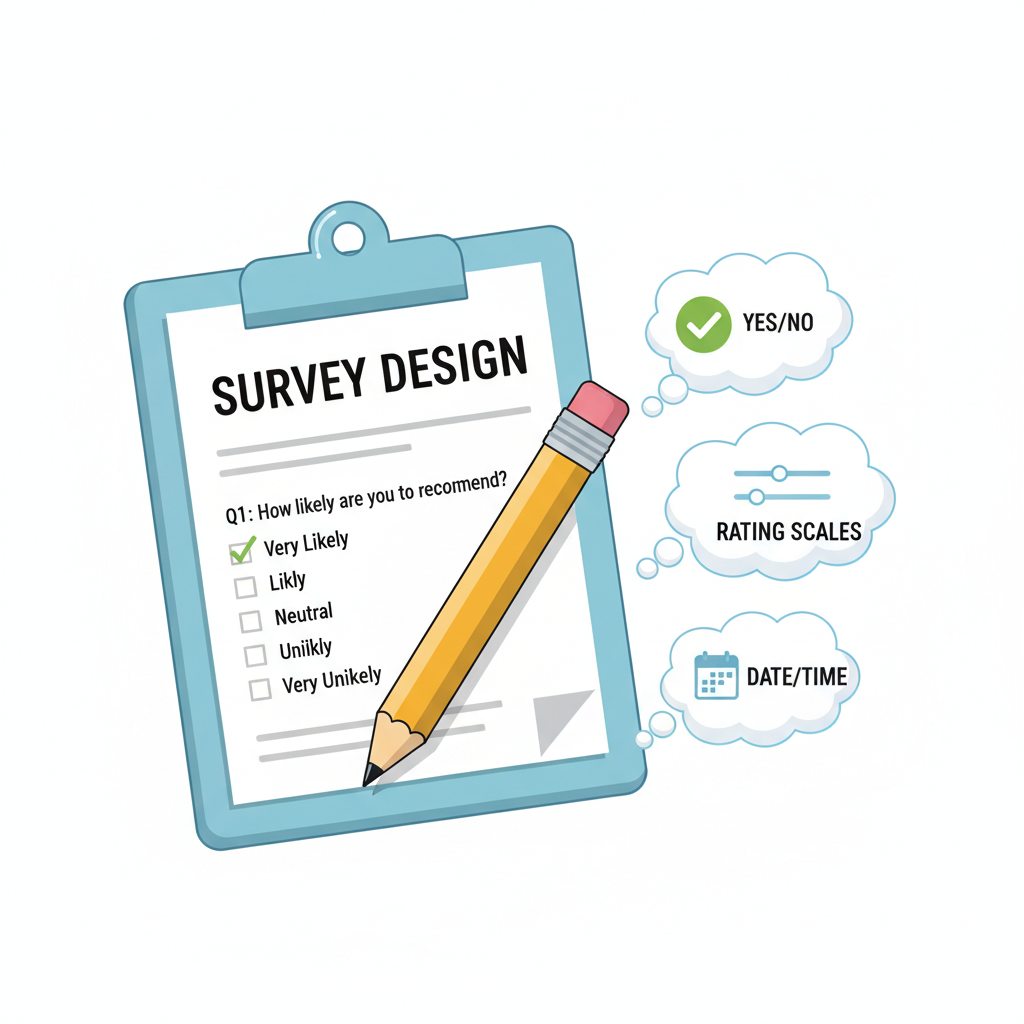 ⚠️ This picture may have spelling mistakes. Trust the words in the lesson.Rules for Writing Great Questions:
- Keep it Simple and Clear: Use words that everyone in your audience understands. Avoid big, confusing words or complicated sentences.
- Bad Example: "Do you frequently engage in sedentary activities during your diurnal hours?" (Too complex for a 6th grader!)
- Good Example: "Do you often sit down during the day?"
- Be Specific: Don't be vague. The more specific your question, the clearer the answer will be.
- Bad Example: "Do you like school?" (Likes what about school? Too broad.)
- Good Example: "What is your favorite subject in school?" or "Do you enjoy reading during library time?"
- Avoid Leading Questions (Don't Put Words in Their Mouth!): Don't make people feel like there's a "right" or "wrong" answer. Your questions should be neutral.
- Bad Example: "Don't you agree that chocolate is the best flavor of ice cream?" (This pushes them to say yes, even if they prefer vanilla.)
- Good Example: "What is your favorite flavor of ice cream?"
- Analogy: It's like asking someone, "You do want to play my game, right?" instead of just, "What game do you want to play?"
- Avoid Double-Barreled Questions (One Question at a Time!): Never ask two things in one question. If someone likes one part but not the other, how can they answer?
- Bad Example: "Do you like the new cafeteria food and the longer lunch break?" (What if they love the food but hate the long break, or vice versa?)
- Good Example: "Do you like the new cafeteria food?" (This is one question) AND "Do you like the longer lunch break?" (This is a separate, clear question).
Types of Questions You Can Ask:
There are two main types of questions you'll use in simple surveys:
- Closed-Ended Questions: These are like multiple-choice tests. You give people a few specific options to pick from. They can't write their own answer; they choose one of yours.
- Examples: Yes/No, True/False, picking from A/B/C/D, or choosing options like "Strongly Agree, Agree, Neutral, Disagree, Strongly Disagree."
- Pros: They are super easy to count and compare answers quickly.
- Cons: They don't always capture unique or detailed opinions.
- Analogy: Closed-ended is like ordering from a menu – you pick from the options provided.
- Open-Ended Questions: These are like asking someone to tell you a story or explain their thoughts. They get to write or say whatever they want in their own words.
- Examples: "What do you like most about school?" or "Tell me about your favorite hobby and why you enjoy it."
- Pros: You get rich, detailed, and often surprising answers.
- Cons: They can be harder to count and compare because everyone's answer might be different.
- Analogy: Open-ended is like asking the chef to make something special just for you, allowing for creativity.
Step 4: Practice Makes Perfect (Test Your Survey!)
Before you give your survey to your whole audience, it's a super smart idea to try it out on just a few friends or family members first. This is called a pilot test. Ask them to answer your questions and then tell you if any questions were confusing, hard to understand, or if they had trouble picking an answer.
They might spot mistakes or suggest better ways to ask something that you didn't even notice!
Analogy: A chef always tastes a dish before serving it to customers to make sure it's perfect! You're doing the same thing with your survey.
Step 5: Collect Your Data!
Once your survey is perfect and you've fixed any problems from your pilot test, it's time to ask your actual audience. You can do this in many ways:
- In Person: You can ask people the questions and write down their answers.
- Paper Forms: Hand out paper surveys for people to fill out.
- Simple Online Tools: If your teacher allows, you might use a simple online tool to create your survey and collect answers digitally.
Make sure you collect the answers clearly and fairly from everyone you survey.
Step 6: What Did You Find Out? (Analyze Your Results!)
After you've collected all the answers, the fun part begins: looking at what you found! This is called analyzing your data. Count how many people picked each option for your closed-ended questions. Read through the answers to your open-ended questions to see common themes.
- Example: If 20 out of 30 students chose "pizza" as their favorite school lunch, you've learned that pizza is very popular!
- Example: If many students wrote that they like "play time" in response to "What do you like most about recess?" you know that direct, unstructured play is important to them.
What does all this information tell you? Did you answer your main goal question from Step 1? This step helps you turn those raw numbers and words into meaningful insights.
You're a Survey Master!
Designing surveys is like solving a puzzle, and you're the master puzzle maker! It's a fantastic skill that helps us understand the world around us, make better decisions, and give everyone a voice. Keep practicing, and you'll become an amazing data detective!
Keep learning, free
Create a free Syllabax account to unlock practice questions and games for this topic.
Visual Learning Enhanced! 🚀
To help you master this topic, we use Advanced Syllabax AI to generate detailed diagrams and visual models.
Note on Visuals: The AI sometimes makes spelling errors in image labels. Please refer to the lesson text for the correct terminology.