Learning Journey
Watch this topic in 60 seconds
Free preview · Lesson 1
Understanding Real-life applications (tiles, fields, rooms) [Area]
Discovering Area: How Much Space Does Something Take Up?
Have you ever wondered how much space a carpet covers, how many tiles you need for a floor, or how big a garden is? These are all questions about area! Area is a fundamental concept in math that helps us measure the amount of surface something covers.
What is Area?
Imagine you have a chocolate bar. Area is like figuring out how many little squares make up the whole bar. It's the measurement of the flat space inside a shape. We don't measure area with a ruler like we do length (how long something is). Instead, we measure it using square units.
Square Units: The Building Blocks of Area
Think of square units as tiny, perfect squares. They are like the LEGO bricks of area! We can use different sizes of square units, but the most common ones are:
- Square inches (in²): Imagine a tiny square, the size of your thumbnail.
- Square feet (ft²): Imagine a square, the size of a small book or a tile on your floor.
- Square yards (yd²): Imagine a square, about the size of a small rug.
- Square meters (m²): Similar to square feet, but used in countries that use the metric system.
When we measure area, we're essentially counting how many of these square units fit perfectly inside a shape without any gaps or overlaps. It's like tiling a floor – you count how many tiles (square units) you need!
Area in Real Life: Seeing is Believing!
Area is everywhere around you! Let's look at some common examples:
1. Tiling a Floor or Wall
When you want to tile a bathroom floor or a kitchen backsplash, you need to know the area of the surface. The tiles themselves are usually square (or rectangular, which can be thought of as made up of squares). You measure the length and width of the floor (or wall) and then figure out how many tiles of a certain size will cover that entire space. If a floor is 10 feet long and 8 feet wide, you need enough tiles to cover that 80 square feet!
2. Painting a Room
Have you ever helped paint a room? Painters need to know the area of the walls to buy the right amount of paint. Too little paint, and you'll have patches left unpainted. Too much, and you'll have leftover paint. They measure the height and length of each wall to calculate the total square footage they need to cover.
3. Buying Carpet or Rugs
When you buy carpet for a bedroom or a rug for the living room, the price is often based on its area. You need to measure the space where the carpet or rug will go to make sure you buy the right size. A 9 ft by 12 ft rug covers 108 square feet!
4. Designing a Garden or Field
Gardeners and farmers need to know the area of their plots of land. This helps them decide how much soil, fertilizer, or seeds to buy. A soccer field has a specific area, which helps in understanding how much grass is needed to maintain it.
5. Covering a Table with a Tablecloth
Even something as simple as putting a tablecloth on a table involves understanding area. You want a tablecloth that is large enough to cover the entire surface of the table.
Calculating Area: Simple Shapes
For basic shapes, calculating area is quite straightforward.
Rectangles and Squares
Rectangles and squares are the easiest shapes to work with when learning about area. Think of them as perfect grids.
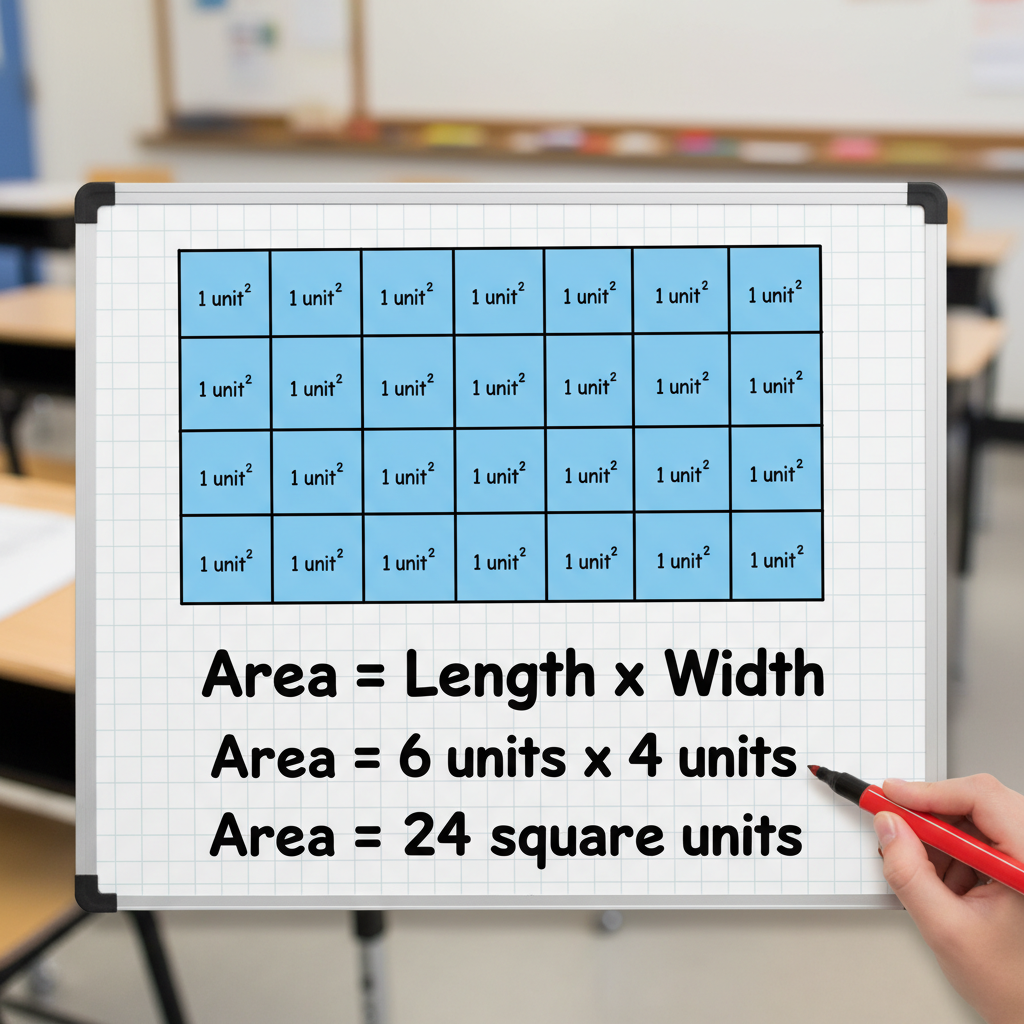
To find the area of a rectangle or a square, you multiply its length by its width.
Formula: Area = Length × Width
Example: Imagine a rectangular garden that is 5 yards long and 3 yards wide.
- Length = 5 yards
- Width = 3 yards
- Area = 5 yards × 3 yards = 15 square yards (yd²)
This means that 15 squares, each 1 yard by 1 yard, would fit perfectly inside the garden.
For a square, since all sides are equal, the formula is often written as: Area = Side × Side
Analogy: Think of building a chocolate bar with square pieces. If the bar is 4 pieces long and 3 pieces wide, you have 4 x 3 = 12 pieces in total. That's the area!
 ⚠️ This picture may have spelling mistakes. Trust the words in the lesson.
Triangles (A Sneak Peek!)
Triangles are a bit trickier, but the basic idea is still about fitting squares. A triangle's area is half the area of a rectangle that it could fit inside. The formula is Area = (1/2) × Base × Height. We'll explore this more later!
Why is Area Important?
Understanding area helps us:
- Plan and build: From houses to roads, area calculations are crucial.
- Decorate: Choosing the right size furniture, rugs, or paint.
- Garden and farm: Knowing how much space is available for planting.
- Budget: Estimating costs for materials like tiles, carpet, or paint.
- Understand our world: Measuring land, oceans, and even the size of countries.
Area is a powerful tool that helps us quantify and manage the space around us. Keep an eye out for how area is used in your everyday life – you'll be surprised how often you see it!
Keep learning, free
Create a free Syllabax account to unlock practice questions and games for this topic.
Visual Learning Enhanced! 🚀
To help you master this topic, we use Advanced Syllabax AI to generate detailed diagrams and visual models.
Note on Visuals: The AI sometimes makes spelling errors in image labels. Please refer to the lesson text for the correct terminology.