Learning Journey
Free preview · Lesson 1
Understanding Converting between fractions ↔ decimals (Decimals)
Fractions and Decimals: A Dynamic Duo!
Welcome, super learners! Today, we're diving into the amazing world of numbers and exploring two ways to represent parts of a whole: fractions and decimals. Think of them like two different languages that say the same thing! Sometimes, it's easier to say something in one language than the other, and knowing how to switch between them is a superpower in math.
What's a Fraction?
Remember fractions? They look like this: 1/2 or 3/4. A fraction has two parts:
- Numerator (Top Number): This tells us how many parts we have.
- Denominator (Bottom Number): This tells us how many equal parts the whole is divided into.
Imagine a delicious pizza! If the pizza is cut into 8 equal slices (that's our denominator), and you eat 3 of those slices (that's our numerator), you've eaten 3/8 of the pizza. The denominator (8) is the total number of slices, and the numerator (3) is the number of slices you gobbled up!
What's a Decimal?
Decimals are numbers that use a decimal point (.). They are also used to represent parts of a whole, but in a different way. Decimals are based on powers of 10.
Think about money! When you see $0.50, that means 50 cents. The '0.' part means zero whole dollars, and the '50' part tells us about the cents, which are parts of a dollar. We can also write 50 cents as 50/100 of a dollar, or even 1/2 of a dollar!
The places after the decimal point have special names:
- The first digit after the decimal point is the tenths place. (e.g., 0.1 means 1 out of 10 equal parts).
- The second digit after the decimal point is the hundredths place. (e.g., 0.01 means 1 out of 100 equal parts).
- The third digit after the decimal point is the thousandths place. (e.g., 0.001 means 1 out of 1000 equal parts), and so on!
Connecting Fractions and Decimals: The Bridge
The really cool part is that fractions and decimals are deeply connected. The denominator of a fraction often tells you how to read it as a decimal. Fractions with denominators of 10, 100, 1000, and so on, are the easiest to convert.
Example 1: From Fraction to Decimal
Let's take the fraction 1/10. The denominator is 10. This means we have 1 part out of 10. In the decimal system, the first place after the decimal point is the tenths place. So, 1/10 is the same as 0.1.
What about 7/10? That's 7 parts out of 10, so it's 0.7.
Now, let's try 3/100. The denominator is 100. The second place after the decimal point is the hundredths place. So, 3/100 is written as 0.03. Notice we need a 0 in the tenths place to hold that spot!
If we have 25/100, that's 25 hundredths, which is 0.25.
What if the denominator isn't 10 or 100? For example, 1/2? We can think of this pizza! If you cut the pizza into 2 equal slices and take 1, that's half the pizza. How can we write that as a decimal? We need a denominator that's a power of 10. We can *change* the fraction to have a denominator of 10 or 100 without changing its value. To change the denominator from 2 to 10, we multiply 2 by 5. Whatever we do to the bottom, we MUST do to the top! So, we multiply the numerator (1) by 5 as well. (1 × 5) / (2 × 5) = 5/10. And we know 5/10 is 0.5!
So, 1/2 is the same as 0.5. It's like saying half a dollar is 50 cents ($0.50).
Let's try another one: 3/4. Can we make the denominator 10? Not easily. Can we make it 100? Yes! We multiply 4 by 25 to get 100. So, we multiply the numerator (3) by 25 too: (3 × 25) / (4 × 25) = 75/100. And 75/100 is 0.75.
Example 2: From Decimal to Fraction
This is often even easier! Just read the decimal aloud and write it as a fraction.
Let's take 0.4. You can read this as 'four tenths'. So, as a fraction, it's 4/10. We can simplify this fraction by dividing both the top and bottom by 2: (4 ÷ 2) / (10 ÷ 2) = 2/5. So, 0.4 is the same as 4/10 or 2/5.
How about 0.65? You can read this as 'sixty-five hundredths'. So, as a fraction, it's 65/100. We can simplify this by dividing both the top and bottom by 5: (65 ÷ 5) / (100 ÷ 5) = 13/20. So, 0.65 is the same as 65/100 or 13/20.
One more: 0.125. This is 'one hundred twenty-five thousandths'. As a fraction, it's 125/1000. We can simplify this by dividing by 5 repeatedly, or by noticing that 125 goes into 1000 eight times (because 8 x 125 = 1000). So, (125 ÷ 125) / (1000 ÷ 125) = 1/8. Thus, 0.125 is the same as 1/8.
Visualizing the Connection
Imagine a square divided into 100 tiny, equal squares. This is like our whole, or 1.00.
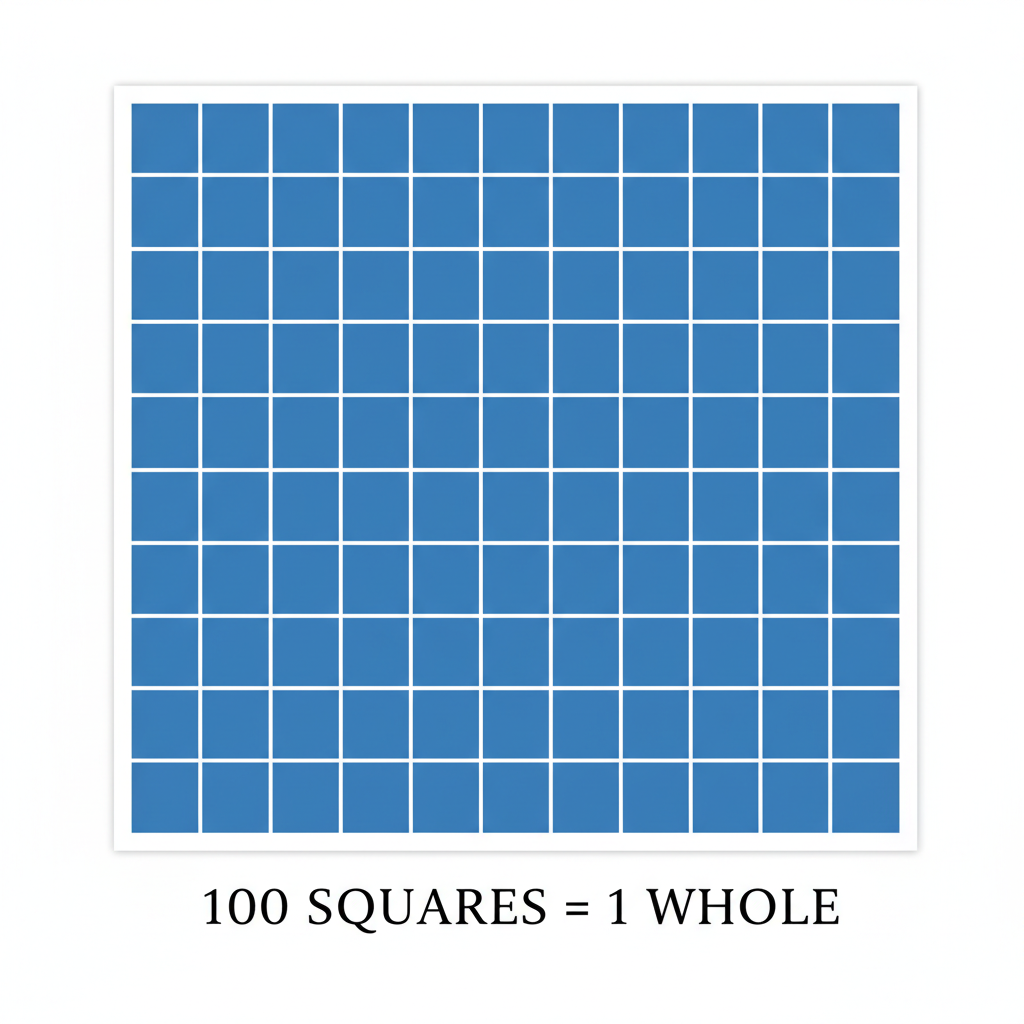
If we shade in 50 of those tiny squares, we've shaded 50 out of 100, which is 50/100. As a decimal, this is 0.50. Notice that shading 50 squares is the same as shading exactly half of the whole grid!
If we shade in 25 of those tiny squares, we've shaded 25/100. As a decimal, this is 0.25. This looks like one quarter of the grid.
If we shade in just 10 squares, we have 10/100. As a decimal, this is 0.10. This is the same as 1/10, or one column of the grid.
Why is this Useful?
Knowing how to convert between fractions and decimals is super handy!
- Comparing Numbers: Sometimes it's easier to compare 1/2 and 3/4 if you convert them to decimals: 0.5 and 0.75. Then it's clear that 0.75 is bigger.
- Calculators: Most calculators show numbers as decimals. If you need to work with fractions, you'll need to convert them.
- Real-World Problems: From understanding discounts in stores (25% off is like 0.25) to measuring ingredients in recipes, decimals and fractions are everywhere!
Keep practicing these conversions, and you'll become a master of both number languages!
Keep learning, free
Create a free Syllabax account to unlock practice questions and games for this topic.
Visual Learning Enhanced! 🚀
To help you master this topic, we use Advanced Syllabax AI to generate detailed diagrams and visual models.
Note on Visuals: The AI sometimes makes spelling errors in image labels. Please refer to the lesson text for the correct terminology.