Reflection basics (PHYSICS)
Watch this topic in 60 seconds
Free preview · Lesson 1
Understanding Reflection basics (PHYSICS)
Understanding Reflection: Bouncing Light Around!
Imagine you're playing catch with a friend. When you throw the ball, it travels through the air and lands in your friend's hands. What if your friend is standing behind a wall? The ball can't go through the wall, right? So, what happens if you throw the ball towards the wall?
That's right! The ball bounces off the wall and comes back towards you, or maybe goes in a different direction. This bouncing off is a lot like what happens with light! In physics, we call this special kind of bouncing 'reflection'.
What is Reflection?
Reflection is the change in direction of a wavefront (like light, sound, or even a water wave) at an interface, which is the boundary between two different media, so that the wavefront returns into the medium from which it originated. Think of it like a ball hitting a trampoline. The ball (light) hits the trampoline (a reflective surface), and instead of going through, it bounces back up!
Types of Surfaces and Reflection
Not all surfaces reflect light in the same way. It depends on how smooth or rough the surface is.
1. Smooth Surfaces (like a Mirror)
When light hits a very smooth surface, like the shiny back of a spoon or a mirror, most of the light rays bounce off in the same direction. This is called specular reflection. It's like if you rolled a perfectly round ball across a perfectly flat, smooth table. It would travel in a straight line and bounce off predictably.
When you look in a mirror, you see a clear reflection because the light rays from your face hit the smooth glass surface and bounce back to your eyes in an organized way. It's like seeing yourself in a calm lake on a still day – you can see a clear image!
2. Rough Surfaces (like a Wall)
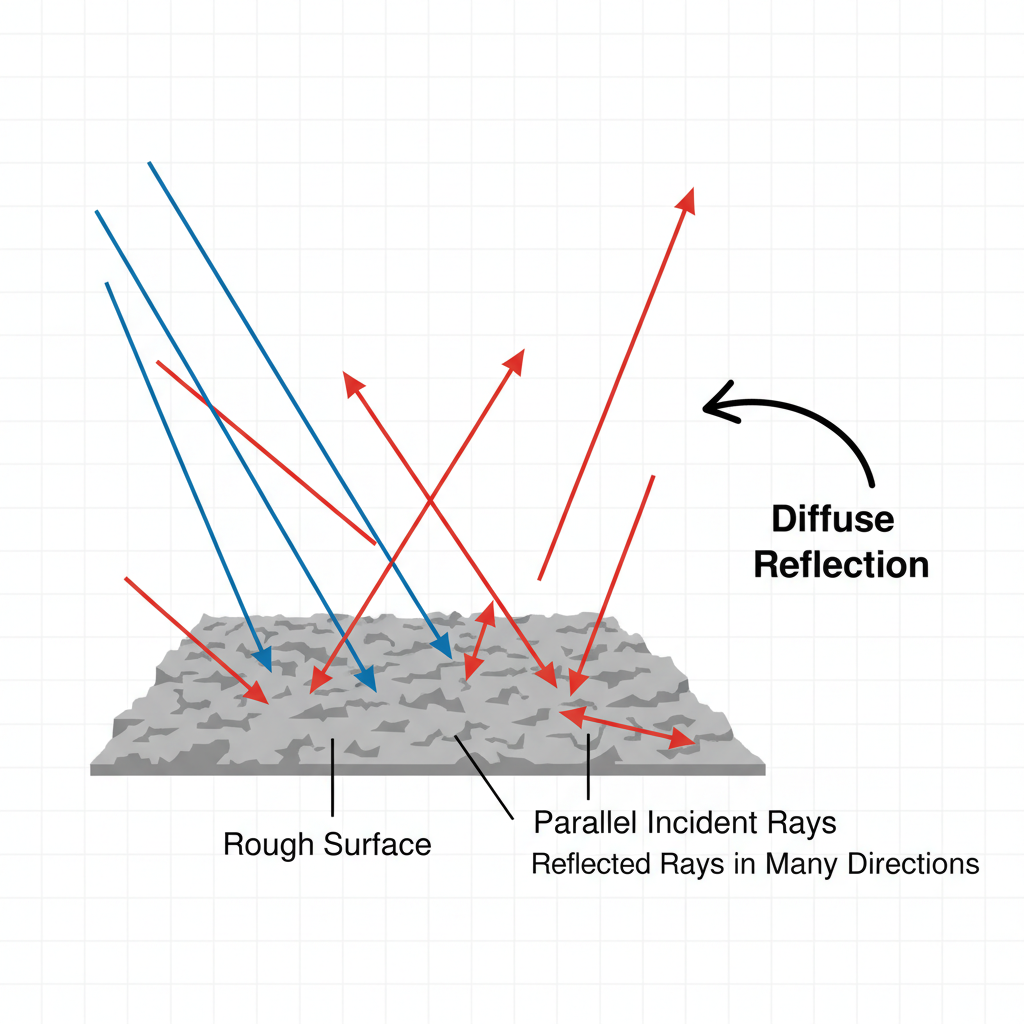
Now, imagine the surface is rough, like a wall, a piece of paper, or the bark of a tree. When light hits these surfaces, it bounces off in many different directions. This is called diffuse reflection. It's like throwing a handful of marbles onto a bumpy, uneven surface. Each marble will bounce off in its own random direction.
This diffuse reflection is why you can see most objects around you. Light from a lamp or the sun hits your book, and the light bounces off the rough paper in all directions, reaching your eyes no matter where you are looking at the book from. You don't see a clear, sharp image of the lamp on the book; you just see the book itself!
Key Terms in Reflection
To understand reflection better, let's learn a few important words:
- Incident Ray: This is the ray of light that is traveling towards the surface. Think of it as the ball you are about to throw at the wall.
- Reflected Ray: This is the ray of light that bounces off the surface. This is the ball after it has hit the wall and bounced back.
- Point of Incidence: This is the exact spot on the surface where the incident ray hits. It's the specific point on the wall where the ball makes contact.
- Normal: This is an imaginary line that is drawn perpendicular (at a 90-degree angle) to the surface at the point of incidence. Think of it as an imaginary line straight up from the wall at the point where the ball hits. It helps us measure angles.
The Laws of Reflection
Scientists have discovered some fundamental rules, called the Laws of Reflection, that always apply when light reflects off a surface. These laws are like the rules of a game that light always follows!
Law 1: The Angle of Incidence equals the Angle of Reflection
This is a very important rule! The angle of incidence is the angle between the incident ray and the normal. The angle of reflection is the angle between the reflected ray and the normal. These two angles are always equal!
Imagine the normal line is like the center line in a game of table tennis. If you hit the ball towards the center line at a certain angle, it will bounce off at the exact same angle on the other side. So, if the incident ray hits the surface at 30 degrees from the normal, the reflected ray will bounce off at 30 degrees from the normal.
Law 2: The Incident Ray, the Reflected Ray, and the Normal all lie in the same plane.
This means that the incident ray, the reflected ray, and the imaginary normal line all exist on the same flat surface (or plane). They don't go off in different directions off this plane. Think of it like drawing on a piece of paper. Everything you draw – the incident ray, the reflected ray, and the normal – stays on that flat paper.
Why is Reflection Important?
Reflection is happening all around us, all the time! It's how we see:
- Seeing Objects: As we mentioned, diffuse reflection allows us to see objects that don't produce their own light.
- Mirrors: Specular reflection in mirrors allows us to see our own reflection, which is useful for grooming, safety (like in cars), and even for scientific instruments.
- Echoes: Sound waves also reflect! When you shout in a canyon and hear your voice come back, that's an echo, which is sound reflection.
- Seeing the Moon: The Moon doesn't create its own light. We see it because sunlight reflects off its surface and travels to our eyes.
So, the next time you look in a mirror or see your reflection in a window, remember the fascinating physics of reflection at play!
Keep learning, free
Create a free Syllabax account to unlock practice questions and games for this topic.
Visual Learning Enhanced! 🚀
To help you master this topic, we use Advanced Syllabax AI to generate detailed diagrams and visual models.
Note on Visuals: The AI sometimes makes spelling errors in image labels. Please refer to the lesson text for the correct terminology.