Why Collect Data?
Watch this topic in 60 seconds
Free preview · Lesson 1
Understanding Why Collect Data?
Why Collect Data? Becoming a Data Detective!
Have you ever tried to figure out what kind of snack your friends like best? Or wondered why your plant isn't growing as fast as you expected? Or maybe you just wanted to know which path to take to get to school the quickest? If you've ever asked questions like these and looked for answers, congratulations! You've already started to understand the amazing world of data collection!
At its heart, data is just information. It's like collecting clues to solve a mystery, or gathering ingredients to bake a cake. Every little piece of information, whether it's a number, a description, or an observation, is a piece of data. And collecting this data helps us understand things better, make smarter choices, and even solve problems!
1. Data Helps Us Make Awesome Decisions!
Imagine you have a big party coming up, and you want to choose the perfect game that everyone will enjoy. You could just guess, but what if you guess wrong and people are bored? A better way is to collect data! You could ask five of your friends, 'What's your favorite party game: Charades, Pictionary, or Musical Chairs?'
If three friends say Pictionary, one says Charades, and one says Musical Chairs, what do you learn? You learn that Pictionary is the most popular! This piece of data helps you make the decision to probably play Pictionary, making your party a bigger hit. It's like being a super-smart party planner!
Analogy: Think about choosing an outfit for school. If you check the weather forecast (collecting data about temperature and rain), you'll know if you need a jacket or an umbrella. Without that data, you might wear shorts on a freezing day or get soaked in the rain! So, the weather data helps you make a good decision about your clothes.
2. Data Helps Us Solve Tricky Problems!
Let's say your pet fish isn't swimming around much and seems a bit sluggish. This is a problem! How do you figure out what's wrong? You become a data detective!
- You might check the water temperature (collecting data).
- You might observe how much food it's eating (collecting data).
- You might notice if its fins look different (collecting data).
By collecting all these clues, you might discover that the water is too cold, or you're feeding it too much. This data helps you identify the problem and find a solution, like adjusting the heater or giving it less food. Without collecting data, you'd just be guessing, and your fish might not get better.
Analogy: Imagine your bike chain keeps falling off. You start collecting data: 'When does it fall off? Only when I go uphill? Only when I shift gears quickly?' This data helps your parent or bike mechanic figure out if it's a loose chain, a bent gear, or how you're riding. It helps them fix the problem instead of just randomly tightening bolts!
3. Data Helps Us Understand Our World Better!
Our world is full of amazing things, and data helps us learn about them. Scientists collect data to understand everything from the tiniest insects to the biggest planets. For example:
- Meteorologists collect data on temperature, wind, and clouds to predict the weather.
- Biologists collect data on animal movements and diets to understand how different species live.
- Teachers collect data on how students perform on tests to understand what topics might need more explanation.
This understanding helps us prepare for storms, protect endangered animals, and even learn better in school!
Analogy: Think about watching birds at a bird feeder. If you write down (collect data) which types of birds visit, what time of day they come, and what seeds they eat, you'll start to understand their habits. You might discover that cardinals love sunflower seeds in the morning, while sparrows prefer mixed seeds in the afternoon. This helps you understand the 'world' of your backyard birds!
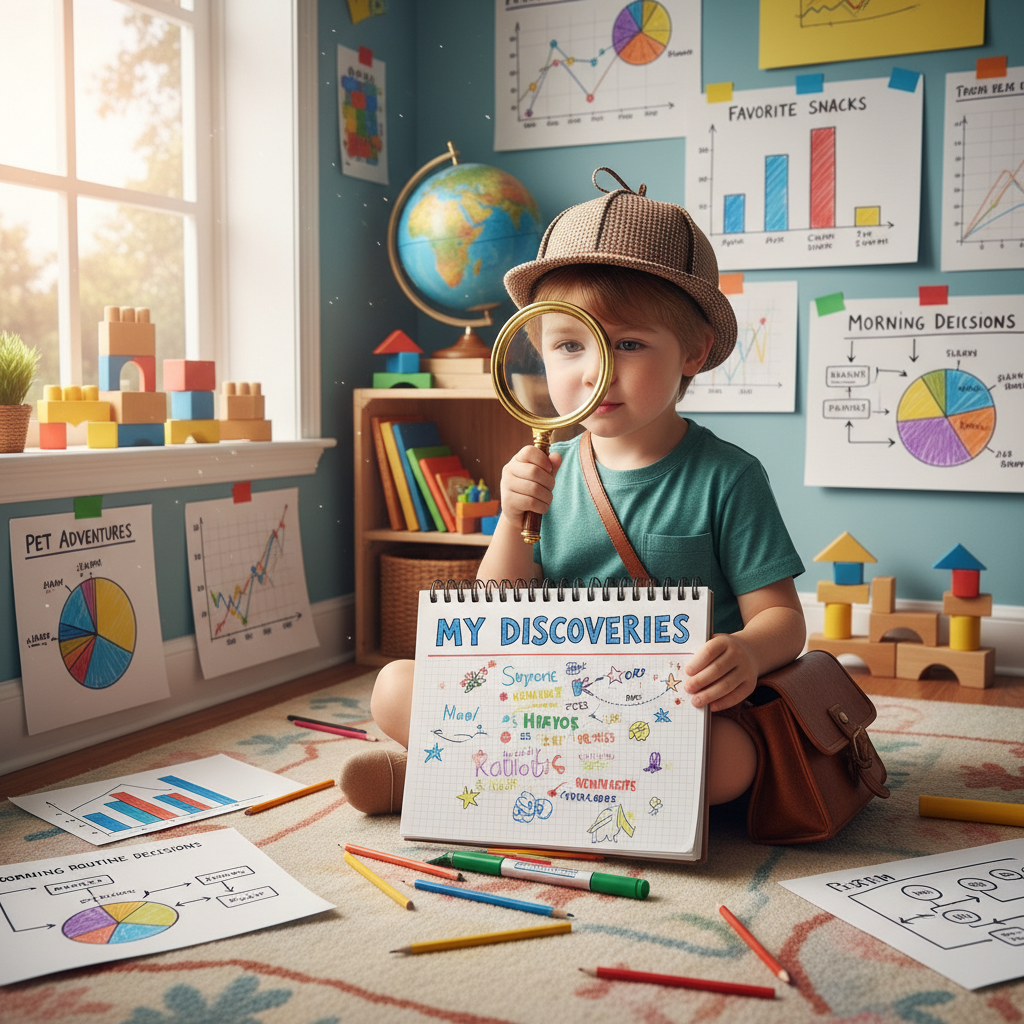 ⚠️ This picture may have spelling mistakes. Trust the words in the lesson.
4. Data Helps Us Track Progress and See How Things Change!
Have you ever wanted to get better at something, like a video game, a sport, or playing an instrument? Data is your best friend for tracking your progress!
If you're trying to improve your jump shot in basketball, you might collect data:
- Day 1: Made 5 out of 20 shots.
- Day 2: Made 7 out of 20 shots.
- Day 3: Made 8 out of 20 shots.
Looking at this data, you can clearly see that you are getting better! It shows your progress and can even motivate you to keep practicing. If you suddenly made only 2 shots on Day 4, that's also data, and it might tell you to think about what changed (maybe you were tired, or changed your technique).
Analogy: Growing a plant! If you measure its height every week and write it down (collect data), you can see how much it's grown. If it suddenly stops growing, your data tells you there might be a problem, and you can investigate (collect more data!) why. Data helps you notice changes and respond to them.
How Do We Collect Data? Just Like a Detective!
Collecting data doesn't have to be complicated! Here are some simple ways:
- Observing: Watching things carefully and noting what you see. (Like watching your fish or birds).
- Measuring: Using tools like rulers, thermometers, or scales to get numbers. (Like measuring a plant's height or water temperature).
- Asking Questions: Conducting surveys or interviews to get people's opinions or facts. (Like asking friends about their favorite game).
- Counting: Simply keeping track of how many of something there are. (Like counting how many shots you make in basketball).
So, the next time you're trying to figure something out, remember the power of data. It's not just for grown-up scientists; it's a superpower for kids too! By collecting information, you become a data detective, ready to make better decisions, solve mysteries, and understand the amazing world around you, one clue at a time.
Keep learning, free
Create a free Syllabax account to unlock practice questions and games for this topic.
Visual Learning Enhanced! 🚀
To help you master this topic, we use Advanced Syllabax AI to generate detailed diagrams and visual models.
Note on Visuals: The AI sometimes makes spelling errors in image labels. Please refer to the lesson text for the correct terminology.