Learning Journey
Watch this topic in 60 seconds
Free preview · Lesson 1
Understanding Distance & displacement[PHYSICS]
Understanding Distance and Displacement: A Journey Through Motion
Welcome, young scientists! Today, we're embarking on a fundamental journey into the world of physics to understand two very important concepts that describe how things move: distance and displacement. While they sound similar, they tell us different things about an object's motion. Let's explore!
What is Distance? The Total Path Traveled
Imagine you're going on a treasure hunt. You follow a winding path, maybe you have to go around a big rock, then climb a small hill, and finally reach the treasure chest. Distance is like the total length of that entire path you walked. It's the sum of all the steps you took, no matter which direction you went or how many twists and turns there were.
In physics terms, distance is a scalar quantity. This means it only tells us how much of something there is, without any direction. Think of it like this:
- If you walk 5 meters east, then 3 meters west, the total distance you've traveled is 5 + 3 = 8 meters.
- If you run around a circular track that is 400 meters long, the distance you cover is 400 meters, even if you end up right where you started.
Key characteristics of Distance:
- It's always a positive value (or zero if you haven't moved).
- It measures the total length of the path taken.
- It's a scalar quantity (only has magnitude, no direction).
Analogy: Walking to the Store
Let's say your house is here:
And the store is over here. You don't walk in a perfectly straight line. You might have to walk down your driveway, turn left onto the sidewalk, go past a few houses, maybe even cross a street. Let's say the total length of your walk from your front door to the store's front door, following all the sidewalks and paths, is 200 meters. That 200 meters is the distance you traveled. It's the total amount of ground you covered.
What is Displacement? The Straight-Line Change in Position
Now, let's think about displacement. Using our treasure hunt example again, instead of counting every single step, displacement is like drawing a straight line directly from where you started (your starting point) to where you ended up (your ending point). It only cares about the beginning and the end, not the journey in between.
Displacement is a vector quantity. This is a fancy way of saying it has both a magnitude (how far) and a direction. It tells us how far you are from your starting position and in which direction.
Let's revisit our earlier examples:
- If you walk 5 meters east, then 3 meters west: Your starting point is your home. You move 5 meters east, then 3 meters back west. Your final position is 5 - 3 = 2 meters east of your starting point. So, your displacement is 2 meters east. Notice how different this is from the distance of 8 meters!
- If you run around a circular track that is 400 meters long and you end up right back where you started: Your starting point and ending point are the same. Therefore, your displacement is 0 meters. You haven't changed your overall position relative to where you began.
Key characteristics of Displacement:
- It can be positive, negative, or zero.
- It measures the change in position from start to finish.
- It's a vector quantity (has both magnitude and direction).
Analogy: The Quickest Route vs. The Actual Route
Think about getting from your house to the store again. The distance was the 200 meters you walked along the sidewalks. But what if someone asked, "How far is the store from your house, as the crow flies?" This means, "What is the shortest, most direct distance?" That shortest distance, drawn as a straight line from your front door to the store's front door, is your displacement. If the store is generally to the east of your house, your displacement would be "X meters east" (where X is the straight-line distance).
Let's look at our house and store example with displacement in mind:
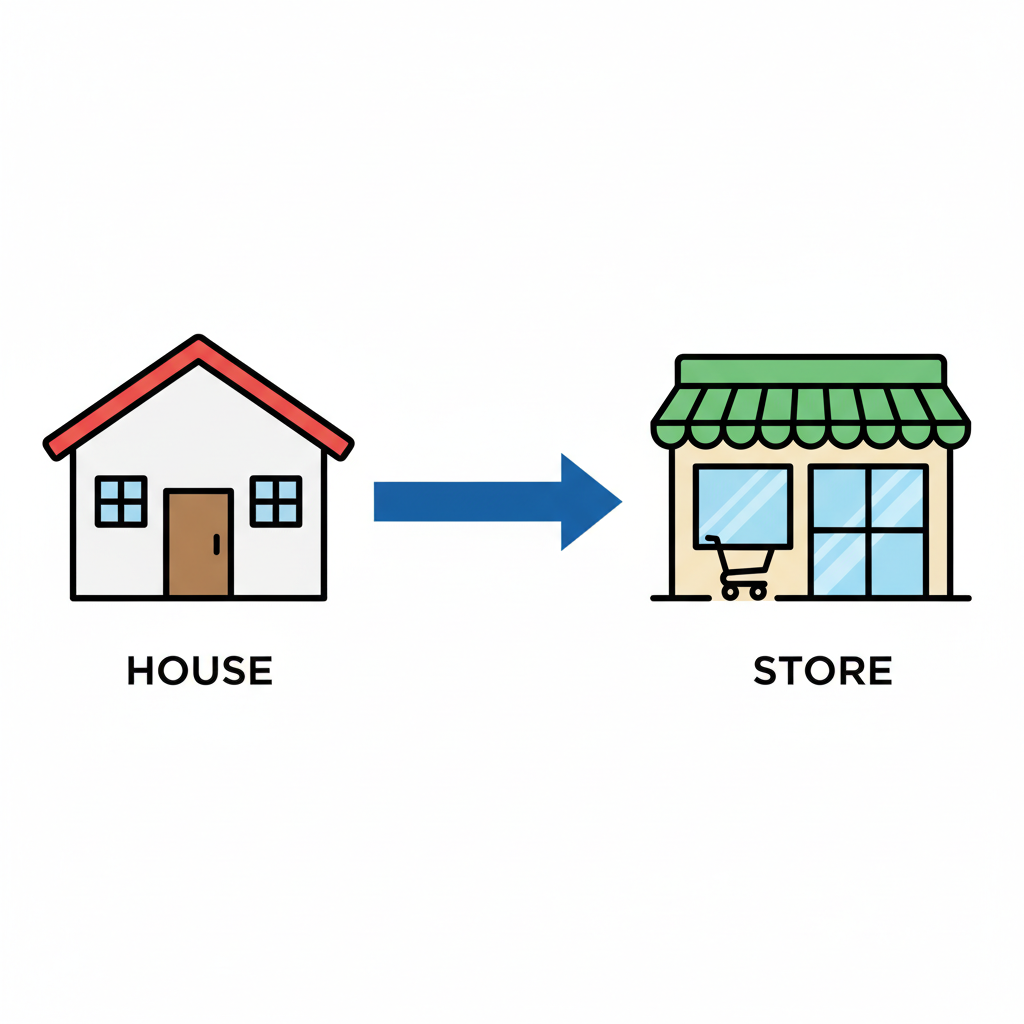
The arrow represents the displacement. It has a length (the straight-line distance) and a direction (e.g., 'northeast'). The actual path you walked (the distance) was much longer and followed the curves of the streets.
When are Distance and Displacement the Same?
There's one special case where the distance traveled and the magnitude of the displacement are the same: when an object moves in a straight line without changing direction.
Example: If you walk 10 meters straight east from your starting point and stop, your distance traveled is 10 meters, and your displacement is also 10 meters east. The length of the path (10m) is the same as the straight-line distance from start to end (10m).
Why Do We Need Both?
Distance tells us the total effort or energy expended in travel. If you're planning a road trip, you need to know the total distance to estimate fuel and time. Displacement, on the other hand, is crucial for understanding the net change in an object's position. In physics, when we talk about velocity (how fast you're going) and acceleration (how your velocity is changing), displacement is the key measurement, not just the total path.
Think about a race: A runner might complete many laps (covering a large distance), but their displacement might be zero if they finish at the starting line.
Summary Table: Distance vs. Displacement
| Feature | Distance | Displacement |
|---|---|---|
| Definition | Total length of the path traveled. | The straight-line change in position from start to end. |
| Quantity Type | Scalar (magnitude only) | Vector (magnitude and direction) |
| Value | Always positive or zero. | Can be positive, negative, or zero. |
| Focus | The journey itself. | The start and end points. |
Understanding the difference between distance and displacement is a fundamental step in understanding motion. Keep practicing, and soon these concepts will feel like second nature!
Keep learning, free
Create a free Syllabax account to unlock practice questions and games for this topic.
Visual Learning Enhanced! 🚀
To help you master this topic, we use Advanced Syllabax AI to generate detailed diagrams and visual models.
Note on Visuals: The AI sometimes makes spelling errors in image labels. Please refer to the lesson text for the correct terminology.