Learning Journey
Watch this topic in 60 seconds
Free preview · Lesson 1
Understanding Future Technologies & Innovations
Future Technologies & Innovations: A Glimpse into Tomorrow
Hello 8th Graders! Get ready to travel through time – not literally, but by exploring the amazing technologies and innovations that are shaping our future right now! Think of it like looking into a super cool crystal ball, but instead of seeing vague predictions, we're going to learn about real science and engineering that's changing the world around us and what's coming next. This isn't science fiction anymore; it's science fact in the making!
Why should you care about future technologies? Because YOU are the future! The world you'll live in, the jobs you'll have, and the problems you'll solve will all be profoundly influenced by these incredible advancements. Understanding them now gives you a head start in imagining, creating, and even becoming part of that future.
1. Artificial Intelligence (AI): Computers That Think (Sort Of!)
Imagine having a super smart assistant that can learn, understand, and even make decisions. That's a bit like Artificial Intelligence, or AI! AI isn't about robots taking over the world like in movies (at least not yet!). It's about giving computers the ability to perform tasks that usually require human intelligence.
-
What it is: AI is a branch of computer science that creates machines capable of reasoning, learning, and problem-solving. Think of it as teaching computers to be 'smart'.
-
How it works (simply): AI systems learn from huge amounts of data. For example, if you show an AI program thousands of pictures of cats and dogs, it learns to recognize the difference. It's like how you learn from experience – the more you see, the better you get.
-
Real-world examples:
- Your phone's voice assistant (Siri, Google Assistant, Alexa) uses AI to understand your questions and commands.
- Recommendation systems on Netflix or YouTube use AI to suggest movies or videos you might like, based on what you've watched before.
- Self-driving cars use AI to 'see' the road, understand traffic, and make decisions about steering and braking.
-
Analogy: Imagine AI as a super-powered calculator that doesn't just do math, but can also 'think' about what you need and learn from its mistakes. It's like having a digital brain that keeps getting smarter!
2. Robotics: Our Mechanical Helpers
When you hear 'robot,' you might think of R2-D2 or a factory arm building cars. Both are correct! Robotics is the field of engineering that deals with designing, building, operating, and applying robots.
-
What it is: Robots are machines designed to carry out a complex series of actions automatically, often programmed by a computer. They can perform tasks that are dangerous, dull, or difficult for humans.
-
How it works (simply): Robots have different parts: sensors (to 'see' or 'feel' their environment), actuators (motors to move their parts), and a 'brain' (a computer program) that tells them what to do based on the information from their sensors.
-
Real-world examples:
- Factory robots assemble products faster and more accurately than humans.
- Robots explore other planets, like Mars rovers, which send back amazing pictures and data.
- Surgical robots assist doctors in performing delicate operations with incredible precision.
- Delivery robots are starting to bring food and packages right to your doorstep.
-
Analogy: Think of a robot as a highly skilled tool or a helpful friend that can do physical jobs for us. It’s like having a tireless worker who never gets bored or tired of doing repetitive tasks.
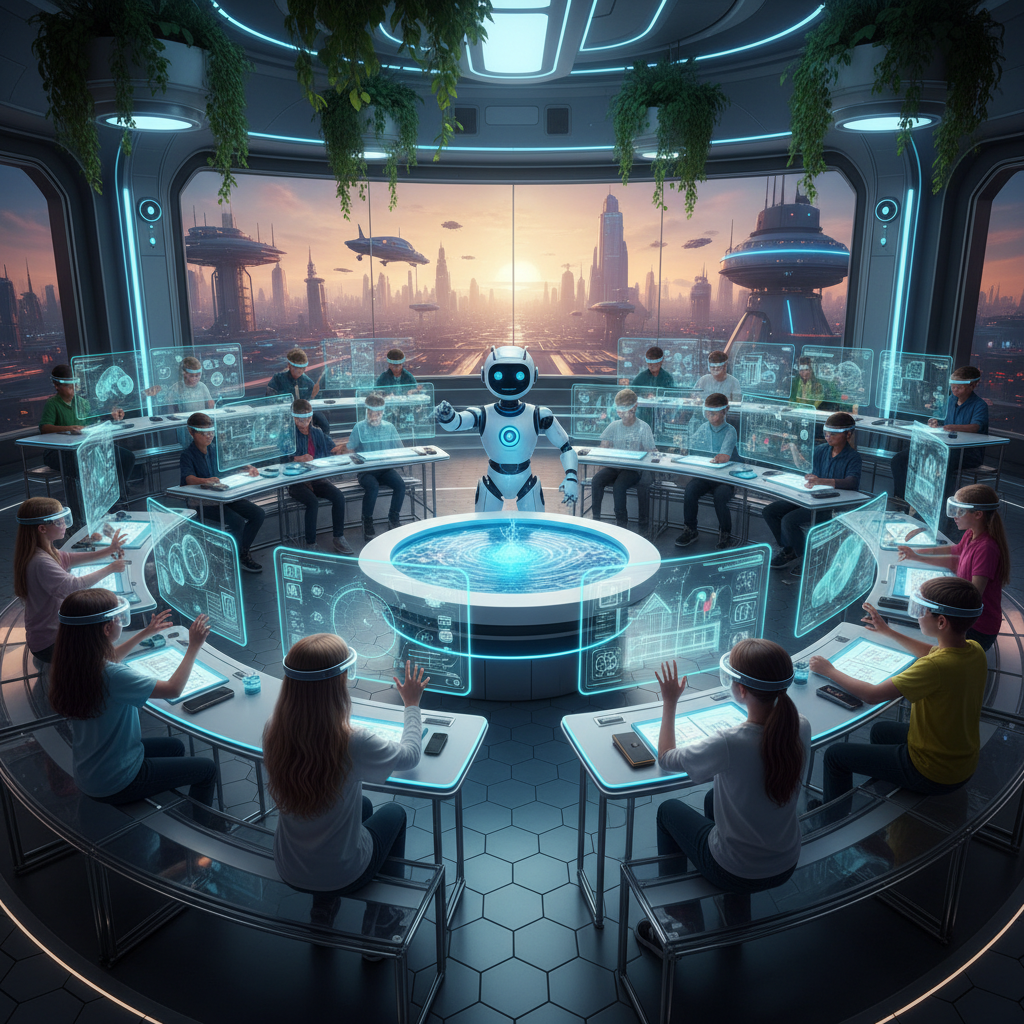 ⚠️ This picture may have spelling mistakes. Trust the words in the lesson.
Imagine learning in a future classroom, with interactive technology all around!
3. Virtual Reality (VR) & Augmented Reality (AR): New Ways to See the World
Get ready to step into new worlds or enhance the one you're already in! VR and AR are two technologies that are changing how we experience digital information.
-
Virtual Reality (VR):
-
What it is: VR completely immerses you in a simulated environment. When you put on a VR headset, your real surroundings disappear, and you're transported to a digital world – it could be the top of Mount Everest, a spaceship, or a fantastical kingdom.
-
How it works: Special headsets display a 3D environment and often track your head movements, so when you turn your head, the view in the virtual world also turns. It tricks your brain into thinking you're really there!
-
Examples: VR video games, virtual tours of historical sites, training simulations for doctors or pilots.
-
Analogy: VR is like jumping into a really realistic dream or stepping inside a video game. You're completely surrounded by the digital world.
-
-
Augmented Reality (AR):
-
What it is: AR overlays digital information (like images, sounds, or text) onto your real-world view. Instead of replacing your reality, it 'augments' or enhances it.
-
How it works: You usually use a smartphone, tablet, or special AR glasses. The device's camera captures the real world, and then the software adds digital elements on top of it, which you see on your screen.
-
Examples: Pokémon GO (digital creatures appear in your park), trying on virtual furniture in your living room before buying, AR filters on social media that add dog ears or sunglasses to your face.
-
Analogy: AR is like wearing magical glasses that let you see digital drawings and information floating in front of real-world objects. It's like having a digital layer on top of your everyday life.
-
4. Biotechnology: Life-Changing Science
Biotechnology is a huge field that uses living organisms and biological systems to create new products and technologies. It's all about harnessing the power of nature at a tiny, molecular level to solve big problems.
-
What it is: Biotechnology uses biological processes, organisms, or systems to produce products that improve human lives and the planet. Think of it as biology and technology working together.
-
How it works (simply): Scientists might study the DNA of plants to make them more resistant to pests, or use tiny microorganisms (like bacteria) to produce medicines, or even grow 'meat' in a lab instead of from animals.
-
Real-world examples:
- Developing new vaccines and medicines to fight diseases.
- Creating genetically modified crops that can grow in harsh conditions or have more nutrients.
- Producing biofuels from algae or plants as an alternative to fossil fuels.
- Gene editing to correct genetic defects that cause illnesses.
-
Analogy: Biotechnology is like having a microscopic toolbox filled with nature's own building blocks. Scientists are like master builders using these tiny parts to construct solutions for health, food, and environmental challenges.
5. Renewable Energy: Powering Our Planet Cleanly
Our planet needs energy, but burning fossil fuels like coal and oil causes pollution. Renewable energy technologies offer a clean, sustainable solution by harnessing natural resources that replenish themselves.
-
What it is: Renewable energy comes from sources that don't run out or replenish naturally on a human timescale. Unlike fossil fuels, they are sustainable and produce little to no greenhouse gas emissions.
-
How it works (simply): Instead of digging up fuel, we capture natural forces. Solar panels capture sunlight, wind turbines capture wind, and hydroelectric dams capture flowing water. These forces are then converted into electricity.
-
Types of Renewable Energy:
- Solar Power: Uses photovoltaic (PV) panels to convert sunlight directly into electricity.
- Wind Power: Uses large turbines to capture the kinetic energy of wind and convert it into electricity.
- Hydroelectric Power: Uses the force of moving water (typically from dams) to spin turbines and generate electricity.
- Geothermal Energy: Uses heat from the Earth's interior to generate electricity or directly heat buildings.
- Bioenergy: Uses organic matter (biomass) like plants or animal waste to produce heat, electricity, or fuel.
-
Analogy: Think of renewable energy as using nature's free, endless gifts – sunshine, wind, flowing water – to power our homes and cities, instead of using up limited, messy resources like coal or oil. It's like having a never-ending battery powered by the Earth itself!
6. Space Exploration & Commercial Space Travel: Reaching for the Stars
Humans have always looked up at the stars with wonder. Now, with incredible new technologies, space exploration is not just for governments anymore; private companies are also joining the race to the stars!
-
What it is: Space exploration involves sending spacecraft, probes, and sometimes humans beyond Earth's atmosphere to study other planets, moons, asteroids, and the universe itself. Commercial space travel means private companies are developing ways for regular people (or at least wealthy ones!) to travel to space.
-
How it works (simply): Rockets carry spacecraft into orbit or beyond. Advanced telescopes help us see distant galaxies. New materials make spacecraft lighter and stronger. Reusable rockets, like those from SpaceX, make space travel cheaper by landing back on Earth after launch, ready for another trip.
-
Real-world examples:
- The James Webb Space Telescope sends back breathtaking images of the early universe.
- NASA's Perseverance rover explores Mars, searching for signs of ancient life.
- SpaceX is developing rockets to eventually take humans to Mars.
- Companies like Virgin Galactic are offering suborbital tourist flights to space.
-
Analogy: Space exploration is like being the ultimate adventurer, journeying to the wildest, most unknown places imaginable. Commercial space travel is like a new kind of airline, but instead of flying across countries, it flies you to the edge of space!
Impact of Future Technologies on Our Lives
These technologies aren't just cool; they're going to change everything!
-
Jobs: New jobs will emerge (e.g., AI trainers, robot maintenance engineers), and some old jobs might change or disappear. Learning about these fields now is a smart move for your future career.
-
Daily Life: Imagine personalized medicine tailored just for you, smart homes that anticipate your needs, faster and safer transportation, and even more engaging ways to learn and play.
-
Solving Global Problems: Future tech can help us tackle climate change, cure diseases, feed a growing population, and explore new frontiers for humanity.
Using Technology Wisely: The Ethical Side
With great power comes great responsibility! As technology advances, it's important to think about the 'right' way to use it.
-
Privacy: If AI knows so much about us, how do we protect our personal information?
-
Fairness: How do we make sure new technologies benefit everyone, not just a few?
-
Safety: How do we ensure robots and AI systems are safe and don't harm people?
These are big questions that you, as future leaders and innovators, will help answer!
Conclusion: Your Role in the Future
The future isn't something that just happens; it's something we build together. By understanding these foundational concepts of future technologies, you're taking the first step towards becoming innovators, problem-solvers, and responsible citizens of tomorrow's world. Keep exploring, keep questioning, and get excited about the incredible possibilities that lie ahead!
Keep learning, free
Create a free Syllabax account to unlock practice questions and games for this topic.
Visual Learning Enhanced! 🚀
To help you master this topic, we use Advanced Syllabax AI to generate detailed diagrams and visual models.
Note on Visuals: The AI sometimes makes spelling errors in image labels. Please refer to the lesson text for the correct terminology.