Organizing Data: Tally Marks
Watch this topic in 60 seconds
Free preview · Lesson 1
Understanding Organizing Data: Tally Marks
Organizing Data: Tally Marks – A Super Simple Guide for 4th Graders!
Hey there, future data detectives! Have you ever seen a pile of toys all over your room and wished there was an easy way to put them away so you could find your favorite action figure or doll quickly? Well, data is a bit like that pile of toys. Data is just information or facts, like how many people in your class like pizza, or how many red cars you see on the way to school. When we have a lot of data, it can get messy and hard to understand. That's why we need ways to organize it!
Imagine your toy box. If all your toys are just thrown in, it's hard to find anything, right? But if you have different sections for cars, blocks, and dolls, it's much easier! In the world of numbers and information, one super simple and super useful way to organize data is by using something called Tally Marks.
What Are Tally Marks?
Tally marks are like little sticks or lines we draw to count things. Think of them as a simple way to keep score in a game or count how many times something happens. They are really easy to make and even easier to read once you know the secret!
When you count with your fingers, you use one finger for each item. Tally marks work the same way! Each little line stands for one thing. So, if you count one apple, you draw one line. If you count another apple, you draw another line next to it.
The Super Secret Tally Mark Rule: Bundles of Five!
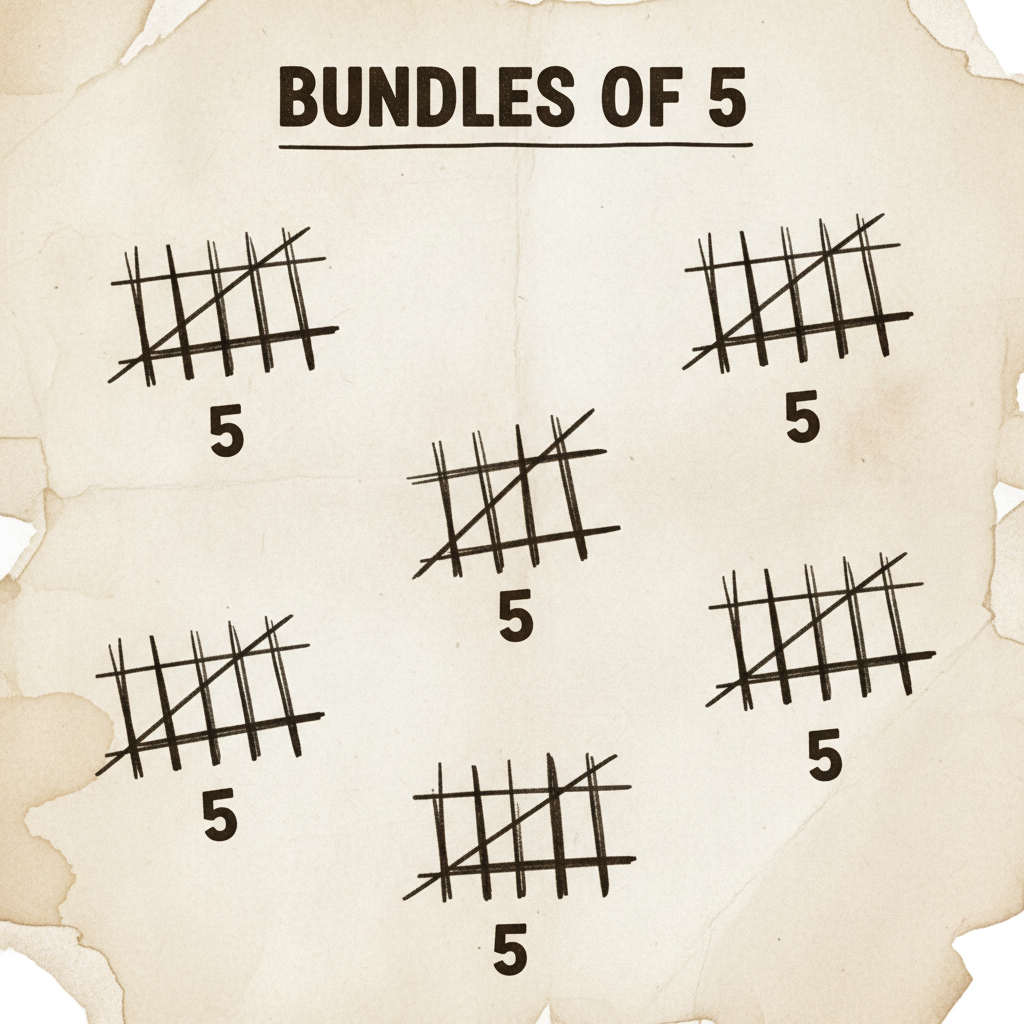
Now, here's the best part about tally marks and what makes them so clever: we group them into bundles of five! Why five? Because it's easy to count quickly. Just like you have five fingers on one hand, we make a special group of five tally marks.
Here's how it works:
- For 1, you draw one straight line: |
- For 2, you draw two straight lines: ||
- For 3, you draw three straight lines: |||
- For 4, you draw four straight lines: ||||
And now for the magic fifth one! Instead of drawing a fifth straight line next to the others, which would start to look messy and hard to count quickly, we draw a line across the first four. This creates a neat little bundle, like tying up a small bunch of flowers!
- For 5, you draw four straight lines and then one line diagonally across them:
||||
This bundle of four vertical lines with one diagonal line always means FIVE. It’s like a quick 'high five' for your counting! Every time you see this symbol, you know immediately it's five, without having to count each line.
Why Are Bundles of Five So Great?
Imagine you're counting how many students in your class like chocolate ice cream. If 17 students like it, and you just drew 17 separate lines (|||||||||||||||||), it would take you a while to count them all up. But with bundles of five, it's super fast!
For 17, you would make three bundles of five and then two more single lines:
|||| |||| |||| ||
See? You just count by fives: 5, 10, 15, and then add the two extra: 15 + 2 = 17! It's much faster than counting 17 individual lines. This is why tally marks are so useful for keeping track of things as they happen, like counting votes or seeing how many times a red car drives by.
Let's Practice Reading Tally Marks!
When you see tally marks, remember the bundles of five. Each group of five is easy to spot. Then, you just add any extra single lines.
Example 1:
|||| |||
This is one bundle of five (which is 5) plus three more lines (3). So, 5 + 3 = 8!
Example 2:
|||| ||||
This is two bundles of five. So, 5 + 5 = 10!
Tally marks are a fantastic first step in learning how to collect and organize data. They help us turn messy information into neat, easy-to-read groups, just like organizing your toys into different boxes. Keep practicing, and you'll be a tally mark pro in no time!
Ready to be a Data Detective?
Next time you want to count something, try using tally marks! How many birds do you see outside your window? How many times does your pet bark or meow in an hour? Use tally marks to find out!
Keep learning, free
Create a free Syllabax account to unlock practice questions and games for this topic.
Visual Learning Enhanced! 🚀
To help you master this topic, we use Advanced Syllabax AI to generate detailed diagrams and visual models.
Note on Visuals: The AI sometimes makes spelling errors in image labels. Please refer to the lesson text for the correct terminology.