Profit & loss (intro) [Arithmetic in Daily Life]
Watch this topic in 60 seconds
Free preview · Lesson 1
Understanding Profit & loss (intro) [Arithmetic in Daily Life]
Understanding Profit and Loss: Your Money in Action!
Welcome to the exciting world of **Profit and Loss**! This is all about understanding how buying and selling things can make or lose us money. It's like a game we play every day, even when we don't realize it!
What is Profit and Loss?
Imagine you have a favorite toy. You bought it for a certain price, right? Then, maybe you decide you want to sell it to a friend. The price you sell it for compared to the price you bought it for is where profit or loss comes in!
1. The Cost Price (CP): The Price You Pay!
The **Cost Price (CP)** is simply the amount of money you spend to buy something. Think of it as the price tag when you first get your item.
- Analogy 1: Buying a Treat
Let's say you go to the store and buy a delicious chocolate bar for - Analogy 2: Starting a Lemonade Stand
If you want to start a lemonade stand, you need to buy lemons, sugar, and cups. The total money you spend on these ingredients and supplies is your Cost Price.
2. The Selling Price (SP): The Price You Sell For!
The **Selling Price (SP)** is the amount of money you receive when you sell something. This is how much you get back (or more!) from someone else.
- Analogy 1: Selling Your Toy
Remember that toy you bought? If you decide to sell it to your friend for - Analogy 2: Selling Lemonade
If you sell each cup of lemonade for
When Do You Make a Profit?
You make a **profit** when you sell something for *more* than you bought it for. It's like getting a little bonus!
The Formula for Profit:
Profit = Selling Price (SP) - Cost Price (CP)
- Analogy: The Successful Bake Sale
Imagine you baked cookies for a school bake sale. It cost you - Key Idea: SP is Bigger than CP
When the Selling Price is greater than the Cost Price, you have made a profit.
When Do You Make a Loss?
You make a **loss** when you sell something for *less* than you bought it for. It means you didn't get back all the money you spent.
The Formula for Loss:
Loss = Cost Price (CP) - Selling Price (SP)
- Analogy: The Unpopular Gadget
Let's say you bought a cool new gadget for - Key Idea: CP is Bigger than SP
When the Cost Price is greater than the Selling Price, you have incurred a loss.
What if the Cost Price and Selling Price are the Same?
Sometimes, you might sell something for exactly the same price you bought it for. In this case, you have **neither profit nor loss**. You just broke even.
- Analogy: Trading Fairly
If you bought a comic book for
Let's Visualize it!
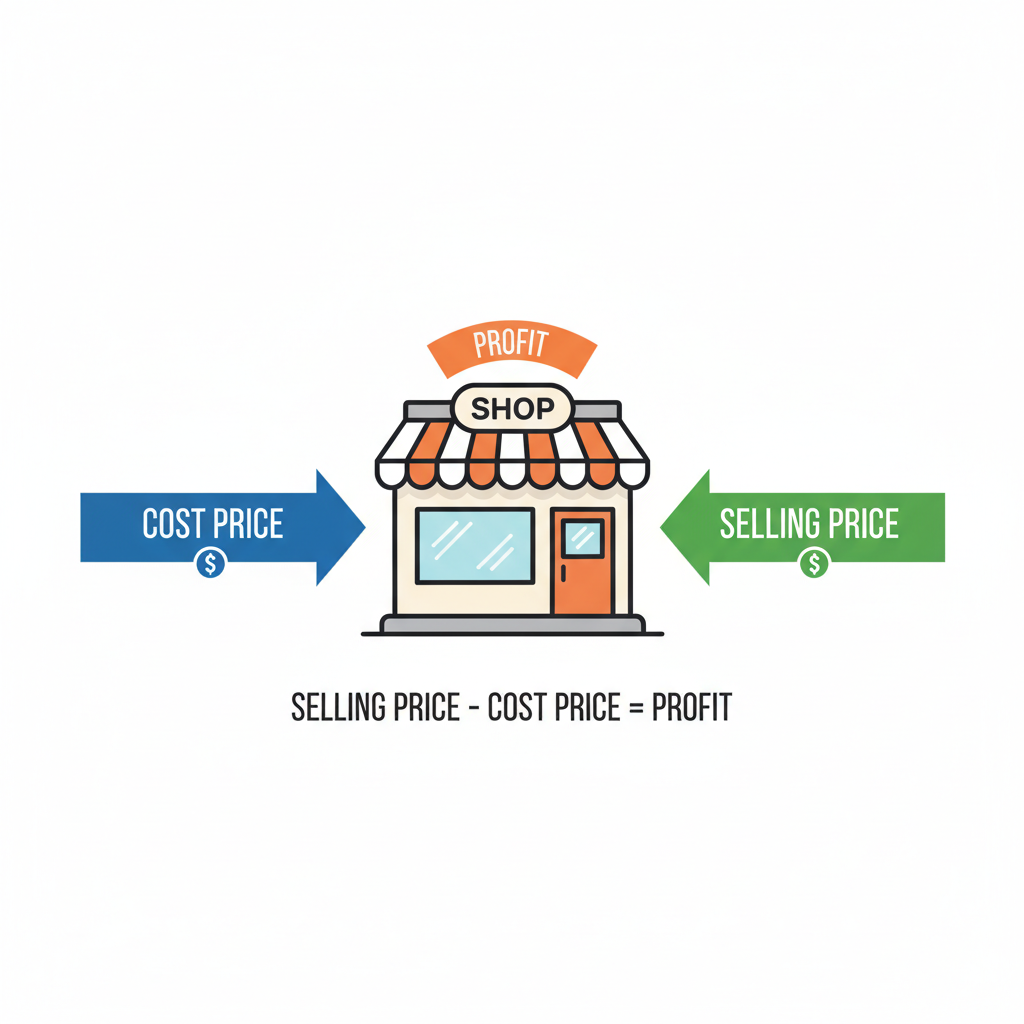
Think of a simple shop. The shopkeeper buys items (this is the CP), and then sells them to customers (this is the SP). If the SP is more than the CP, the shopkeeper is happy because they made a profit! If the SP is less than the CP, the shopkeeper is sad because they made a loss.
Why is this Important in Daily Life?
Understanding profit and loss helps us make smart decisions about money:
- Shopping Wisely: You can figure out if a sale is actually a good deal or if you're paying too much.
- Earning Money: If you want to start a small business (like selling crafts or washing cars), you need to know how to price your services to make a profit.
- Budgeting: It helps you understand where your money is going and how to save more.
Key Terms to Remember:
- Cost Price (CP): The price you pay to buy something.
- Selling Price (SP): The price you sell something for.
- Profit: When SP is greater than CP (SP - CP).
- Loss: When CP is greater than SP (CP - SP).
- Break-Even: When SP equals CP (no profit, no loss).
Keep practicing, and you'll become a money expert in no time!
Keep learning, free
Create a free Syllabax account to unlock practice questions and games for this topic.
Visual Learning Enhanced! 🚀
To help you master this topic, we use Advanced Syllabax AI to generate detailed diagrams and visual models.
Note on Visuals: The AI sometimes makes spelling errors in image labels. Please refer to the lesson text for the correct terminology.