Simple real-life math situations (HOTS)
Watch this topic in 60 seconds
Free preview · Lesson 1
Understanding Simple real-life math situations (HOTS)
Fun with Math in Real Life!
Welcome, super math explorers! Today, we're going on an adventure to discover how math is all around us, even when we don't think we're doing math at all! Think of math like a secret code that helps us understand the world. It’s like being a detective, but instead of clues, we use numbers!
What are Real-Life Math Situations?
Imagine you’re building with LEGOs, sharing cookies with friends, or counting how many toys you have. All of these are real-life math situations! They are times when we use math to solve everyday problems or understand things better. It's not just about numbers in a book; it’s about how numbers help us in our homes, at school, and when we play.
Math is Like Sharing!
Let’s think about sharing. If you have 6 yummy cookies and you want to share them equally with your friend, how many cookies does each person get? This is a math problem! You might count them out, or you might know that 6 divided by 2 is 3. Math helps us share fairly so everyone gets a turn or the same amount. It’s like making sure everyone at a party gets a slice of cake!
Math is Like Building!
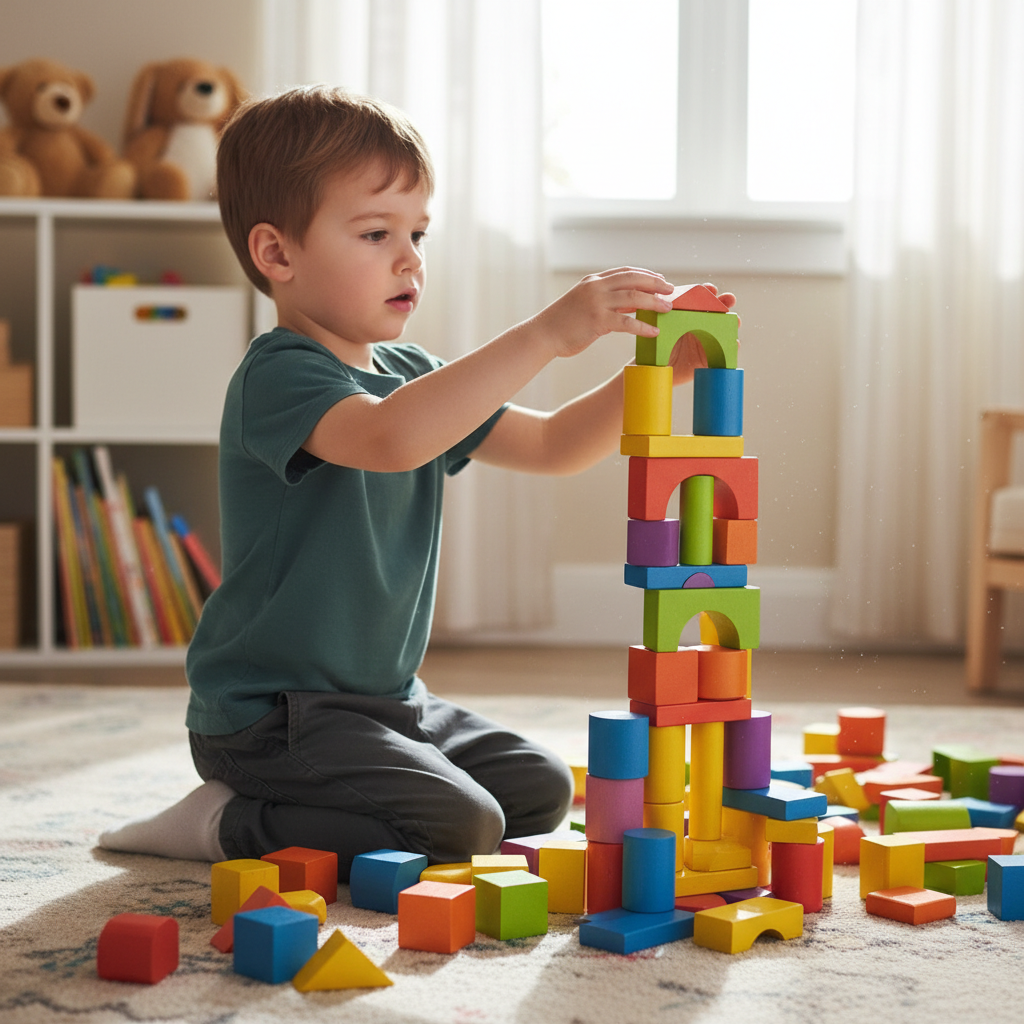
When you build a tall tower with blocks, you are using math! You need to think about how many blocks you have, how tall you want your tower to be, and if it will stand up straight. This involves counting, estimating (guessing how many you might need), and even thinking about shapes. Math helps us build things, big or small, just like a builder uses math to make houses.
 ⚠️ This picture may have spelling mistakes. Trust the words in the lesson.
Math is Like Telling Time!
Have you ever looked at a clock? That’s math! Knowing what time it is helps you know when it’s time to play, time to eat lunch, or time to go to bed. We use numbers to measure time. If your mom says, "We will leave in 10 minutes," you can count the minutes until it's time to go. It's like using a stopwatch to see how fast you can run!
Math is Like Counting Your Money!
When you get allowance or birthday money, you use math to count it. You might want to buy a new toy. You need to know how much money you have and how much the toy costs. If the toy costs more than your money, you know you need to save more. This is called addition and subtraction. It's like having a treasure chest and counting all your shiny coins!
Math is Like Measuring!
Imagine you want to draw a very long line on a big piece of paper. How do you know if it’s long enough? You might use a ruler, which has numbers on it! Or, if you’re helping bake, you might need to measure 1 cup of flour. Measuring is all about using numbers to see how much of something there is, like how tall a plant has grown or how much juice is in a pitcher. It’s like using a measuring tape to see how big your pet is!

Putting it all Together: Hot Tasks for Your Brain!
Sometimes, math problems are like puzzles where you have to think a little harder. These are called Higher Order Thinking Skills (HOTS). They help your brain grow strong and smart!
Example 1: The Busy Bee!
A bee visits 3 flowers in the morning and 5 flowers in the afternoon. How many flowers did the bee visit in total?
To solve this, we need to combine the flowers visited in the morning and the afternoon. We use addition! 3 + 5 = 8. The bee visited 8 flowers!
Example 2: The Sharing Toy Box!
You have 10 toy cars. You want to share them equally with your 4 friends. How many toy cars does each friend get, and how many do you have left over?
This is a bit trickier! We have 10 cars and 4 friends. If we give 1 car to each friend, that's 4 cars. If we give another car to each friend, that's another 4 cars (total 8 cars given away). We can't give another whole car to everyone. So, each friend gets 2 cars (4 friends x 2 cars = 8 cars). You have 10 - 8 = 2 cars left over. Math helps us figure out these sharing puzzles!
Example 3: The Growing Plant!
A tiny seed is planted. On Monday, the plant is 2 centimeters tall. On Tuesday, it grows 3 centimeters taller. On Wednesday, it grows 1 centimeter taller. How tall is the plant after Wednesday?
We start with the height on Monday: 2 cm. Then we add the growth on Tuesday: 2 + 3 = 5 cm. Then we add the growth on Wednesday: 5 + 1 = 6 cm. The plant is 6 centimeters tall!
Why is This Important?
Learning to solve these real-life math problems makes you a super problem-solver! You can understand more about the world around you. You can make smart choices, share fairly, and even help with cooking or building. Math is a superpower that everyone can learn!
Keep learning, free
Create a free Syllabax account to unlock practice questions and games for this topic.
Visual Learning Enhanced! 🚀
To help you master this topic, we use Advanced Syllabax AI to generate detailed diagrams and visual models.
Note on Visuals: The AI sometimes makes spelling errors in image labels. Please refer to the lesson text for the correct terminology.