Water cycle (Water )
Watch this topic in 60 seconds
Free preview · Lesson 1
Understanding Water cycle (Water )
The Amazing Journey of Water: Earth's Never-Ending Water Cycle!
Hey there, young explorers! Have you ever wondered where the rain comes from, or why a puddle disappears on a sunny day? It's all part of an incredible, never-ending adventure that water takes all around our planet! This adventure is called the Water Cycle, and it's how Earth always has fresh water for us to drink, for plants to grow, and for animals to live.
Think of water like a super energetic traveler who loves to explore! It doesn't just sit still; it's always on the move, changing its form and visiting different places. Let's follow water on its grand journey, step by step!
Step 1: Evaporation – Water Takes Flight!
Our story begins with the sun! The sun is like a giant, warm hairdryer for all the water on Earth. When the sun shines on oceans, lakes, rivers, and even puddles, it heats up the water. When water gets warm enough, it doesn't just sit there anymore. It starts to turn into an invisible gas called water vapor.
- Analogy Time!
- Have you ever seen clothes drying on a clothesline? The water seems to vanish, right? It doesn't really vanish; it turns into water vapor and floats up into the air!
- Or maybe you've watched a kettle boil? The steam you see rising is water turning into vapor. Our vast oceans and lakes do this all the time, just on a much, much bigger scale, and without boiling!
- Think about a puddle on the sidewalk after a rain shower. If the sun comes out, the puddle gets smaller and smaller until it's gone. That's evaporation at work!
So, evaporation is when liquid water gets warm and changes into an invisible gas (water vapor) that rises up into the sky. It's like water getting wings and flying up into the air!
Step 2: Condensation – Clouds Begin to Form!
Once the water vapor rises high into the sky, it's a very different place. It gets much, much colder up there! When the warm water vapor meets the cold air, it gets chilly and decides to turn back into tiny, tiny liquid water droplets or even tiny ice crystals. These little droplets and crystals are so small that they can float!
- Analogy Time!
- Have you ever taken a cold drink out of the fridge on a warm day? After a little while, tiny drops of water appear on the outside of the glass. The glass isn't leaking! It's the water vapor in the warm air around the glass touching the cold glass and turning back into liquid water. That's condensation!
- Another example: After a hot shower, the bathroom mirror often fogs up. That's hot water vapor from the shower hitting the cooler mirror and turning back into tiny water droplets, making it cloudy.
- When you breathe out on a very cold day, you might see a little puff of 'smoke.' That's the warm water vapor from your breath hitting the cold air and condensing into tiny water droplets you can see!
These tiny water droplets and ice crystals then gather together with dust and other tiny bits in the air, and guess what they form? That's right – clouds! Clouds are just big groups of these tiny, floating water droplets or ice crystals. They're like big, fluffy cotton balls in the sky, holding all that water!
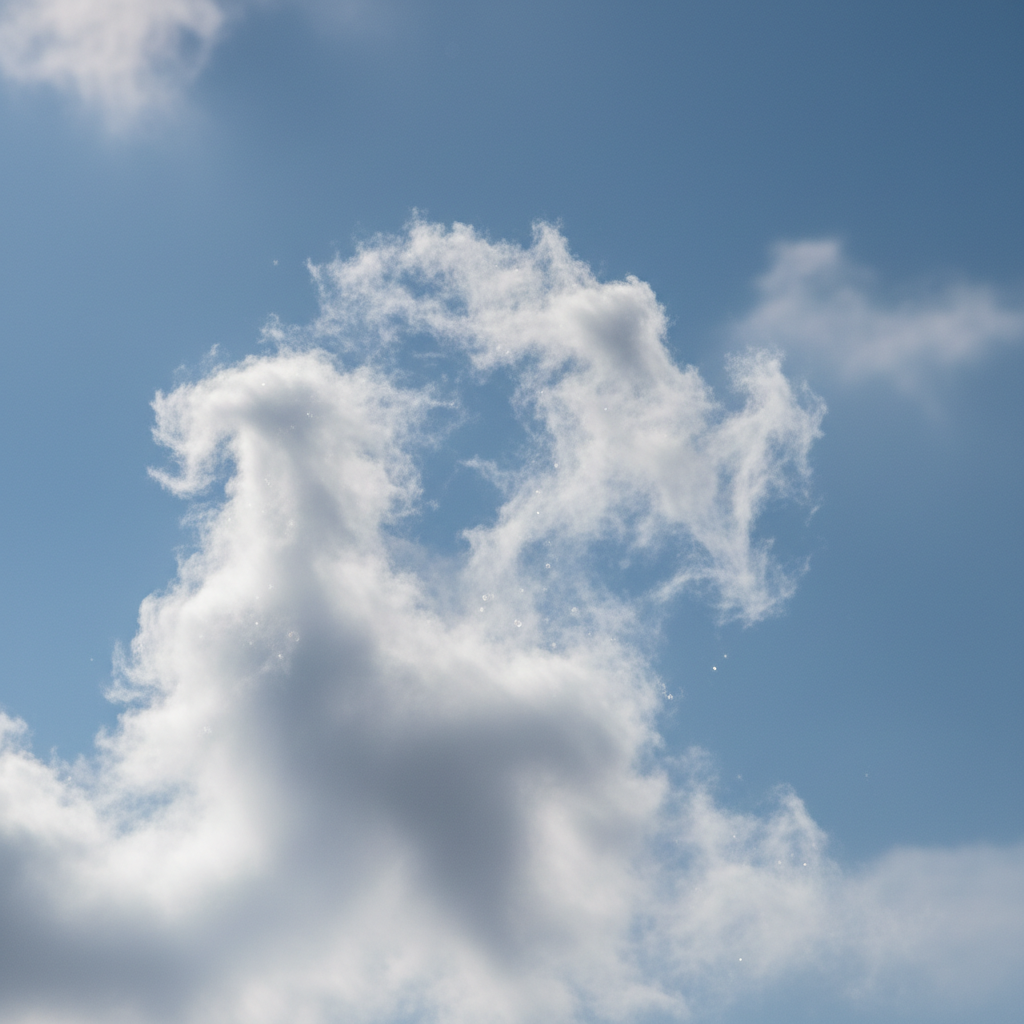 ⚠️ This picture may have spelling mistakes. Trust the words in the lesson.
Step 3: Precipitation – Water Comes Home!
As more and more water vapor condenses, the clouds get bigger and heavier. Imagine a cloud like a giant sponge that's soaking up water. Eventually, the cloud gets so full and so heavy that it can't hold all the water anymore! Just like a full sponge drips, the water has to fall back down to Earth.
This falling water is called precipitation. Precipitation can take many forms, depending on how cold it is in the sky and on the ground:
- Rain: This is the most common kind of precipitation. It happens when the tiny water droplets in the clouds get bigger and heavier and fall as liquid water.
- Snow: If the air in the clouds and all the way down to the ground is very cold, the water vapor turns directly into ice crystals that stick together to form beautiful snowflakes.
- Sleet: Sometimes, rain falls through a layer of freezing cold air on its way down and turns into tiny ice pellets.
- Hail: This is when ice pellets get carried up and down in very strong storm clouds, adding layers of ice, until they get too heavy and fall as lumps of ice.
So, precipitation is when water falls from the sky back to the Earth, usually as rain, snow, sleet, or hail. It's how our planet gets fresh water delivered right to its surface!
Step 4: Collection – The Journey Continues!
Once the water falls back to Earth as precipitation, it has to go somewhere! This is the collection part of the water cycle. The water gathers together in different places, ready to start its journey all over again.
- Some water falls directly into oceans, lakes, and rivers.
- Some water lands on the ground and flows over the surface, often finding its way into streams and then into bigger rivers, which eventually lead to lakes or the ocean. This is called runoff.
- Some water soaks into the ground and becomes groundwater. This water can be stored deep below the surface and slowly make its way back to rivers, lakes, or the ocean, or it can be taken up by plants.
- Puddles are also a form of collection, but as we learned, they don't last long before they evaporate!
So, collection is when all the water that falls back to Earth gathers in oceans, lakes, rivers, and underground, waiting for the sun to warm it up again.
The Never-Ending Loop!
And then what happens? The water collected in the oceans, lakes, and rivers gets warmed by the sun, evaporates, turns into vapor, rises, condenses into clouds, precipitates back down, and collects again! It's a continuous, wonderful loop that never stops. This is why we call it a cycle!
The water cycle is truly amazing! It's nature's way of making sure our Earth always has fresh water. Every drop of water you see, drink, or play in has been on this journey many, many times, and it will continue to travel for millions of years to come. Isn't that incredible?
Keep learning, free
Create a free Syllabax account to unlock practice questions and games for this topic.
Visual Learning Enhanced! 🚀
To help you master this topic, we use Advanced Syllabax AI to generate detailed diagrams and visual models.
Note on Visuals: The AI sometimes makes spelling errors in image labels. Please refer to the lesson text for the correct terminology.