Using a Microphone
Watch this topic in 60 seconds
Free preview · Lesson 1
Understanding Using a Microphone
Welcome to the Wonderful World of Microphones!
Hello, super learners! Have you ever wondered how your teacher's voice gets extra loud sometimes, or how your favorite singer's voice fills a whole stadium? The secret often involves a super cool tool called a microphone! Think of a microphone like a magical ear that helps your voice travel further or get recorded. Isn't that neat?
What is a Microphone? (It's a Sound Catcher!)
Imagine you have a tiny, invisible friend who is an expert at catching sounds. That's kind of what a microphone does! A microphone is a special device that hears your voice and other sounds, and then turns them into a tiny electrical signal. This signal can then be made much, much louder or saved for later, like recording a message or a song.
Think of your own ears. They catch sounds all day long, right? A microphone is like a giant, super-sensitive ear, especially designed to pick up sounds you make. When you speak, tiny vibrations, like invisible ripples in water, come out of your mouth. These ripples are called sound waves. The microphone catches these waves, just like a fishing net catches fish! It gathers up all those sound ripples and sends them on a special journey to be made louder or saved.
Why Do We Use Microphones? (Making Voices BIG!)
We use microphones for lots of reasons! Here are some big ones:
- To Make Voices Louder: Have you ever been in a big room or outside and tried to talk to someone far away? It's hard to hear each other! A microphone can make your voice so much louder, helping everyone hear you clearly. It's like having a superpower that lets you shout without actually shouting! Your normal speaking voice can suddenly fill a whole room, just like magic.
- To Record Sounds: Sometimes we want to save sounds, like a special message for grandma, a song you sang, or even just our own voice practicing reading. A microphone helps us "catch" these sounds and store them on a computer or a recording device. It's like taking a picture, but for sounds instead of sights! You can listen to them again and again later.
- For Fun and Learning: Microphones are used in so many fun places! Think about karaoke, where you sing along to your favorite songs. They're used for making videos, like when YouTubers talk to their audience. They're also used for podcasts (which are like radio shows you can listen to anytime) and even talking to friends online in a video game. In school, your teacher might use one to make sure everyone hears story time, or you might use one for a special presentation about your favorite animal.
Getting to Know Your Microphone: Simple Parts
Most microphones, especially the kind you'll use, have a few simple parts:
- The Grille (where you talk!): This is the top part, usually a metal mesh or a screen. This is the "mouth" of the microphone, where you aim your voice. Inside, there's a tiny part that actually "hears" the sound waves and turns them into that electrical signal. It's like the part of your ear that wiggles when sounds come in!
- The Body: This is the part you hold! It protects the inside parts and makes it easy to handle. It's like the handle of a toothbrush – it helps you hold it just right.
- The Wire (or Wireless magic!): Many microphones have a wire that connects them to a speaker or a recording machine. This wire is like a super highway for the sound signals, carrying them quickly from the microphone to where they need to go. Some microphones are wireless, meaning they send signals through the air, like magic radio waves! But they still need to connect to a receiver somewhere.
- The Plug: At the end of the wire, there's a plug that fits into a special hole on a speaker, computer, or recording device. This is how the microphone "talks" to other machines and shares the sounds it has caught. It's like plugging in a lamp – you need to connect it to the power (or in this case, the sound system) for it to work!

How to Be a Microphone Master! (Using It Just Right)
Using a microphone is easy once you know a few tricks. Here are the golden rules:
Rule #1: The Perfect Distance (Not Too Close, Not Too Far!)
Imagine you're telling a secret. You wouldn't shout it from across the room, right? And you wouldn't whisper it directly into someone's ear so loudly it tickles! Microphones are a bit like that.
- Not Too Close: If you hold the microphone right against your mouth, your voice can sound fuzzy, distorted, or too loud and "buzzy." It's like shouting directly into someone's ear – it's uncomfortable and can hurt their ears! The microphone gets overwhelmed. Try to keep it about a fist's distance away from your mouth.
- Not Too Far: If you hold the microphone too far away, it won't be able to catch your sound waves very well, and your voice will still sound quiet. It's like trying to talk to a friend across a playground without raising your voice – they won't hear you! The sound waves get too weak before they reach the microphone.
- Just Right: The best spot is usually about 4-6 inches away, which is about the size of your fist held between your mouth and the microphone. Experiment a little to find the "sweet spot" where your voice sounds clear and strong, and everyone can hear you comfortably.
Rule #2: Speak Clearly and Naturally (Like You Usually Talk!)
You don't need to shout into a microphone! In fact, shouting can make your voice sound harsh and unpleasant through the speakers. Just speak in your normal, clear voice. Pretend you're talking to a friend sitting right next to you, but remember the microphone is helping your voice reach everyone else in the room or even far away. Let the microphone do the hard work of making your voice loud!
Rule #3: Don't Tap or Blow (Microphones are Sensitive!)
Microphones are very sensitive. That means they can hear even tiny sounds, even sounds you might not think are important. Tapping on the microphone or blowing into it can make a very loud, unpleasant "POP!" or "THUMP!" sound for everyone listening. It's like a sudden, loud clap right next to their ear! This can hurt listeners' ears and damage the microphone or speakers. Always be gentle with microphones, just like you would with a delicate toy.
Rule #4: Point it at Your Voice (Aim for the Grille!)
Remember the grille? That's the part that "hears" your voice. Make sure you're pointing the microphone towards your mouth, so your sound waves can easily travel into it. Don't point it at the floor or the ceiling if you want people to hear you! Think of it like a flashlight – you point the light where you want it to shine, and you point the microphone where you want it to hear. The sound waves need to go straight into that grille.
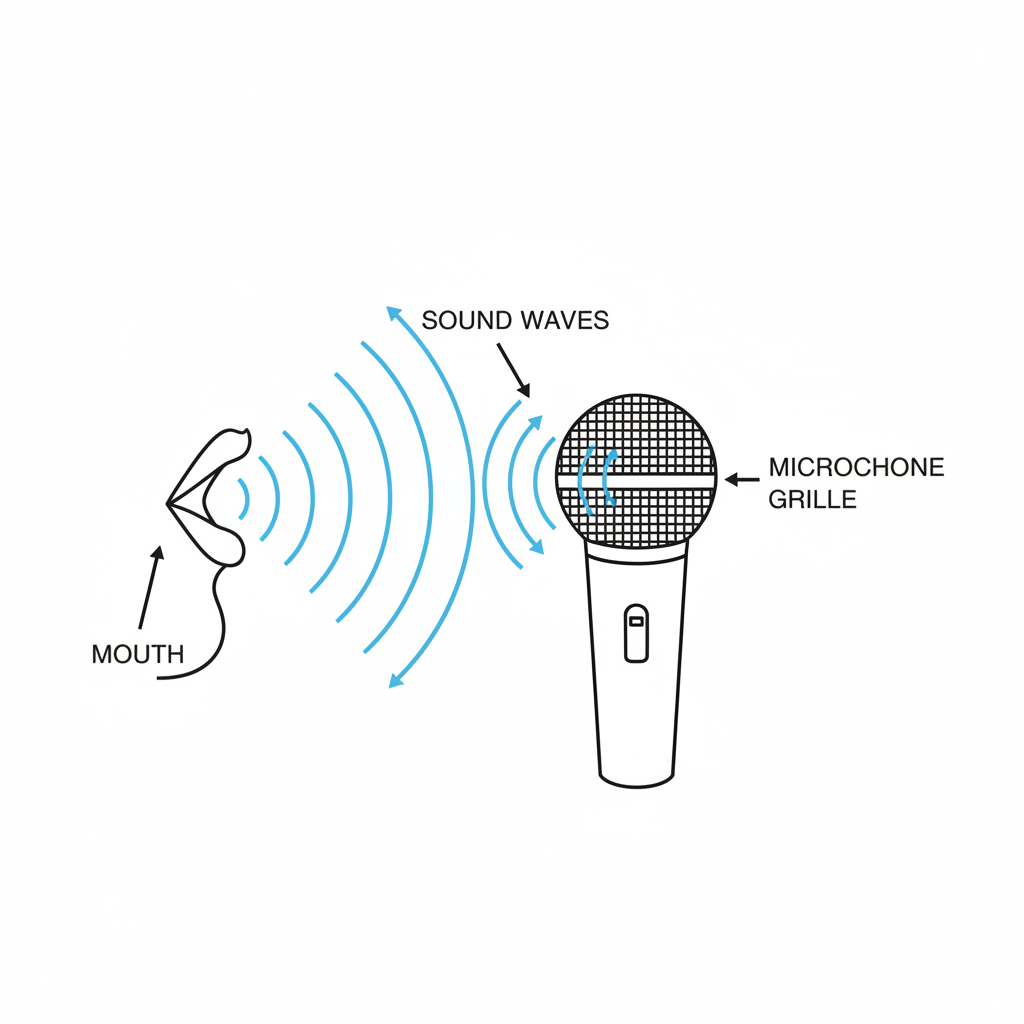 ⚠️ This picture may have spelling mistakes. Trust the words in the lesson.
Connecting Your Microphone (Getting Ready to Be Heard!)
If you have a microphone with a wire, you'll need to plug it into the right place. This place is usually called an "input jack" or "mic input." It often looks like a small round hole, and sometimes it even has a little picture of a microphone next to it. Your teacher or an adult will show you exactly where to plug it in. It's like plugging in a lamp – you need to connect it to the power (or in this case, the sound system) for it to work and for your voice to be heard!
Microphone Manners (Being a Good Listener and Speaker)
When you're using a microphone, especially in a group, it's good to remember some manners:
- Take Turns: If many people are using one microphone, wait patiently for your turn. Everyone will get a chance to share their voice!
- Listen to Instructions: Your teacher or adult will tell you how to use the microphone for that specific activity. Listen carefully to their directions so you can use it correctly and safely.
- Be Respectful: Remember that everyone can hear you when you're using a microphone, so use kind words and speak respectfully. It's a powerful tool, and we want to use it for good!
You Are a Microphone Pro!
Wow! You've learned so much about microphones. You know what they are, why we use them, their simple parts, and most importantly, how to use them like a pro. Keep practicing, and soon you'll be using microphones with confidence, making your voice heard loud and clear!
Next time you see a microphone, you'll know it's not just a fancy stick, but a powerful tool that helps us share our voices with the world!
Keep learning, free
Create a free Syllabax account to unlock practice questions and games for this topic.
Visual Learning Enhanced! 🚀
To help you master this topic, we use Advanced Syllabax AI to generate detailed diagrams and visual models.
Note on Visuals: The AI sometimes makes spelling errors in image labels. Please refer to the lesson text for the correct terminology.