Mixtures & pure substances[CHEMISTRY]
Watch this topic in 60 seconds
Free preview · Lesson 1
Understanding Mixtures & pure substances[CHEMISTRY]
Mixtures vs. Pure Substances: A Chemistry Adventure!
Welcome, young scientists, to an exciting exploration of the world around us! Everything we can see, touch, and even smell is made up of tiny building blocks. Today, we're going to learn about two fundamental ways these building blocks are put together: as pure substances and as mixtures.
What is a Pure Substance?
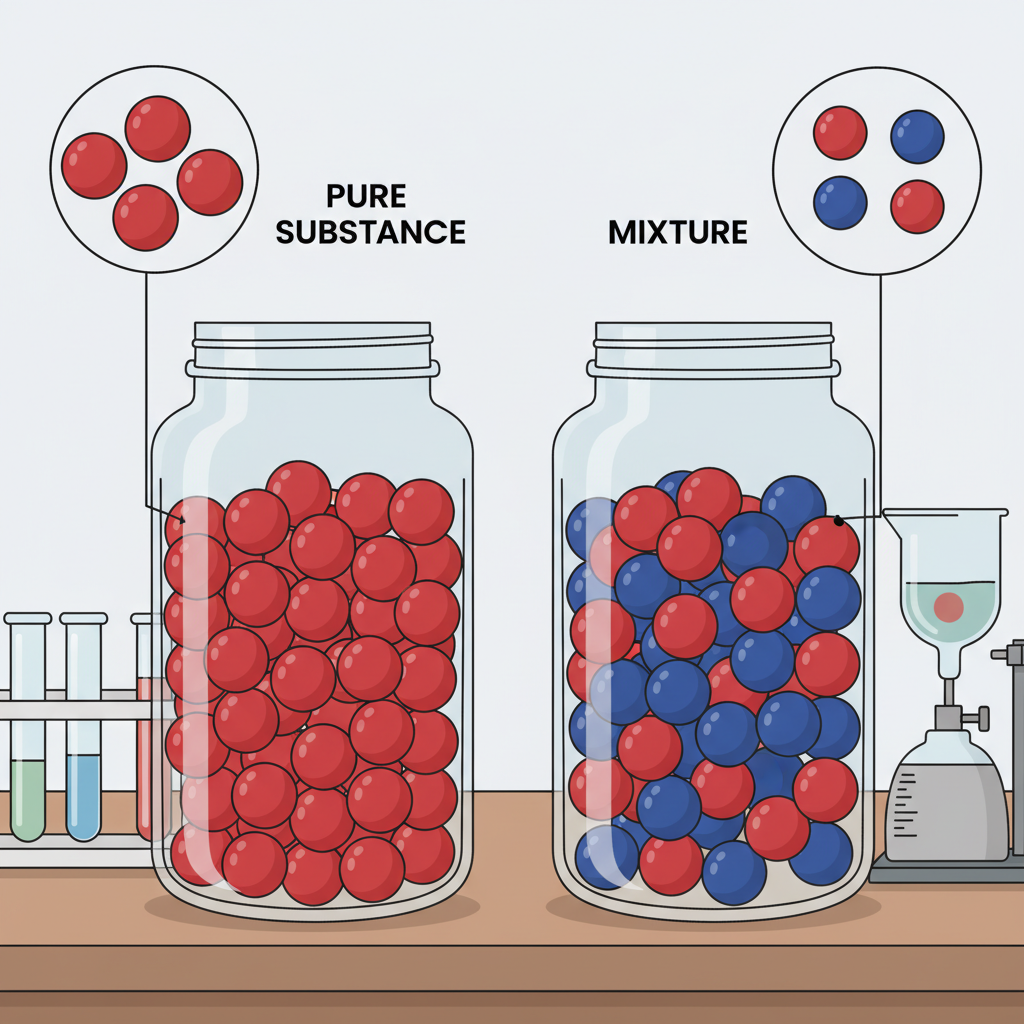
Imagine you have a bag of only shiny, red marbles. Every single marble is identical – they are all red and all marbles. That bag of marbles is like a pure substance. A pure substance is something that is made up of only one type of particle. These particles can be individual atoms or groups of atoms joined together (called molecules).
Think of it like a special ingredient that can't be broken down into simpler parts by physical means. Here are some examples:
- Water (H₂O): Even though it looks simple, pure water is made up of only water molecules. Each water molecule has two hydrogen atoms and one oxygen atom bonded together. It doesn't matter if it's liquid water, ice, or steam – it's still pure water!
- Gold (Au): A pure gold ring is made up of only gold atoms.
- Salt (NaCl): Table salt is made up of sodium (Na) and chlorine (Cl) atoms, but they are always bonded together in a specific way to form salt compounds.
- Oxygen gas (O₂): The oxygen we breathe is made up of only oxygen molecules, where two oxygen atoms are bonded together.
Key characteristics of pure substances:
- They have a fixed composition. This means the ratio of atoms or molecules is always the same. For example, water is *always* H₂O, never H₃O or HO.
- They have distinct properties, like a specific melting point and boiling point. Pure water boils at 100°C (at sea level) and freezes at 0°C. These temperatures don't change unless the substance is impure.
Analogy: The Building Blocks. Think of atoms and molecules as LEGO bricks. A pure substance is like a structure built using only one color and shape of LEGO brick. For example, a wall made entirely of red 2x4 bricks.
What is a Mixture?
Now, imagine you have a bag with both shiny red marbles and shiny blue marbles. You have two different types of things mixed together. This is like a mixture. A mixture is when two or more different substances are combined, but they are not chemically bonded together.
The substances in a mixture keep their own identities and properties. You can usually separate them using physical methods.
Let's look at some common mixtures:
- Salad: A salad is a mixture of lettuce, tomatoes, cucumbers, and dressing. Each ingredient is still itself. You can pick out the tomatoes if you want!
- Air: The air we breathe is a mixture of gases like nitrogen, oxygen, argon, and carbon dioxide. They are all floating around together, but they haven't chemically joined to form new substances.
- Saltwater: When you dissolve salt in water, you create a mixture. The salt and water are together, but they are not chemically stuck to each other. You can evaporate the water to get the salt back.
- Trail Mix: A delicious mix of nuts, seeds, dried fruit, and chocolate chips! Each part is still its own thing.
Analogy: The LEGO Bucket. A mixture is like a big bucket filled with different types and colors of LEGO bricks – red ones, blue ones, yellow ones, square ones, long ones. They are all in the same bucket, but they aren't permanently stuck together to form one new thing. You can easily pull out the blue bricks or the square bricks.
Types of Mixtures
Mixtures can be further divided into two main types:
1. Homogeneous Mixtures (Solutions)
A homogeneous mixture is a mixture where the composition is uniform throughout. This means it looks the same everywhere you look. It's like everything is perfectly blended!
Analogy: Smoothies. A perfectly blended fruit smoothie is a great example. Once blended, you can't see the individual pieces of banana, strawberry, or yogurt. It all looks like one uniform drink.
- Saltwater: Once the salt dissolves, you can't see the salt crystals anymore. The salty taste is spread evenly throughout the water.
- Steel: An alloy (mixture of metals) of iron and carbon. It looks like one uniform metal.
- Vinegar: A mixture of acetic acid and water.
These are often called solutions. In a solution, one substance (the solute, like salt) dissolves into another substance (the solvent, like water).
2. Heterogeneous Mixtures
A heterogeneous mixture is a mixture where the composition is not uniform. You can see different parts or components of the mixture. They are not evenly spread out.
Analogy: Cereal with Milk. Imagine a bowl of cereal with milk. You can clearly see the individual pieces of cereal and the milk. They are mixed, but not blended uniformly. You can also see if there are more marshmallows than cereal bits in one spoonful.
- Sand and water: The sand particles don't dissolve and will settle at the bottom. You can see the sand and the water separately.
- Pizza: You can see the cheese, sauce, crust, and toppings as distinct parts.
- Concrete: A mixture of cement, sand, gravel, and water. You can see the different components.
Key Differences Summarized
Here’s a quick way to remember the main differences:
| Feature | Pure Substance | Mixture |
|---|---|---|
| Composition | Only one type of particle (atom or molecule) | Two or more different substances combined |
| Bonding | Atoms/molecules are chemically bonded (if it's a compound) or are identical atoms | Substances are physically combined, not chemically bonded |
| Separation | Cannot be separated by physical means (requires chemical reactions) | Can often be separated by physical means (filtering, evaporation, etc.) |
| Properties | Fixed melting/boiling points | Melting/boiling points can vary |
| Appearance | Uniform throughout (if pure) | Can be uniform (homogeneous) or have visible parts (heterogeneous) |
Understanding the difference between pure substances and mixtures is a fundamental step in chemistry. It helps us describe and understand all the matter that makes up our universe!
Keep learning, free
Create a free Syllabax account to unlock practice questions and games for this topic.
Visual Learning Enhanced! 🚀
To help you master this topic, we use Advanced Syllabax AI to generate detailed diagrams and visual models.
Note on Visuals: The AI sometimes makes spelling errors in image labels. Please refer to the lesson text for the correct terminology.