Probability of Simple Events
Watch this topic in 60 seconds
Free preview · Lesson 1
Understanding Probability of Simple Events
Unlocking the Chances: Probability of Simple Events for 7th Graders
Welcome, future math whizzes! Have you ever wondered what the chances are of winning a game, or if it will rain tomorrow? These questions are all about probability! Probability is a super cool part of math that helps us understand how likely it is for something to happen. It's like being a detective trying to figure out the odds!
What is Probability, Really?
At its heart, probability is just a way to measure the likelihood of an event occurring. It's a number that tells us if something is more likely, less likely, or equally likely to happen compared to other possibilities.
Analogy Time! The Weather Forecaster
Think about a weather forecaster. When they say there's a "70% chance of rain," they're using probability! They're telling you that out of 100 similar days, 70 of them ended up with rain. It doesn't mean it WILL rain for sure, but it's pretty likely!
Key Ingredients for Understanding Probability
Before we jump into calculating probabilities, let's learn some essential vocabulary. These are like the building blocks of our probability adventure!
1. Experiment or Trial
An experiment or trial is any action or process that has a clear, well-defined result. It's what you do.
- Example: Flipping a coin, rolling a die, spinning a spinner, drawing a card from a deck.
Analogy Time! The Game You Play
Imagine you're playing a board game. Each time you roll the die, that's an experiment! You're performing an action to see what result you get.
2. Outcome
An outcome is one possible result of an experiment. It's what can happen.
- Example: If you flip a coin, the outcomes are "Heads" or "Tails". If you roll a standard six-sided die, the outcomes are 1, 2, 3, 4, 5, or 6.
3. Sample Space
The sample space is the list or set of ALL possible outcomes for an experiment. It's everything that could possibly happen.
- Example: For a coin flip, the sample space is {Heads, Tails}. For a standard die roll, the sample space is {1, 2, 3, 4, 5, 6}.
Analogy Time! All the Toys in the Box
Imagine you have a toy box filled with different toys. The sample space is like a list of every single toy inside that box. If you close your eyes and pick, any one of those toys is a possible outcome.
4. Event (and Simple Event)
An event is one or more outcomes that you are interested in. It's what you are looking for.
A simple event is an event that consists of only one outcome. It's the simplest thing you can be looking for!
- Example (Simple Event): Getting "Heads" when flipping a coin. Rolling a "4" on a die. Drawing a red marble from a bag.
- Example (Not a Simple Event - but good to know for later!): Rolling an "even number" on a die (this includes 2, 4, or 6 – three outcomes).
Analogy Time! Your Favorite Toy
Going back to the toy box: if the sample space is all the toys, then an event is like wanting to pick a specific type of toy, say, a car. A simple event would be wanting to pick *just one particular* car, like your favorite blue race car.
The Golden Rule: How to Calculate Simple Probability
Now for the exciting part! To find the probability of a simple event, we use a simple formula:
P(Event) = (Number of Favorable Outcomes) / (Total Number of Possible Outcomes)
- P(Event) means "The Probability of the Event happening."
- Favorable Outcomes are the outcomes you are interested in (the ones that match your event).
- Total Possible Outcomes is the size of your sample space – all the things that could happen.
Let's see it in action with an image!
Imagine a spinner with different colored sections. What's the probability of landing on a specific color?
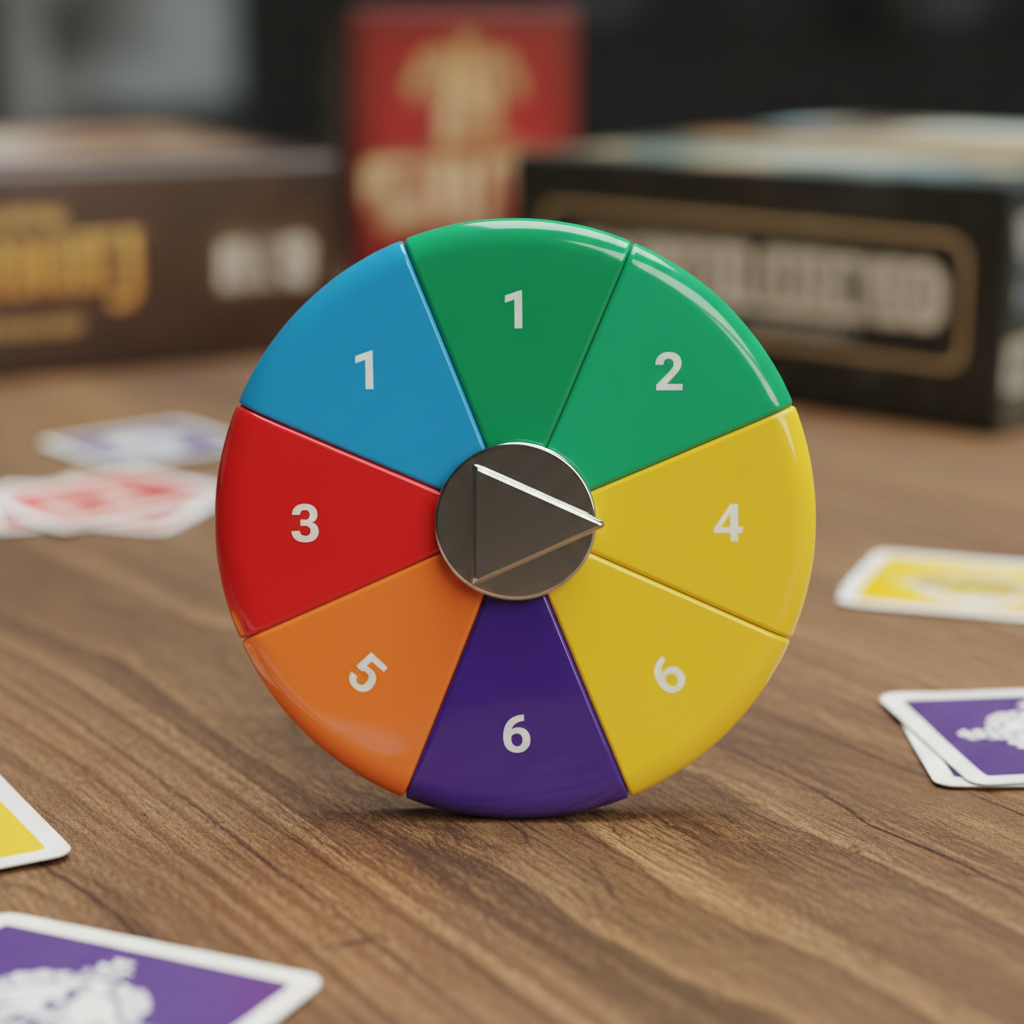
In this spinner, there are 6 equally sized sections, each a different color (red, blue, green, yellow, orange, purple).
- Total Possible Outcomes: 6 (because there are 6 sections).
- Event: Landing on "Red".
- Number of Favorable Outcomes: 1 (because there's only one red section).
- P(Landing on Red) = 1/6
Probability's Scale: From Impossible to Certain
Probabilities are always numbers between 0 and 1, inclusive. You can write them as fractions, decimals, or percentages.
- 0 (or 0%): Means the event is Impossible. It will definitely not happen.
- 1 (or 100%): Means the event is Certain. It will definitely happen.
- 1/2 (or 0.5 or 50%): Means the event is Equally Likely to happen or not happen. It's a "fifty-fifty" chance!
Analogy Time! The Probability Ramp
Think of a ramp. At the very bottom (0), it's impossible to climb. At the very top (1), you've already reached your goal, it's certain! In the middle (0.5), it's a bit of a climb, but you have an equal chance of making it or not. You can't go below the bottom or above the top!
Let's Practice with More Examples!
Example 1: Rolling a Die
You roll a standard six-sided die. What is the probability of rolling a 3?
- Experiment: Rolling a die.
- Sample Space: {1, 2, 3, 4, 5, 6} -> Total Possible Outcomes = 6
- Event: Rolling a 3.
- Favorable Outcomes: {3} -> Number of Favorable Outcomes = 1
- P(Rolling a 3) = 1/6
Example 2: Picking a Marble
A bag contains 4 red marbles, 3 blue marbles, and 3 green marbles. If you pick one marble without looking, what is the probability that it is a blue marble?
- Experiment: Picking a marble from the bag.
- Total Marbles: 4 (red) + 3 (blue) + 3 (green) = 10 marbles -> Total Possible Outcomes = 10
- Event: Picking a blue marble.
- Favorable Outcomes: 3 (blue marbles) -> Number of Favorable Outcomes = 3
- P(Picking a Blue Marble) = 3/10
Example 3: Spin the Wheel (Different Section Sizes)
Imagine a spinner divided into 8 equal sections. Two sections are yellow, three are blue, and three are red. What is the probability of landing on a yellow section?
- Experiment: Spinning the wheel.
- Total Sections: 8 -> Total Possible Outcomes = 8
- Event: Landing on a yellow section.
- Favorable Outcomes: 2 (yellow sections) -> Number of Favorable Outcomes = 2
- P(Landing on Yellow) = 2/8. This can be simplified to 1/4.
Wrapping Up
Understanding the probability of simple events is your first step into a fascinating world of chance and prediction! Remember these core ideas:
- Probability helps us measure how likely an event is to happen.
- It's always a number between 0 (impossible) and 1 (certain).
- You calculate it by dividing the number of favorable outcomes by the total number of possible outcomes.
Keep practicing, and you'll be a probability pro in no time!
Keep learning, free
Create a free Syllabax account to unlock practice questions and games for this topic.
Visual Learning Enhanced! 🚀
To help you master this topic, we use Advanced Syllabax AI to generate detailed diagrams and visual models.
Note on Visuals: The AI sometimes makes spelling errors in image labels. Please refer to the lesson text for the correct terminology.