Learning Journey
Watch this topic in 60 seconds
Free preview · Lesson 1
Understanding Giving Directions to a Robot (Unplugged)
Welcome, Super Direction Givers! Let's Learn About Robots!
Have you ever tried to tell a friend how to find your favorite toy? Or how to get to the swings at the park? When you do that, you are giving directions! Directions are like a map made of words, telling someone exactly how to get from one place to another.
Analogy Time! Giving Directions to a Friend
Imagine your friend, Lily, wants to find your red car toy. You might say: "Go two big steps forward, then turn to your right, and then take one more step!" If your directions are clear and exact, Lily will find the toy!
Meet Robby the Robot!
Today, we're going to pretend we have a special friend named Robby the Robot. Robby is super cool, but there's something important about Robby: Robby only understands EXACT directions! Robby can't guess what you mean. If you tell Robby to "go over there," Robby will just stand still because "over there" isn't exact enough!
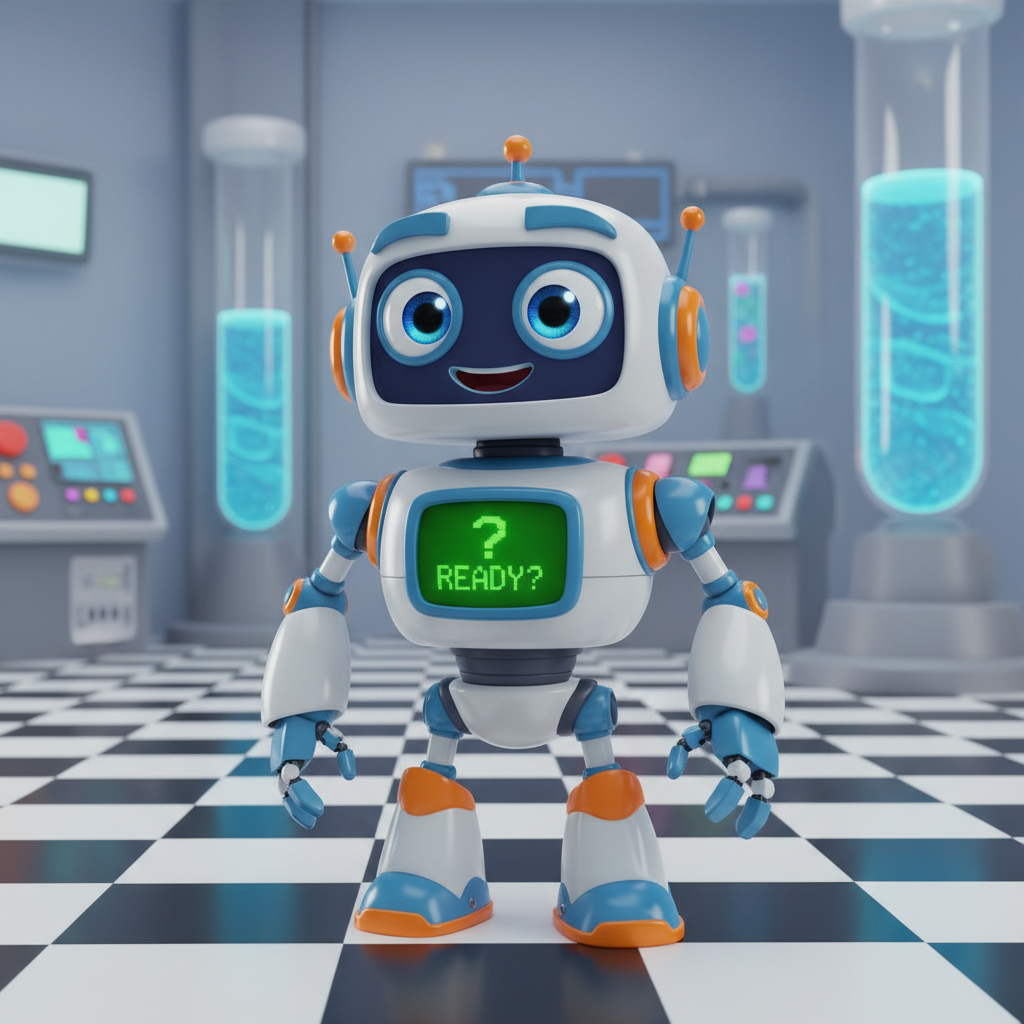
Robot Tip #1: Robots Need Super Clear Words!
Robby is not like a person. Robby doesn't know to look around or figure things out. Robby only knows a few special words, and you have to use them perfectly!
Robby's Special Movement Words:
Let's learn the four most important words Robby understands:
-
1. Forward!
When you tell Robby to go FORWARD, it means to move straight ahead, in the direction Robby's nose is pointing. Think of it like walking straight ahead to get a cookie from the kitchen!
You can say: "Forward 1 step," or "Forward 3 steps."
Analogy: Imagine you are standing at the starting line of a race. When the teacher says "Go!", you run forward to the finish line!
-
2. Backward!
When you tell Robby to go BACKWARD, it means to move straight behind, away from where Robby's nose is pointing. Think of it like walking backwards to sit down in your chair!
You can say: "Backward 1 step," or "Backward 2 steps."
Analogy: You are at the edge of a puddle. To avoid getting wet, you take a big step backward!
-
3. Turn Left!
When you tell Robby to TURN LEFT, Robby will spin around to face the left side. Robby won't move forward or backward yet, just turn! Think of it like when you turn your whole body to look at something on your left side.
Analogy: You are walking and see a yummy ice cream truck on your left. You turn left to go towards it!
-
4. Turn Right!
When you tell Robby to TURN RIGHT, Robby will spin around to face the right side. Again, Robby won't move forward or backward, just turn! Think of it like when you turn your whole body to look at something on your right side.
Analogy: You are drawing a picture and need a red crayon. You turn right to face your crayon box!
Robot Tip #2: Order, Order, Order!
The order of your directions is super, super important! Robby will do exactly what you say, in the exact order you say it. If you tell Robby to "Turn Left" and then "Forward 3 steps," Robby will turn first, then walk. If you said "Forward 3 steps" and THEN "Turn Left," Robby would walk straight and then turn in a different spot!
Analogy: Think about getting ready for school. First, you brush your teeth, then you eat breakfast, then you put on your clothes. If you do it in the wrong order (like brushing your teeth AFTER you leave for school!), it just doesn't work right!
Let's Practice Being a Robot! (Unplugged Activity)
The best way to learn to give directions to a robot is to pretend! You can do this with a friend, a grown-up, or even your favorite stuffed animal!
- Draw a Path: On a big piece of paper or a mat, draw a simple path with a "Start" and an "End." You can draw obstacles too, like a pretend "river" or "tree."
- Be the Robot: Ask a friend or a grown-up to be the "robot." They close their eyes (or wear a blindfold if it's safe and they agree!) or just don't look at the path. They only listen to your voice.
- Give Commands: You are the programmer! Give the robot directions using only our special words: "Forward X steps," "Backward X steps," "Turn Left," "Turn Right." Remember to say how many steps if it's Forward or Backward!
- Watch and Learn: Watch where your "robot" goes. If they go off the path, that means your directions weren't exact enough! Try again!
 ⚠️ This picture may have spelling mistakes. Trust the words in the lesson.
Why is this important?
Learning to give clear, exact directions is a super important skill! It's not just for robots. It helps you tell stories clearly, explain how to play a game, or even help a grown-up find something in the house. You're learning to think like a computer scientist, breaking big tasks into small, easy steps!
Keep practicing, and you'll be a master robot programmer in no time!
Keep learning, free
Create a free Syllabax account to unlock practice questions and games for this topic.
Visual Learning Enhanced! 🚀
To help you master this topic, we use Advanced Syllabax AI to generate detailed diagrams and visual models.
Note on Visuals: The AI sometimes makes spelling errors in image labels. Please refer to the lesson text for the correct terminology.