Learning Journey
Watch this topic in 60 seconds
Free preview · Lesson 1
Understanding Data Collection Methods: Experiments
Unveiling the Secrets: Data Collection Through Experiments (Grade 9 Foundational)
Hey future scientists and curious minds! Have you ever wondered how we figure out if a certain medicine really cures a sickness, or if a new study method actually helps students get better grades? How do we know if one thing causes another? This isn't just about guessing or observing; it's often about a special way of collecting information called an Experiment!
What is Data Collection? (A Detective's Work!)
Imagine you're a detective. To solve a mystery, you need clues, right? Those clues are like 'data.' Data is simply information, facts, or statistics that we collect and analyze. We collect data all the time – from checking the weather forecast to seeing how many points your favorite basketball team scored. But not all data collection methods are the same, and some are better at answering specific kinds of questions.
Enter the Experiment: Your Superpower for Cause-and-Effect!
While other data collection methods (like surveys or observations) are great for describing things or finding patterns, an experiment is like having a superpower. It's the best way to figure out if one thing causes another thing to happen. Think of it like this: if you want to know if a specific type of plant food makes a plant grow taller, you don't just give it to your plants and hope for the best. You set up a careful test – an experiment!
Analogy Time! The "Super-Bounce Sneaker" Test
Let's say a company claims their new "Super-Bounce Sneakers" make you jump higher. How do we test this? We can't just ask people who bought them if they feel bouncier (that's an opinion!). We need to conduct an experiment!
The Building Blocks of an Experiment: Variables
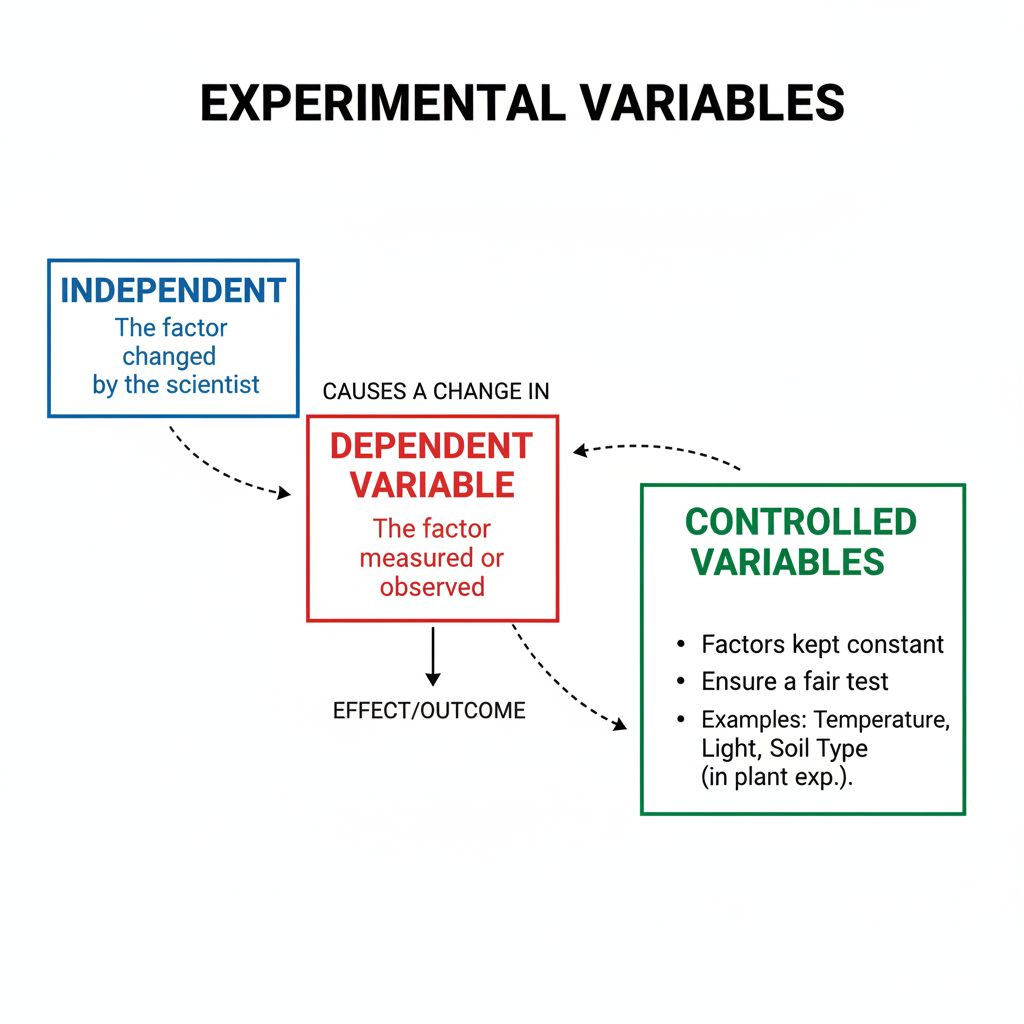
In science, when we talk about experiments, we often use the word 'variables.' A variable is anything that can change or vary in an experiment. Think of it like the different dials and buttons on a control panel. You change some, and others respond.
There are three main types of variables you need to know:
-
1. The Independent Variable (IV): The 'Cause' (What YOU Change!)
This is the one thing you, the experimenter, intentionally change or manipulate. It's the 'cause' you are testing. In our "Super-Bounce Sneaker" example, what are we changing? The type of shoe! We're giving some people the Super-Bounce Sneakers and others different shoes. That's our Independent Variable!
Analogy: Think of your TV remote control. The Independent Variable is like the button you press (e.g., 'Channel Up'). You choose to press it.
-
2. The Dependent Variable (DV): The 'Effect' (What YOU Measure!)
This is what you observe or measure to see if it changes because of your independent variable. It's the 'effect.' In our sneaker test, what are we hoping to see change? How high people can jump! So, the height of the jump is our Dependent Variable. It 'depends' on what you did with the independent variable.
Analogy: Still with the TV remote, the Dependent Variable is like the channel that actually changes on the screen. It changes because you pressed the button.
-
3. Controlled Variables: Keeping Things Fair (What You Keep the Same!)
These are all the other things that could potentially affect your results, but you want to keep them constant or the same for everyone in the experiment. Why? Because if these things change, you won't know if your results are due to your independent variable or something else! In our sneaker test, what should we keep the same?
- The jumping surface (same type of floor)
- The way we measure the jump (e.g., measuring tape, consistent technique)
- The people jumping (similar fitness levels, same person does all jumps)
- The environment (same room temperature, no distractions)
If we let some people jump on a trampoline and others on concrete, we wouldn't know if the shoes or the surface made the difference!
Analogy: For the TV remote, controlled variables are things like making sure the TV is plugged in, the remote has working batteries, and there are no objects blocking the signal. If any of these change, your button press (IV) might not lead to a channel change (DV).
Two Essential Groups: Experimental vs. Control
To really prove cause and effect, you can't just test your new idea on one group. You need something to compare it to! That's where two special groups come in:
-
1. The Experimental Group: The 'Treatment' Group
This group receives the special treatment, the new thing you are testing – in other words, they get the independent variable applied to them. In our "Super-Bounce Sneaker" experiment, this would be the group of people who wear the Super-Bounce Sneakers.
-
2. The Control Group: The 'Comparison' Group
This group does not receive the special treatment or independent variable. Instead, they either get no treatment, a standard treatment, or a placebo (a fake treatment). They are essential for comparison! If the experimental group shows a big change, but the control group doesn't, then you have good evidence that your independent variable caused the change. For our sneaker test, the control group would be people who wear their regular sneakers, or even just a standard, non-bouncy pair of sneakers.
Analogy: Imagine tasting a new flavor of ice cream. The Experimental Group gets the new flavor. The Control Group gets the original vanilla flavor. Without tasting the original, how would you know if the new one is truly different or better?
Fairness is Key: Random Assignment
Okay, so we have our groups. But how do we decide who goes into the Super-Bounce sneaker group and who goes into the regular sneaker group? We can't just pick our friends who are already great jumpers for the Super-Bounce group, right? That wouldn't be fair, and it would mess up our results!
This is where random assignment comes in. It means assigning participants to either the experimental group or the control group purely by chance (like flipping a coin or drawing names from a hat). This helps to make sure that, on average, both groups are as similar as possible at the start of the experiment. This way, any differences we see at the end are more likely due to our independent variable and not some other hidden factor.
Putting It All Together: A Simple Experiment Example
Let's say you want to know if playing specific study music (like classical) improves test scores.
- Question: Does classical music improve test scores for 9th graders?
- Hypothesis (your educated guess): Yes, students who listen to classical music will score higher on a test than those who don't.
- Independent Variable (IV): Presence or absence of classical music during the test.
- Dependent Variable (DV): The test scores of the students.
- Controlled Variables: The difficulty of the test, the test duration, the quietness of the room (for the non-music group), the type of subject, time of day, teacher.
- Experimental Group: Students who take the test while classical music plays.
- Control Group: Students who take the exact same test in a silent room.
- Random Assignment: Randomly assign half of your class to the music group and half to the silent group.
- Procedure: Both groups take the test under their assigned conditions.
- Data Collection: Record the test scores for all students.
- Analysis: Compare the average test scores of the two groups.
- Conclusion: Did the music group score significantly higher? If so, you have evidence that classical music causes an improvement in test scores.
Why Are Experiments So Powerful?
Experiments are the gold standard for figuring out cause and effect because they allow us to:
- Control Factors: By keeping controlled variables constant, we reduce the chances that other things are influencing our results.
- Compare Directly: The control group provides a baseline for comparison, showing us what happens without the special treatment.
- Isolate the Cause: Because we only change one thing (the independent variable) and control everything else, if we see a change in our dependent variable, we can be confident it was due to our independent variable.
So, the next time you hear a claim like "X makes Y happen," remember the power of experiments. They are the best tool we have to scientifically test those claims and truly understand the world around us!
Keep learning, free
Create a free Syllabax account to unlock practice questions and games for this topic.
Visual Learning Enhanced! 🚀
To help you master this topic, we use Advanced Syllabax AI to generate detailed diagrams and visual models.
Note on Visuals: The AI sometimes makes spelling errors in image labels. Please refer to the lesson text for the correct terminology.