2-digit × 2-digit (Multiplication)
Watch this topic in 60 seconds
Free preview · Lesson 1
Understanding 2-digit × 2-digit (Multiplication)
Mastering 2-Digit by 2-Digit Multiplication!
Welcome, super mathematicians! Today, we're going on an exciting adventure into the world of multiplying two 2-digit numbers. Imagine you have a huge candy store, and you want to know how many candies you'll have if you have 12 shelves, and each shelf has 34 candies. That's where 2-digit by 2-digit multiplication comes in handy!
What are 2-Digit Numbers?
Remember those numbers that need two digits to write them? Like 10, 25, 99? Those are 2-digit numbers. They are numbers from 10 all the way up to 99.
Why Multiply Big Numbers?
Multiplication is like super-fast addition! Instead of adding the same number over and over again, we multiply. For example, 3 + 3 + 3 + 3 is the same as 3 x 4. When numbers get bigger, like our candy example (12 shelves x 34 candies), adding 34 twelve times would take a long, long time! Multiplication is our shortcut.
Breaking Down the Big Problem: The "Area Model"
One of the best ways to understand multiplying two 2-digit numbers is by using something called the "Area Model." Think of it like building a rectangle with LEGO bricks. The total number of LEGO bricks you use is the answer to your multiplication problem!
Let's take our candy example: 12 x 34.
First, we need to break down our 2-digit numbers into smaller, friendlier parts. We can break them into tens and ones.
- 12 is the same as 10 + 2 (one ten and two ones).
- 34 is the same as 30 + 4 (three tens and four ones).
Now, imagine a rectangle. We'll divide this rectangle into four smaller boxes, like a windowpane. The numbers we just broke down (10, 2, 30, 4) will go on the outside of these boxes.
Here's how it looks:
      +-------+-------+
      |       |       |
   10 |       |       |
      |       |       |
      +-------+-------+
    2 |       |       |
      |       |       |
      +-------+-------+
And the other number:
      +-------+-------+
      |       |       |
   30 |       |       |
      |       |       |
      +-------+-------+  4
      |       |       |
      |       |       |
      +-------+-------+
Now, we put them together on the outside of our four boxes:
        30      4
      +-------+-------+
   10 |       |       |
      +-------+-------+
    2 |       |       |
      +-------+-------+
The magic happens inside the boxes! We multiply the number on the left of a row by the number on the top of a column to fill in that box.
- Top-left box: 10 x 30 = 300. (Think: 1 x 3 = 3, then add the two zeros).
- Top-right box: 10 x 4 = 40. (Think: 1 x 4 = 4, then add the one zero).
- Bottom-left box: 2 x 30 = 60. (Think: 2 x 3 = 6, then add the one zero).
- Bottom-right box: 2 x 4 = 8.
Let's fill those in:
        30      4
      +-------+-------+
   10 |  300  |   40  |
      +-------+-------+
    2 |   60  |    8  |
      +-------+-------+
We're almost there! The final step is to add up all the numbers inside the boxes. This is like collecting all the LEGO bricks you used to build your rectangle.
300 + 40 + 60 + 8 = ?
Let's add them carefully:
- 300 + 40 = 340
- 340 + 60 = 400
- 400 + 8 = 408
So, 12 x 34 = 408. You have 408 candies!
The "Standard Algorithm": Another Way to Multiply
This method is like a recipe you follow step-by-step. It's very common and gets the job done quickly once you practice it!
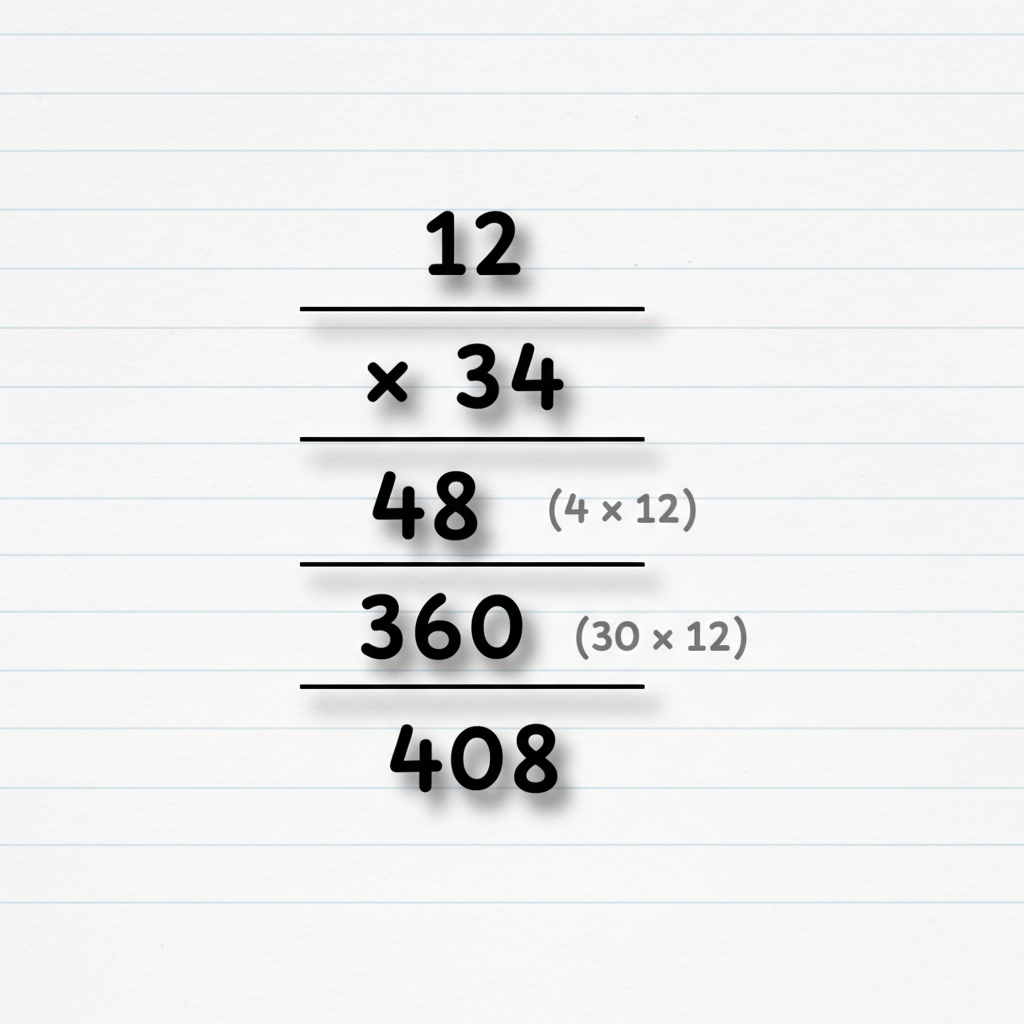
Let's use 12 x 34 again.
- Write the numbers vertically: Write the larger number on top and the smaller number on the bottom.
   12
 x 34
 ----
- Multiply by the ones digit of the bottom number: Take the digit in the ones place of the bottom number (which is 4) and multiply it by each digit in the top number, starting from the right (the ones place).
- 4 x 2 = 8. Write down the 8.
- 4 x 1 = 4. Write down the 4 next to the 8.
   12
 x 34
 ----
   48  (This is 4 x 12)
- Prepare for the tens digit: Now we're going to multiply by the tens digit of the bottom number (which is 3). BUT, since it's a tens digit (30), we need to put a placeholder zero in the ones place of our next row. Think of it as shifting our answer over because we're multiplying by a tens number, not just a ones number.
   12
 x 34
 ----
   48
    0  (Placeholder zero!)
- Multiply by the tens digit of the bottom number: Now, take the 3 (from 30) and multiply it by each digit in the top number, starting from the right.
- 3 x 2 = 6. Write down the 6 next to the placeholder zero.
- 3 x 1 = 3. Write down the 3 next to the 6.
   12
 x 34
 ----
   48
  360  (This is 30 x 12)
- Add the results: Now we add the two numbers we got (48 and 360) together.
   12
 x 34
 ----
   48
+ 360
 ----
  408
And voilà! We got the same answer: 408. Both the Area Model and the Standard Algorithm are powerful tools to help us multiply.
Key Concepts Recap
Multiplication is repeated addition. When we multiply 2-digit by 2-digit numbers, we are essentially breaking down the problem into smaller, manageable multiplication steps and then adding those results together. Both the Area Model (visualizing a rectangle) and the Standard Algorithm (step-by-step calculation) help us achieve this.
Keep learning, free
Create a free Syllabax account to unlock practice questions and games for this topic.
Visual Learning Enhanced! 🚀
To help you master this topic, we use Advanced Syllabax AI to generate detailed diagrams and visual models.
Note on Visuals: The AI sometimes makes spelling errors in image labels. Please refer to the lesson text for the correct terminology.