Prime & composite numbers [Factors & Multiples]
Watch this topic in 60 seconds
Free preview · Lesson 1
Understanding Prime & composite numbers [Factors & Multiples]
Understanding Prime and Composite Numbers: Factors and Multiples
Welcome, super mathematicians! Today, we're going on an exciting adventure into the world of numbers. We'll be exploring two special kinds of numbers called prime numbers and composite numbers. We'll also learn about their best friends: factors and multiples. Think of these like secret codes that help us understand how numbers are built!
What are Factors? The Building Blocks of Numbers
Imagine you have a box of LEGO bricks. To build something, you need to figure out which smaller LEGO bricks fit together perfectly to make a bigger one. Factors are like those smaller LEGO bricks for numbers!
Definition: A factor of a number is any number that divides into it exactly, with no remainder. In simpler terms, it's a number that can be multiplied by another whole number to get our target number.
Let's take the number 12 as an example. What numbers can we multiply together to get 12?
- 1 x 12 = 12
- 2 x 6 = 12
- 3 x 4 = 12
So, the factors of 12 are 1, 2, 3, 4, 6, and 12. These are all the numbers that can 'fit perfectly' into 12 when you divide.
Think of it like sharing cookies. If you have 12 cookies, you can share them equally among:
- 1 friend (you get all 12)
- 2 friends (each gets 6)
- 3 friends (each gets 4)
- 4 friends (each gets 3)
- 6 friends (each gets 2)
- 12 friends (each gets 1)
If you tried to share them equally among 5 friends, it wouldn't work out evenly, so 5 is not a factor of 12.
Every number has at least two factors: 1 and itself. These are always part of the factor family!
Introducing Prime Numbers: The Exclusive Clubs
Now, let's talk about our special numbers. Prime numbers are like exclusive clubs. They have a very strict membership rule!
Definition: A prime number is a whole number greater than 1 that has exactly two factors: 1 and itself.
Let's look at some examples:
- 2: The only numbers that divide into 2 are 1 and 2. So, 2 is prime. (It's the only even prime number! Isn't that cool? All other even numbers can be divided by 2, meaning they have more than two factors.)
- 3: The only numbers that divide into 3 are 1 and 3. So, 3 is prime.
- 5: The only numbers that divide into 5 are 1 and 5. So, 5 is prime.
- 7: The only numbers that divide into 7 are 1 and 7. So, 7 is prime.
- 11: The only numbers that divide into 11 are 1 and 11. So, 11 is prime.
Think of prime numbers like indivisible LEGO bricks. You can't break them down into smaller whole numbers using multiplication, other than by using 1 and the number itself.
Introducing Composite Numbers: The Group Builders
If prime numbers are like indivisible bricks, then composite numbers are like the structures you can build with many different kinds of bricks!
Definition: A composite number is a whole number greater than 1 that has more than two factors. This means it can be divided evenly by numbers other than just 1 and itself.
Let's look at our earlier example, 12. Its factors are 1, 2, 3, 4, 6, and 12. Since it has more than two factors, 12 is a composite number. It's like a big LEGO creation made from many smaller pieces!
Here are some other composite numbers:
- 4: Factors are 1, 2, 4. (More than two factors)
- 6: Factors are 1, 2, 3, 6. (More than two factors)
- 8: Factors are 1, 2, 4, 8. (More than two factors)
- 9: Factors are 1, 3, 9. (More than two factors)
- 10: Factors are 1, 2, 5, 10. (More than two factors)
Every whole number greater than 1 is either prime or composite. There's no in-between!
What about the Number 1?
The number 1 is special. It's not considered prime and it's not considered composite. Why?
- A prime number must have exactly *two* factors. The number 1 only has *one* factor (itself).
- A composite number must have *more than two* factors. The number 1 does not.
So, the number 1 stands all by itself in the number system!
What are Multiples? The Growing Lists
Now let's talk about multiples. If factors are the building blocks, multiples are like the structures that grow and grow!
Definition: A multiple of a number is the result of multiplying that number by any whole number (1, 2, 3, 4, and so on).
Think of it like counting by a specific number. Let's find the multiples of 3:
- 3 x 1 = 3
- 3 x 2 = 6
- 3 x 3 = 9
- 3 x 4 = 12
- 3 x 5 = 15
- ... and so on, forever!
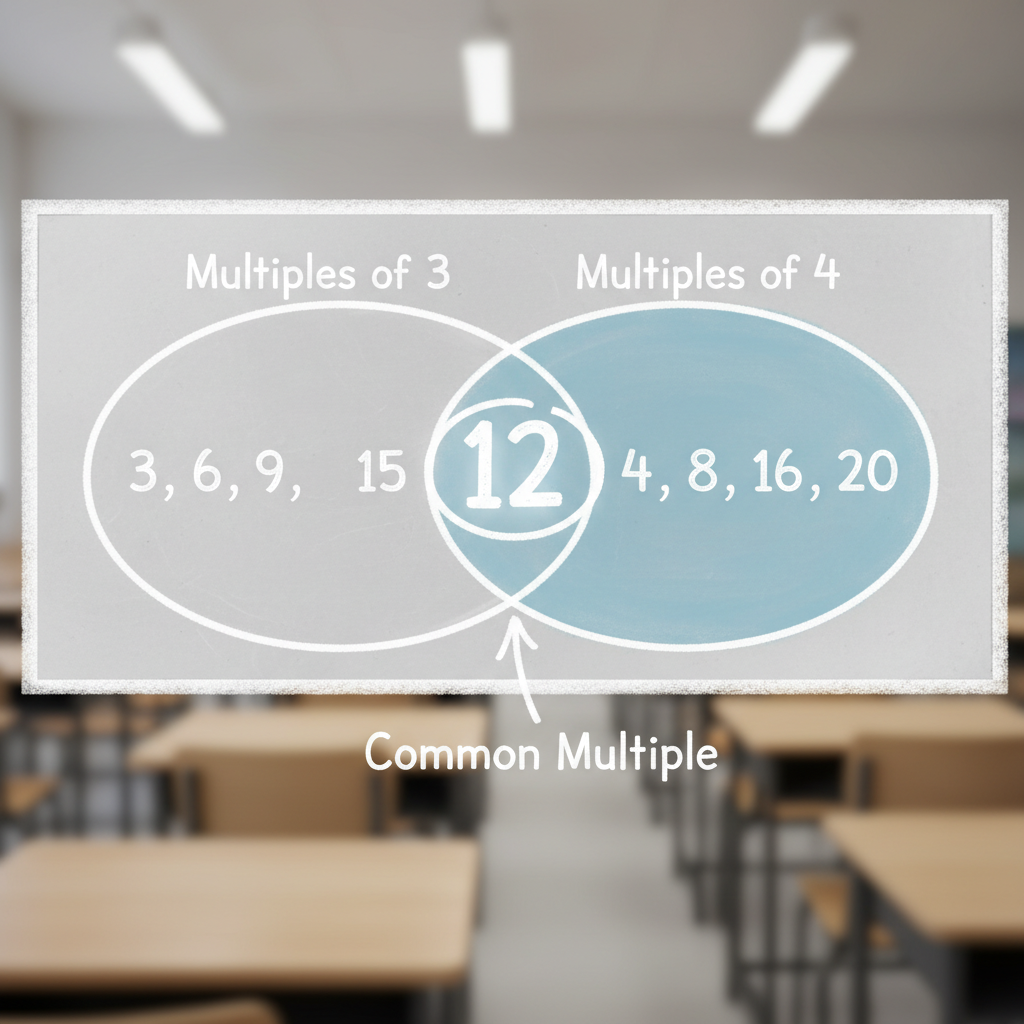
The multiples of 3 are 3, 6, 9, 12, 15, 18, 21, and so on. It's an endless list that keeps growing!
Let's try another one. What are the multiples of 4?
- 4 x 1 = 4
- 4 x 2 = 8
- 4 x 3 = 12
- 4 x 4 = 16
The multiples of 4 are 4, 8, 12, 16, 20, 24, and so on.
Notice something interesting? The number 12 is a multiple of 3 (because 3 x 4 = 12) AND it's a multiple of 4 (because 4 x 3 = 12). This means 12 is a common multiple of 3 and 4!
Putting It All Together: Prime vs. Composite
Let's recap the main differences:
Prime Numbers:
- Greater than 1.
- Have EXACTLY two factors: 1 and itself.
- Cannot be formed by multiplying two smaller whole numbers (other than 1 and itself).
- Examples: 2, 3, 5, 7, 11, 13...
Composite Numbers:
- Greater than 1.
- Have MORE THAN two factors.
- Can be formed by multiplying two smaller whole numbers.
- Examples: 4, 6, 8, 9, 10, 12...
Think of prime numbers as the basic ingredients (like flour, sugar, eggs) and composite numbers as the delicious recipes you can make using those ingredients (like a cake or cookies)!
Factors are the numbers that divide evenly into another number. They are the 'building blocks'.
Multiples are the results of multiplying a number by other whole numbers. They form 'growing lists'.
Keep practicing, and you'll become a number expert in no time!
Keep learning, free
Create a free Syllabax account to unlock practice questions and games for this topic.
Visual Learning Enhanced! 🚀
To help you master this topic, we use Advanced Syllabax AI to generate detailed diagrams and visual models.
Note on Visuals: The AI sometimes makes spelling errors in image labels. Please refer to the lesson text for the correct terminology.