Simple interest (Commercial Math)
Watch this topic in 60 seconds
Free preview · Lesson 1
Understanding Simple interest (Commercial Math)
Understanding Simple Interest: Your Money's Journey!
Hey there, future money wizards! Have you ever wondered how banks pay you a little extra money for keeping your savings with them? Or why, when you borrow money, you end up paying back more than you originally took? The answer often lies in something called Simple Interest. It's a foundational concept in the world of money, and once you understand it, you'll feel much more confident about how money grows or costs over time!
What Exactly is Simple Interest?
Imagine you lend your friend a super cool comic book. After a week, your friend returns it, but also gives you a small, shiny sticker as a thank you for letting them borrow it. That extra sticker? That's kind of like interest!
In the world of money, interest is the extra money paid for the use of someone else's money. Think of it like a rental fee for money. When you put money into a savings account, the bank 'rents' your money to use for their operations, and in return, they pay you interest. When you borrow money (like for a large purchase), you are 'renting' money from the bank, and you pay them interest.
Simple interest is the easiest way to calculate this extra money. It's calculated only on the original amount of money involved. It's like your friend giving you *one* sticker every time you lend them a comic book, no matter how many times you've lent it before. The 'thank you' (interest) is always based on that initial loan (the comic book).
The "Big Three" of Simple Interest: P, R, T
To calculate simple interest, we need three main pieces of information. Let's call them the "Big Three":
1. Principal (P): The Starting Point
This is the original amount of money that is either borrowed or invested. It's your starting point, your base amount, the core of the deal.
- Analogy: If you're saving money, the Principal is the amount of money you first put into your piggy bank or savings account. If you're borrowing money, it's the amount you originally took out. Think of it as the original seeds you plant in a garden.
2. Interest Rate (R): The Growth Speed
The interest rate is a percentage that tells you how much interest will be charged or earned. It's usually given as a percentage per year (e.g., 5% per year).
- Important Note: When using the rate in calculations, you MUST convert the percentage into a decimal! To do this, divide the percentage by 100. For example, 5% becomes 0.05, and 2.5% becomes 0.025.
- Analogy: The Interest Rate is like how fast your garden seeds are expected to grow. A higher rate means more growth (more interest) in the same amount of time.
3. Time (T): How Long the Money Works
This is the duration for which the money is borrowed or invested. Time is almost always measured in years for simple interest calculations.
- Important Note: If the time is given in months, you need to convert it to years by dividing by 12. If it's in days, divide by 365 (or 360, depending on specific instructions, but 365 is common).
- Analogy: Time is how long you let your garden grow. The longer you let your seeds grow, the bigger the plants (and more fruit/vegetables – more interest!) you'll get.
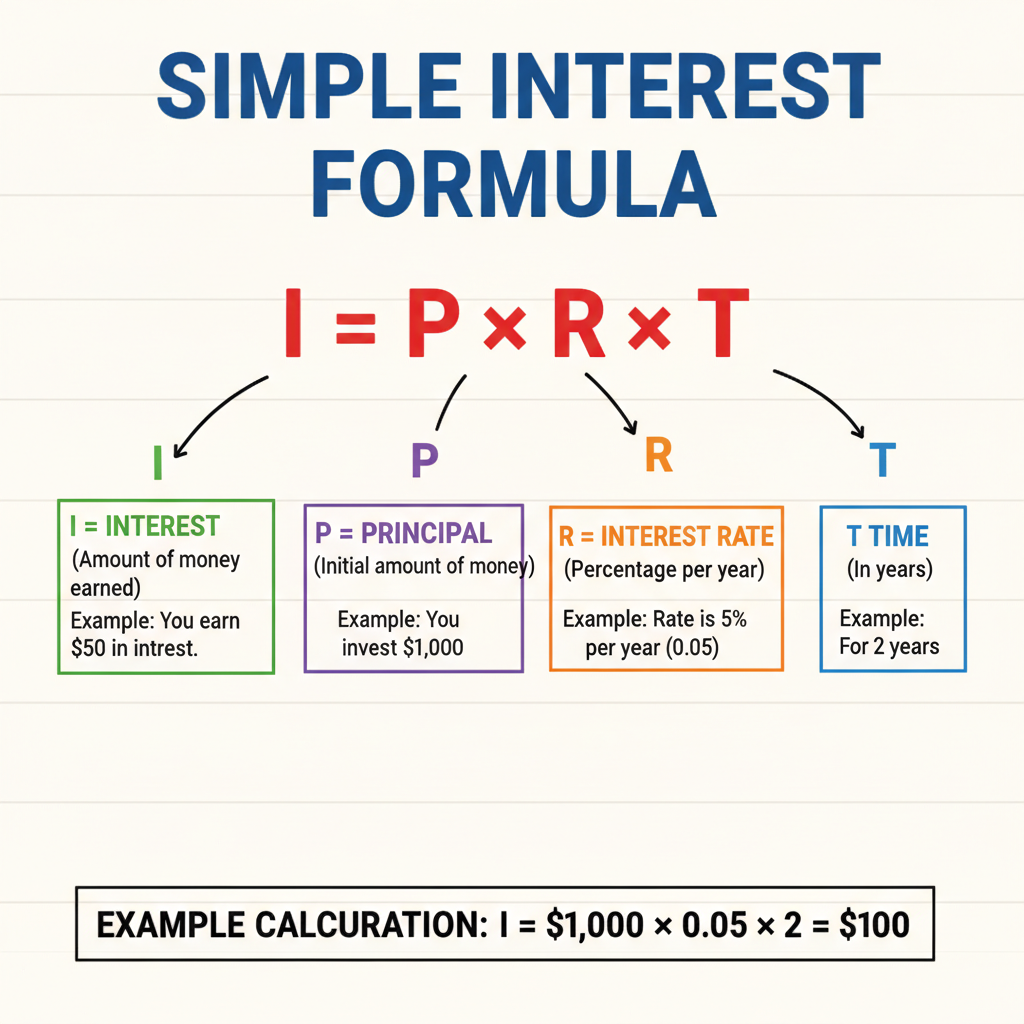
The Magic Formula: I = P × R × T
Now, let's put the "Big Three" together into a super useful formula! This formula is your key to unlocking simple interest calculations:
I = P × R × T
- I stands for Interest (the extra money).
- P stands for Principal (the starting money).
- R stands for Rate (the percentage as a decimal).
- T stands for Time (in years).
Let's look at an example to see how this works:
Example 1: Calculating Interest Earned
Sarah invests $500 in a savings account that offers a simple interest rate of 3% per year. How much interest will she earn after 2 years?
- Identify P, R, and T:
- Principal (P) = $500
- Rate (R) = 3% = 0.03 (remember to convert to decimal!)
- Time (T) = 2 years
- Apply the formula: I = P × R × T
- I = $500 × 0.03 × 2
- I = $15 × 2
- I = $30
- Answer: Sarah will earn $30 in interest after 2 years.
It's that simple! Just multiply the three values together.
 ⚠️ This picture may have spelling mistakes. Trust the words in the lesson.
Beyond Interest: The Total Amount
Often, you don't just want to know how much interest was earned or paid; you want to know the total amount of money at the end. This is super easy! The total amount is just your original money (Principal) plus the extra money (Interest).
Amount (A) = Principal (P) + Interest (I)
So, if Sarah earned
- A = P + I
- A =
- A = $530
Sarah would have $530 in her account after 2 years.
Example 2: Calculating Total Amount Paid on a Loan
John takes out a loan of $1,000 to buy a new bicycle. The bank charges a simple interest rate of 6% per year. He plans to pay back the loan in 18 months. How much will John pay back in total?
- Identify P, R, and T:
- Principal (P) = $1,000
- Rate (R) = 6% = 0.06
- Time (T) = 18 months. We need to convert this to years: 18 / 12 = 1.5 years.
- Calculate the Interest (I = P × R × T):
- I = $1,000 × 0.06 × 1.5
- I = $60 × 1.5
- I = $90
- Calculate the Total Amount (A = P + I):
- A =
- A = $1,090
- A =
- Answer: John will pay back a total of $1,090.
Simple Interest in the Real World
Simple interest might seem like just a math problem, but it's everywhere in your daily life! Understanding it helps you make smarter choices with your money.
- Savings Accounts: Many basic savings accounts use simple interest to calculate how much you earn on your deposits.
- Personal Loans: If you borrow money from a bank for something like a small project, the interest is often calculated simply.
- Bonds: When governments or companies borrow money from people (by issuing bonds), they often pay back simple interest to the bondholders.
- Short-term Investments: Some short-term investments might use simple interest calculations.
Knowing how simple interest works empowers you to understand the true cost of borrowing and the actual earnings from saving. It’s like knowing the rules of a game before you start playing!
Key Things to Remember About Simple Interest:
- Simple interest is calculated ONLY on the original Principal amount.
- Always convert the interest rate from a percentage to a decimal (divide by 100) before using it in the formula.
- Ensure that the time is expressed in years. Convert months to years by dividing by 12.
- The formula is I = P × R × T.
- The total amount at the end is A = P + I.
You've just taken your first big step into the world of commercial math! Keep practicing, and you'll be calculating interest like a pro in no time.
Keep learning, free
Create a free Syllabax account to unlock practice questions and games for this topic.
Visual Learning Enhanced! 🚀
To help you master this topic, we use Advanced Syllabax AI to generate detailed diagrams and visual models.
Note on Visuals: The AI sometimes makes spelling errors in image labels. Please refer to the lesson text for the correct terminology.