Random Sampling
Watch this topic in 60 seconds
Free preview · Lesson 1
Understanding Random Sampling
Understanding Random Sampling: A Fair Look at Data
Imagine you're trying to figure out something about a very large group of people or things. For example, maybe you want to know what percentage of all high school students in your city prefer chocolate ice cream. Or perhaps a company wants to know how many of their customers are happy with a new product. It would be nearly impossible, and definitely too expensive and time-consuming, to ask every single person or check every single item. So, what do we do?
We take a shortcut! We pick a smaller group from the large group and study just them. This smaller group is called a sample. But here's the trick: how do you pick that smaller group so that it gives you a good, honest picture of the whole large group?
If you just pick your friends, or only ask people who are easy to find, you might get a very skewed or unfair result. This is where Random Sampling comes in! It's like ensuring everyone gets a fair shot at being included, making your smaller group a reliable "mini-me" of the larger one.
Population vs. Sample: The Big Picture and the Bite-Sized Piece
Let's start with two very important words:
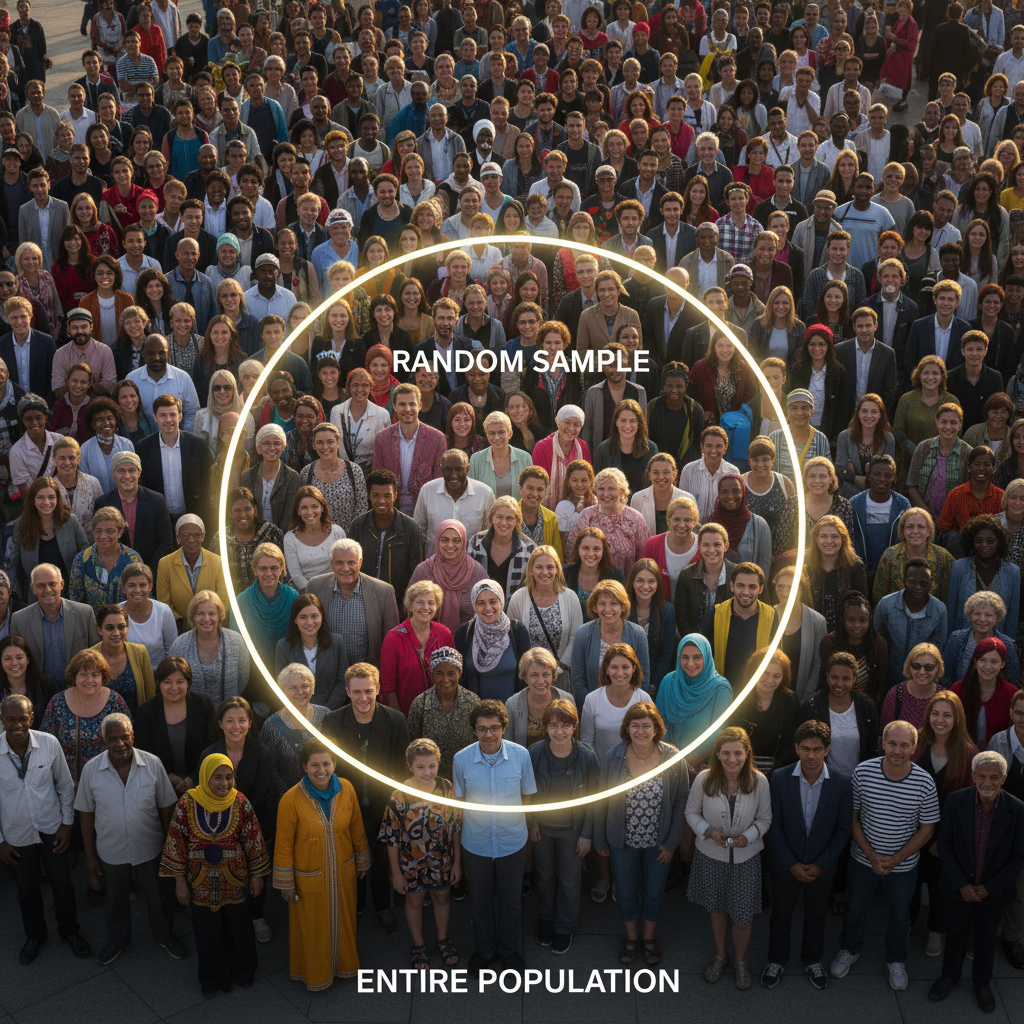
- Population: This is the entire group that you are interested in studying. It's the whole pie, the whole ocean, every single item or person that fits your description.
- Analogy: If you want to know about the favorite colors of all the students in your school, the population is every single student in your school. If a company wants to know about the quality of a batch of 10,000 light bulbs, the population is all 10,000 light bulbs.
- Sample: This is a smaller, manageable group that you select from the population. It's the slice of pie, the net full of fish, the few items or people you actually study.
- Analogy: Instead of asking every student in your school about their favorite color, you might ask 50 students. Those 50 students are your sample. For the light bulbs, you might test 100 of them. Those 100 are your sample.
The whole point of taking a sample is to learn something about the big population without having to examine every single member of it.
What Does "Random" Really Mean? Fairness is Key!
When we say "random" in random sampling, we mean something very specific and very fair. It means that every single member of the population has an equal chance of being chosen for the sample.
Think about a lottery or drawing names from a hat. If the names are all mixed up perfectly, everyone has an equal chance of being picked, right? That's what we're aiming for with random sampling. There's no special favoritism, no bias towards certain people or items.
This fairness is crucial because it helps ensure that your sample truly represents the diversity and characteristics of the larger population. If some people or items have a higher chance of being picked than others, your sample won't be a true reflection.
Why is Random Sampling So Important? Avoiding Bias!
The biggest enemy of getting good information from a sample is something called bias.
- Bias: This happens when your sample doesn't accurately represent the population. It's like having a tilted scale, a rigged game, or a mirror that distorts what it reflects.
Analogy: Let's say you want to know how much students at your school enjoy reading. If you only ask students in the advanced English class, your sample might be biased towards students who *love* reading. This sample wouldn't fairly represent the reading enjoyment of all students in the school, including those who don't like reading as much.
Another example: If you want to know the average height of adults in your town, but you only measure basketball players, your sample would be heavily biased towards taller individuals. It wouldn't give you an accurate picture of the average height of *all* adults in the town.
Random sampling is the best way we know to minimize bias. By giving everyone an equal chance, we reduce the likelihood that our sample will be unfairly skewed in one direction or another. This means the information we get from our sample is more likely to be true for the entire population.
How Do We Do Simple Random Sampling? The Basics!
One of the most straightforward types of random sampling is called Simple Random Sampling (SRS). Here's how it generally works:
- Define your population clearly: First, you need to be absolutely clear about who or what your population is. For example, "all 9th-grade students currently enrolled at Northwood High School" or "every single apple harvested from Orchard A this season."
- Create a list of every member (Sampling Frame): You need a complete list of every individual or item in your population. This list is sometimes called a "sampling frame." If your population is all students in a school, you'd need a roster of all their names. If it's a batch of products, you'd need a way to identify each product (like a serial number).
- Assign a unique number to each member: Give every single person or item on your list a unique number. If there are 500 students, they'd be numbered 1 through 500.
- Use a random method to select your sample: Now, you use a truly random process to pick numbers, and the members corresponding to those numbers become your sample.
- Method 1: Drawing from a Hat (for smaller populations): Write each unique number on a small, identical slip of paper. Put all the slips into a hat or bag, mix them extremely well, and then draw out the number of slips you need for your sample size without looking.
- Method 2: Random Number Generator (for larger populations): This is more common in the real world. You can use a calculator, a computer program, or even websites that generate random numbers. You tell it the range of numbers (e.g., 1 to 500) and how many random numbers you need. The generator will then give you a list of unique numbers, and you select the individuals or items from your list that correspond to those numbers.
Analogy: Imagine your teacher wants to pick 5 students randomly from your class of 30 for a special task. They could write each student's name on a separate index card, put all 30 cards into a box, shake it up thoroughly, and then pull out 5 cards. Each student had an equal chance of being picked, so the sample is random.
The Big Benefit: Trustworthy Results!
When you use random sampling, you can be much more confident that the information you gather from your sample is a good estimate for the entire population. It allows statisticians and researchers to make educated guesses or "inferences" about a large group without the impossible task of measuring every single member. This principle is fundamental to how we conduct surveys, scientific studies, quality control in manufacturing, and many other important areas of life.
Keep learning, free
Create a free Syllabax account to unlock practice questions and games for this topic.
Visual Learning Enhanced! 🚀
To help you master this topic, we use Advanced Syllabax AI to generate detailed diagrams and visual models.
Note on Visuals: The AI sometimes makes spelling errors in image labels. Please refer to the lesson text for the correct terminology.