Probability of Compound Events
Watch this topic in 60 seconds
Free preview · Lesson 1
Understanding Probability of Compound Events
Understanding the Probability of Compound Events (Grade 7)
Welcome, future probability wizards! Today, we're going on an exciting adventure into the world of 'Compound Events'. Don't let the fancy name scare you – it's just about figuring out the chances of two or more things happening together. Think of it like trying to predict what will happen next in a game or in real life!
What is Probability? A Quick Refresher
Before we jump into 'compound' events, let's quickly remember what 'probability' is all about. Probability is simply the chance or likelihood that something will happen. We usually express it as a fraction, a decimal, or a percentage. For example, if you flip a fair coin, the probability of getting heads is 1 out of 2, or 1/2, or 0.5, or 50%.
Analogy Time!
Imagine you have a bag with 5 red marbles and 5 blue marbles. If you reach in without looking, what's the probability of picking a red marble? It's 5 (red marbles) out of 10 (total marbles), so 5/10 or 1/2. Simple!
What Makes an Event 'Compound'?
A compound event is when you consider the outcome of two or more simple events happening together. Instead of just flipping a coin once, a compound event might be flipping a coin *and then* rolling a die. Or picking two cards from a deck. It's about combining actions!
Analogy Time!
Think of it like ordering a combo meal at a fast-food restaurant. You don't just get a burger (a simple event); you get a burger AND fries AND a drink (a compound event)! Each part of the meal is a simple choice, but together they make a combo.
Two Main Types of Compound Events: Independent and Dependent
Compound events can be grouped into two main types, and knowing the difference is super important because it changes how we calculate their probability!
1. Independent Events
Independent events are when the outcome of one event does NOT affect the outcome of the other event. They are completely separate, like two friends playing different games that don't influence each other.
Analogy Time!
Imagine you have two coin flips. The result of your first flip (heads or tails) has absolutely no impact on what you'll get on the second flip. They're independent buddies doing their own thing!
Another analogy: What your favorite sports team does in their game has no bearing on whether it will rain tomorrow. Totally separate!
How to Calculate Probability for Independent Events:
To find the probability of two independent events (let's call them Event A and Event B) both happening, you simply multiply their individual probabilities:
P(A and B) = P(A) × P(B)
Example 1: Flipping a Coin AND Rolling a Die
What is the probability of flipping a coin and getting Heads (H), AND then rolling a standard six-sided die and getting a 4?
- Event A: Getting Heads on a coin flip.
- The probability of Heads, P(H) = 1/2 (since there's 1 head out of 2 sides).
- Event B: Rolling a 4 on a die.
- The probability of rolling a 4, P(4) = 1/6 (since there's 1 '4' out of 6 sides).
Are these independent? Yes! The coin flip doesn't change what you can roll on the die.
So, P(H and 4) = P(H) × P(4) = (1/2) × (1/6) = 1/12.
There's a 1 in 12 chance of both happening!
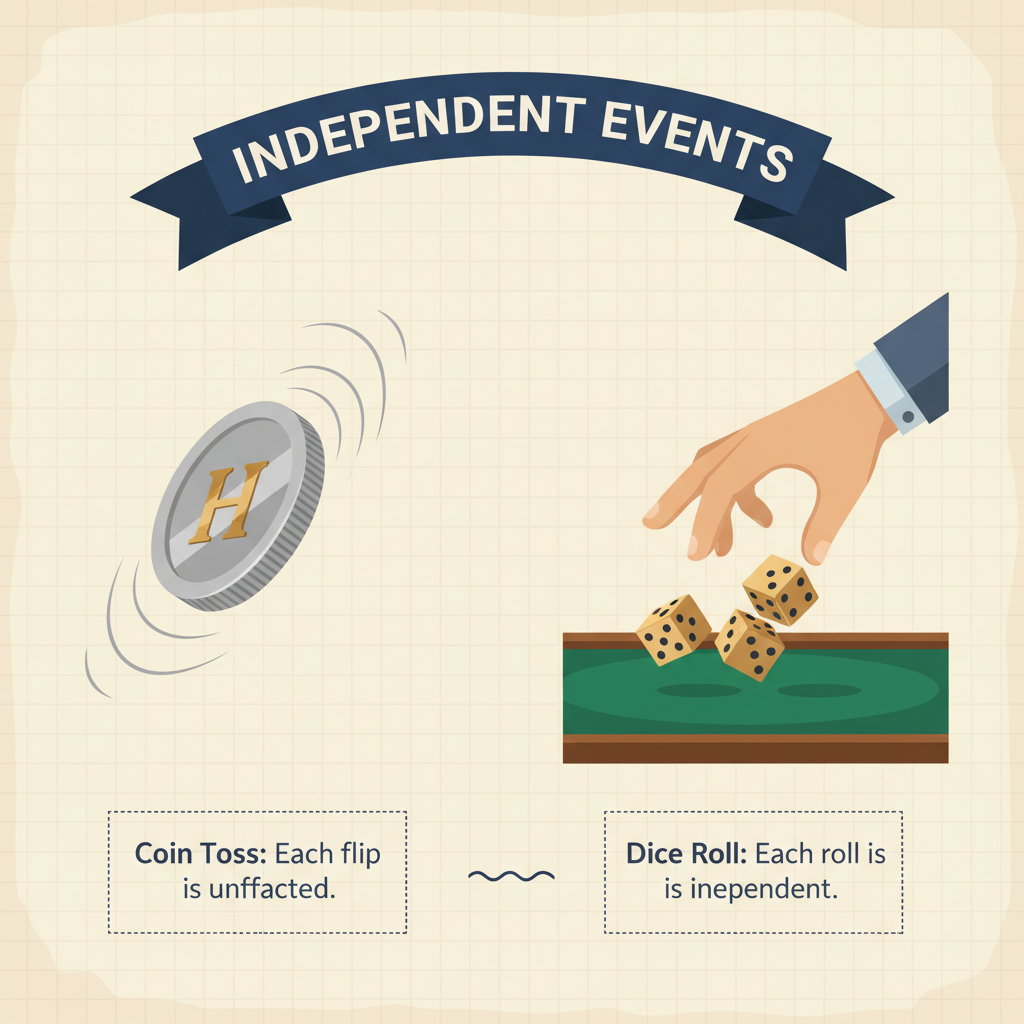 ⚠️ This picture may have spelling mistakes. Trust the words in the lesson.
2. Dependent Events
Dependent events are when the outcome of the first event DOES affect the outcome of the second event. They are connected, like dominoes falling – one action sets up the next.
Analogy Time!
Imagine you have a bag of different colored candies, and you pick one out and eat it! Now, when you reach in for a second candy, the total number of candies has changed, AND the number of that specific color might have changed too. Your first choice directly affected your second choice.
How to Calculate Probability for Dependent Events:
To find the probability of two dependent events, you still multiply, but the probability of the second event changes based on what happened in the first event:
P(A and B) = P(A) × P(B after A)
Where P(B after A) means 'the probability of Event B happening, GIVEN that Event A has already happened'.
Example 2: Drawing Marbles Without Replacement
You have a bag with 5 red marbles and 5 blue marbles (10 total). What is the probability of drawing a red marble, AND then (without putting the first one back) drawing another red marble?
- Event A: Drawing a red marble first.
- P(Red first) = 5/10 = 1/2.
- Now, for the second draw: One red marble is gone, and there are only 9 marbles left in the bag.
- Event B after A: Drawing another red marble (given the first was red and not replaced).
- Now there are only 4 red marbles left, and 9 total marbles.
- P(Red second after Red first) = 4/9.
Are these dependent? Yes! Taking out the first marble changes the bag for the second draw.
So, P(Red first and Red second) = P(Red first) × P(Red second after Red first) = (5/10) × (4/9) = (1/2) × (4/9) = 4/18 = 2/9.
There's a 2 in 9 chance of drawing two red marbles in a row without putting the first one back.
Key Differences to Remember:
- Independent: Event 1 does NOT change the possibilities for Event 2. (Example: Coin flip, then die roll)
- Dependent: Event 1 DOES change the possibilities for Event 2. (Example: Drawing cards or marbles WITHOUT replacement)
Practice Makes Perfect!
The best way to get good at probability is to practice! Always ask yourself:
- What are the individual probabilities of each event?
- Are the events independent or dependent? (Does the first event change the second?)
- Multiply the probabilities together using the correct method!
You've got this! Understanding compound events is a powerful skill for making sense of the world around you, from games to predicting outcomes in experiments.
Keep learning, free
Create a free Syllabax account to unlock practice questions and games for this topic.
Visual Learning Enhanced! 🚀
To help you master this topic, we use Advanced Syllabax AI to generate detailed diagrams and visual models.
Note on Visuals: The AI sometimes makes spelling errors in image labels. Please refer to the lesson text for the correct terminology.