Profit & loss advanced (Commercial Math)
Watch this topic in 60 seconds
Free preview · Lesson 1
Understanding Profit & loss advanced (Commercial Math)
Mastering Profit & Loss: Advanced Concepts for 10th Graders (Foundational)
Welcome, future entrepreneurs and savvy shoppers! In this lesson, we're going to dive deeper into the world of Profit and Loss. You've probably heard these terms before, maybe when your parents talk about their business, or when you see sale signs at your favorite store. While the basic idea of buying low and selling high (or vice-versa) is simple, commercial math often involves a few extra layers. Think of it like baking a cake: you know you need flour and sugar, but what about the butter, eggs, and the electricity for the oven? Those extra ingredients and costs are what we'll explore today!
The Bedrock: Revisiting Core Concepts
Before we build our skyscraper of advanced knowledge, let's quickly reinforce the foundation. Don't worry, we'll keep it simple and use plenty of analogies!
1. Cost Price (CP): The Initial Investment
Imagine you want to start a small business selling handmade friendship bracelets. The money you spend to buy the beads, the string, and maybe a small pair of scissors – that's your Cost Price (CP). It's simply the total amount of money you spend to acquire or produce an item.
- Analogy: If you buy an old bicycle for
- Analogy: For a bakery, the CP of a loaf of bread includes the cost of flour, water, yeast, and salt.
2. Selling Price (SP): What the Customer Pays
After you've made your beautiful friendship bracelets, you put them up for sale. The price you ask your friends or customers to pay for each bracelet – that's your Selling Price (SP). It's the amount for which an item is sold.
- Analogy: You fix up the old bicycle and sell it for
- Analogy: The bakery sells a loaf of bread for $4. That's its SP.
3. Profit: When You Win!
When your Selling Price (SP) is higher than your Cost Price (CP), congratulations! You've made a Profit. This is the good stuff, the reward for your hard work.
- Formula: Profit = SP - CP
- Analogy: If you sold that fixed-up bicycle for
4. Loss: When You Take a Hit
Sometimes, things don't go as planned. If your Selling Price (SP) is lower than your Cost Price (CP), you've incurred a Loss. This means you sold something for less than it cost you to get it.
- Formula: Loss = CP - SP
- Analogy: What if you could only sell that bicycle for
5. No Profit, No Loss (Break-Even): Just Covering Your Bases
If your Selling Price (SP) is exactly equal to your Cost Price (CP), you haven't made a profit or a loss. You've just managed to recover your initial investment. This is often called 'breaking even'.
- Analogy: You sold the bicycle for exactly $50. You didn't make money, but you didn't lose any either.
Introducing Advanced Layers: Beyond the Basics
Now, let's add those extra 'ingredients' and complexities that make commercial math so interesting!
1. Overhead Expenses: The Hidden Costs
Remember our friendship bracelet business? Besides the beads and string, what else did you need? Maybe you bought a special storage box, or paid for a stall at a local craft fair, or even used your internet to research designs. These extra costs, which are necessary for running the business but aren't directly part of making the product itself, are called Overhead Expenses.
These include things like rent, electricity bills, transportation costs, salaries for staff, advertising, packaging, etc. To truly know your total cost, you need to add these in.
- Analogy: If you're a baker, the cost of flour and sugar is direct CP. But the rent for your bakery shop, the electricity for the oven, and the salary for the person who sells the bread are overheads.
- Key Concept: Effective Cost Price (ECP) = Cost Price (CP) + Overhead Expenses
- Once you calculate the ECP, you compare your Selling Price (SP) to this ECP to find your true profit or loss.
2. Profit & Loss Percentage: How Well Did You Do?
Knowing you made a $30 profit is good, but is it a good profit? This is where percentages come in. Profit and Loss percentages tell you the profit or loss relative to your cost. It helps you compare the success of different ventures.
Crucial Rule: Profit and Loss percentages are ALWAYS calculated on the Cost Price (or Effective Cost Price). Why? Because your cost is your baseline investment. You want to know how much return you got on that investment.
- Profit % = (Profit / CP) * 100%
- Loss % = (Loss / CP) * 100%
- Analogy: If you made
3. Discounts: The Art of Attracting Buyers
Walk into any store, especially during sales season, and you'll see signs shouting "20% OFF!" or "Buy One Get One Free!" This is the world of Discounts. A discount is a reduction in the original selling price of an item, usually given to attract more customers or clear old stock.
- Marked Price (MP) / List Price: This is the price tag on the item, the original price before any discounts.
- Discount Amount: The amount reduced from the Marked Price.
- Selling Price (SP) after Discount: The actual price the customer pays after the discount is applied.
- Formula: Discount = Marked Price (MP) - Selling Price (SP)
- Formula: Selling Price (SP) = Marked Price (MP) - Discount
- Formula: Discount % = (Discount / Marked Price) * 100%
- Analogy: A T-shirt has a price tag (MP) of
Successive Discounts: When Discounts Pile Up
Sometimes, stores offer multiple discounts one after another. This is called Successive Discounts. It's important to remember that the second discount is applied to the price AFTER the first discount has been taken off, not the original Marked Price.
- Analogy: A jacket is priced at
4. Connecting Profit/Loss with Discounts
Here's where it gets exciting! A shop owner might offer a discount, but they still want to make a profit. Or, they might offer a discount to clear stock, even if it means a small loss.
To calculate profit or loss when discounts are involved, you compare the final Selling Price (after all discounts) with your Cost Price (CP) or Effective Cost Price (ECP).
- Scenario 1: Seller wants to make a Profit: They decide on a CP, then mark up the price to MP (so they can offer a discount) and still make profit.
- Scenario 2: Seller incurs a Loss: They offer a heavy discount, and the final SP ends up being less than their CP.
Putting It All Together: A Summary
Commercial math in profit and loss isn't just about simple subtraction. It involves understanding all the costs (CP, overheads), setting smart prices (MP, SP), and strategically using tools like discounts. Every decision a business makes, from pricing a product to offering a sale, directly impacts its profit or loss.
By mastering these foundational 'advanced' concepts, you're not just learning math formulas; you're learning how businesses work in the real world. You're developing the skills to make informed financial decisions, whether you're running a lemonade stand or managing a multinational corporation!
Keep learning, free
Create a free Syllabax account to unlock practice questions and games for this topic.
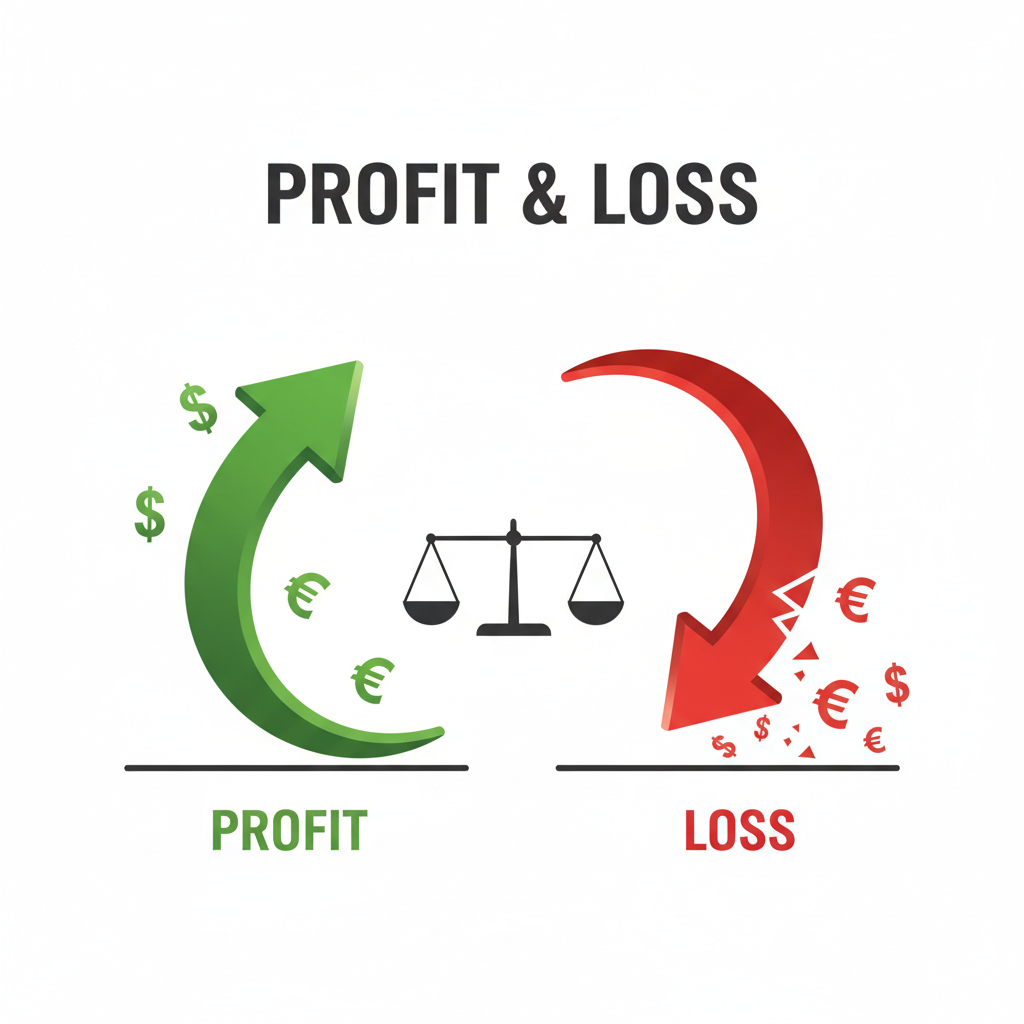
Visual Learning Enhanced! 🚀
To help you master this topic, we use Advanced Syllabax AI to generate detailed diagrams and visual models.
Note on Visuals: The AI sometimes makes spelling errors in image labels. Please refer to the lesson text for the correct terminology.