Learning Journey
Watch this topic in 60 seconds
Free preview · Lesson 1
Understanding Uniform vs non-uniform motion[PHYSICS]
Understanding Motion: Uniform vs. Non-Uniform Motion
Imagine you're playing a game. Sometimes you run really fast, and sometimes you walk slowly. That's like non-uniform motion! But what if you could always run at the exact same speed, like a robot programmed to move? That would be uniform motion.
What is Motion?
Before we talk about different kinds of motion, let's understand what motion is. In physics, we say an object is in motion when its position changes over time. Think about a car driving down the road. Its position is different from one second to the next. That car is in motion!
Speed: How Fast Are We Going?
To describe motion, we often talk about speed. Speed tells us how much distance an object covers in a certain amount of time.
Let's use an analogy. Imagine you have a race with your friends. If you cover 10 meters in 2 seconds, your speed is 5 meters per second (10 meters / 2 seconds = 5 meters/second). This means for every second that passes, you move 5 meters forward.
Formula for Speed:
Speed = Distance / Time
Uniform Motion: The Steady Pace
Now, let's talk about uniform motion. This is the simplest type of motion. An object is in uniform motion if it travels equal distances in equal intervals of time. Another way to say this is that the object moves at a constant speed.
Analogy Time!
- A Train on a Straight, Flat Track: Imagine a super-efficient train moving on a perfectly straight and flat track. If it starts at a certain speed and there's nothing to slow it down or speed it up (like friction or changing gradients), it will continue to travel at that exact same speed. It covers the same amount of track every minute.
- A Record Player's Needle: As the record spins at a constant rate, the needle tracing the groove moves along the groove at a steady speed.
- A Person Walking on a Treadmill (at a fixed setting): If you set a treadmill to a constant speed and you walk on it, you are covering the same amount of 'distance' (the belt moving under you) in equal amounts of time.
Key characteristics of uniform motion:
- Constant Speed: The speed of the object never changes.
- Constant Direction (usually implied for simplicity): Often, when we talk about uniform motion in introductory physics, we also assume the object is moving in a straight line. If it changes direction, even if its speed stays the same, it's not technically uniform velocity, but for foundational understanding, we often simplify it to mean constant speed in a straight line.
Non-Uniform Motion: The Changeable Pace
Most of the time, things don't move at a constant speed. This is called non-uniform motion. In non-uniform motion, an object travels unequal distances in equal intervals of time. This means its speed is changing.
Analogy Time!
- A Car in City Traffic: Think about driving a car. You speed up when the light turns green, slow down for red lights or pedestrians, and sometimes stop completely. Your speed is constantly changing.
- A Ball Thrown Up in the Air: When you throw a ball up, it starts fast, slows down as it goes up, stops for a moment at the very top, and then speeds up as it falls back down.
- A Bicycle with Hills: If you're riding a bike and encounter hills, you'll go faster downhill and slower uphill. Your speed is definitely not constant.
- A Falling Leaf: A leaf falling from a tree doesn't immediately fall at a constant speed. It might flutter and change its speed as it descends due to wind and air resistance.
Key characteristics of non-uniform motion:
- Changing Speed: The speed of the object increases, decreases, or both.
- Acceleration (Speeding Up or Slowing Down): When an object's speed changes, we say it is accelerating. Acceleration isn't just about speeding up; slowing down is also a form of acceleration (sometimes called deceleration).
- Changing Direction (can also occur): Non-uniform motion can also involve changes in direction, even if the speed were to remain constant (like a car turning a corner at a steady 50 mph). However, for foundational understanding, we often focus on the changing speed aspect.
Why Does This Matter?
Understanding the difference between uniform and non-uniform motion helps us describe and predict how things move. For example:
- If you know a train is moving at a uniform speed, you can easily calculate how long it will take to reach its destination.
- If you know a car is in non-uniform motion, you know you can't just use a single speed to predict its arrival time. You'd need more information about how its speed changes.
Visualizing Motion
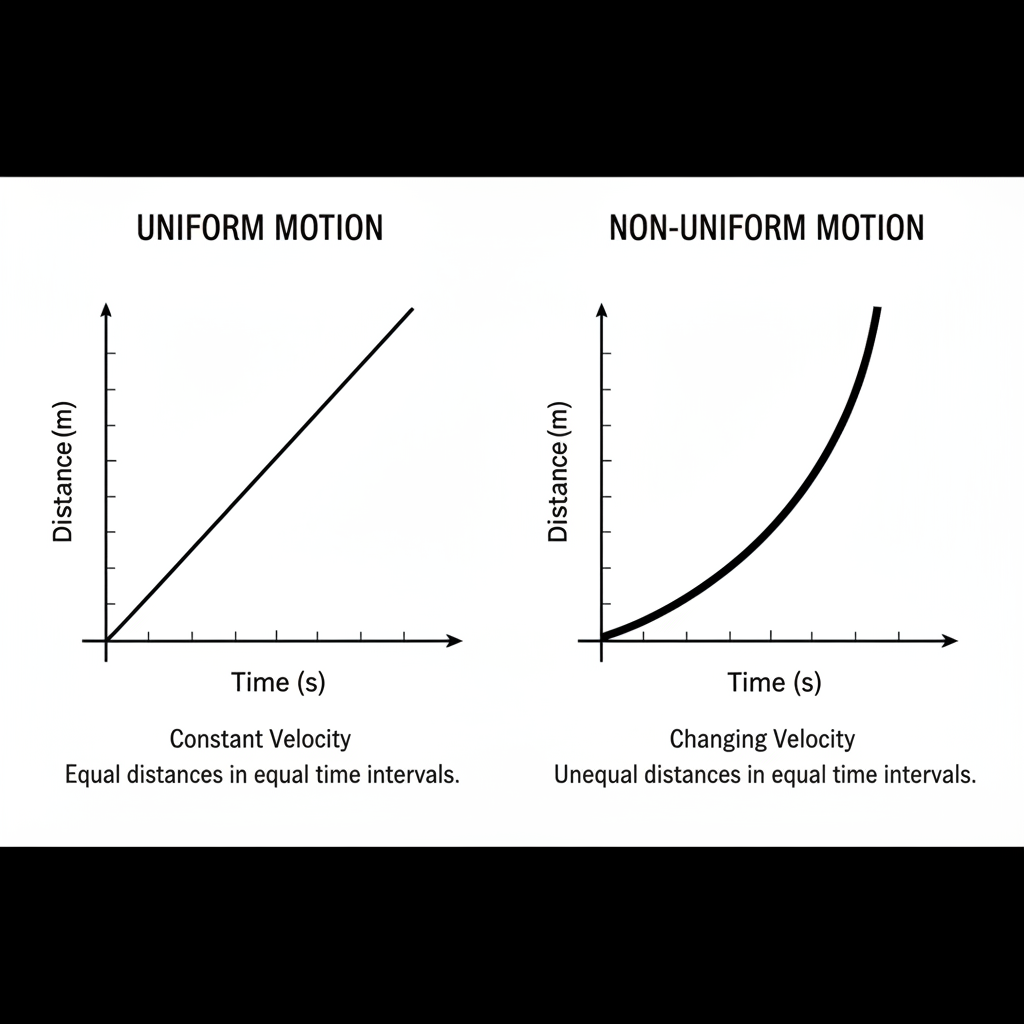
Let's think about how we might see this. Imagine drawing a line on a graph to show how far an object has traveled over time.
- Uniform Motion: If an object moves at a constant speed, the line on a distance-time graph will be a straight line. This means the distance increases by the same amount for every unit of time.
- Non-Uniform Motion: If an object's speed is changing, the line on a distance-time graph will be curved. This shows that the distance covered in each time interval is different.
Summary
In simple terms:
- Uniform Motion: Moving at a steady, unchanging speed. Like a perfectly smooth, straight road trip at cruise control.
- Non-Uniform Motion: Moving at a speed that changes. Like a rollercoaster, going fast, then slow, then changing direction.
The world around us is full of non-uniform motion, but understanding uniform motion gives us a fundamental building block to understand more complex movements!
Keep learning, free
Create a free Syllabax account to unlock practice questions and games for this topic.
Visual Learning Enhanced! 🚀
To help you master this topic, we use Advanced Syllabax AI to generate detailed diagrams and visual models.
Note on Visuals: The AI sometimes makes spelling errors in image labels. Please refer to the lesson text for the correct terminology.