Division (4-digit ÷ 2-digit) [Fundamental Operations]
Watch this topic in 60 seconds
Free preview · Lesson 1
Understanding Division (4-digit ÷ 2-digit) [Fundamental Operations]
Division Fun: Sharing Big Numbers! (4-digit ÷ 2-digit)
Welcome, math explorers! Today, we're diving into a super exciting part of math: **division**. We've already learned how to share smaller numbers, but now we're ready to tackle some bigger challenges! Imagine you have a giant box of 1,234 delicious cookies and you want to share them equally among your 23 best friends. How many cookies does each friend get? That's where division comes in!
What is Division, Anyway?
Division is like sharing fairly. It's about taking a total amount (the dividend) and splitting it into equal groups (determined by the divisor). The answer we get is the number of items in each group (the quotient), and sometimes there's a little bit left over (the remainder).
Think of it like this:
- Sharing Pizzas: If you have 12 slices of pizza (dividend) and you want to give 3 slices to each friend (divisor), you are dividing 12 by 3. Each friend gets 4 slices (quotient).
- Building with Blocks: If you have 20 building blocks (dividend) and you want to build towers that use 5 blocks each (divisor), you can build 4 towers (quotient).
Our Big Numbers: 4-digit ÷ 2-digit
In this lesson, we're focusing on dividing a number with up to four digits (like 1,234) by a number with two digits (like 23). This is like sharing a huge bag of candy among a group of classmates.
Let's use our cookie example: 1,234 cookies divided by 23 friends.
Step-by-Step: The Long Division Dance!
We use a special method called long division to solve these problems. It's like a step-by-step dance that helps us figure out the answer neatly.
Let's try 1234 ÷ 23:
- Set it Up: Write the problem like this:
_______ 23 | 1234 - Can 23 go into 1? Nope, 1 is too small.
_______ 23 | 1234 - Can 23 go into 12? Nope, 12 is also too small.
_______ 23 | 1234 - Can 23 go into 123? YES! This is where the fun begins. We need to estimate. Think: How many times does 23 fit into 123? You can try multiplying 23 by different numbers:
- 23 x 1 = 23
- 23 x 2 = 46
- 23 x 3 = 69
- 23 x 4 = 92
- 23 x 5 = 115
- 23 x 6 = 138 (Too big!)
5____ 23 | 1234 - Multiply and Subtract: Now, multiply the number you just wrote (5) by the divisor (23): 5 x 23 = 115. Write 115 under the 123.
         5____
    23 | 1234
        115
Then, subtract 115 from 123: 123 - 115 = 8.5____ 23 | 1234 115 --- 8 - Bring Down the Next Digit: Bring down the next digit from the dividend (which is 4) next to the 8. You now have 84.
5____ 23 | 1234 115 --- 84 - Repeat the Process: Now we ask, how many times does 23 go into 84? Let's try multiplying again:
- 23 x 1 = 23
- 23 x 2 = 46
- 23 x 3 = 69
- 23 x 4 = 92 (Too big!)
53__ 23 | 1234 115 --- 84 - Multiply and Subtract Again: Multiply 3 x 23 = 69. Write 69 under the 84.
         53__
    23 | 1234
        115
        ---
          84
          69
Subtract 84 - 69 = 15.53__ 23 | 1234 115 --- 84 69 --- 15 - Check for Remainder: Is there anything left to bring down? No! So, 15 is our remainder. It's the amount that couldn't be shared equally.
Our answer is 53 with a remainder of 15. So, each of your 23 friends gets 53 cookies, and you have 15 cookies left over.
Analogies to Help You Remember!
The Baker Analogy: Imagine a baker making cakes. They have 1,575 sprinkles (dividend) and each cake needs 25 sprinkles (divisor). How many cakes can the baker decorate (quotient)? They'll use the long division method to find out!
The Party Planner Analogy: A party planner has 3,450 balloons (dividend) to put into bunches of 15 (divisor) for a big party. Long division helps them figure out how many bunches they can make (quotient).
The Library Analogy: A library has 5,670 books (dividend) to put on shelves that hold 30 books each (divisor). Division tells them how many shelves they will need (quotient).
Why is this Important?
Knowing how to divide big numbers helps us in so many real-life situations:
- Sharing items equally among friends or family.
- Calculating how much of something you need (like ingredients for a recipe or supplies for a project).
- Understanding proportions and fairness in games and activities.
- Figuring out how long something will take if you do it at a steady pace.
Division with 4-digit by 2-digit numbers might seem tricky at first, but with practice, you'll become a division superstar! Remember the steps: Divide, Multiply, Subtract, Bring Down, Repeat!
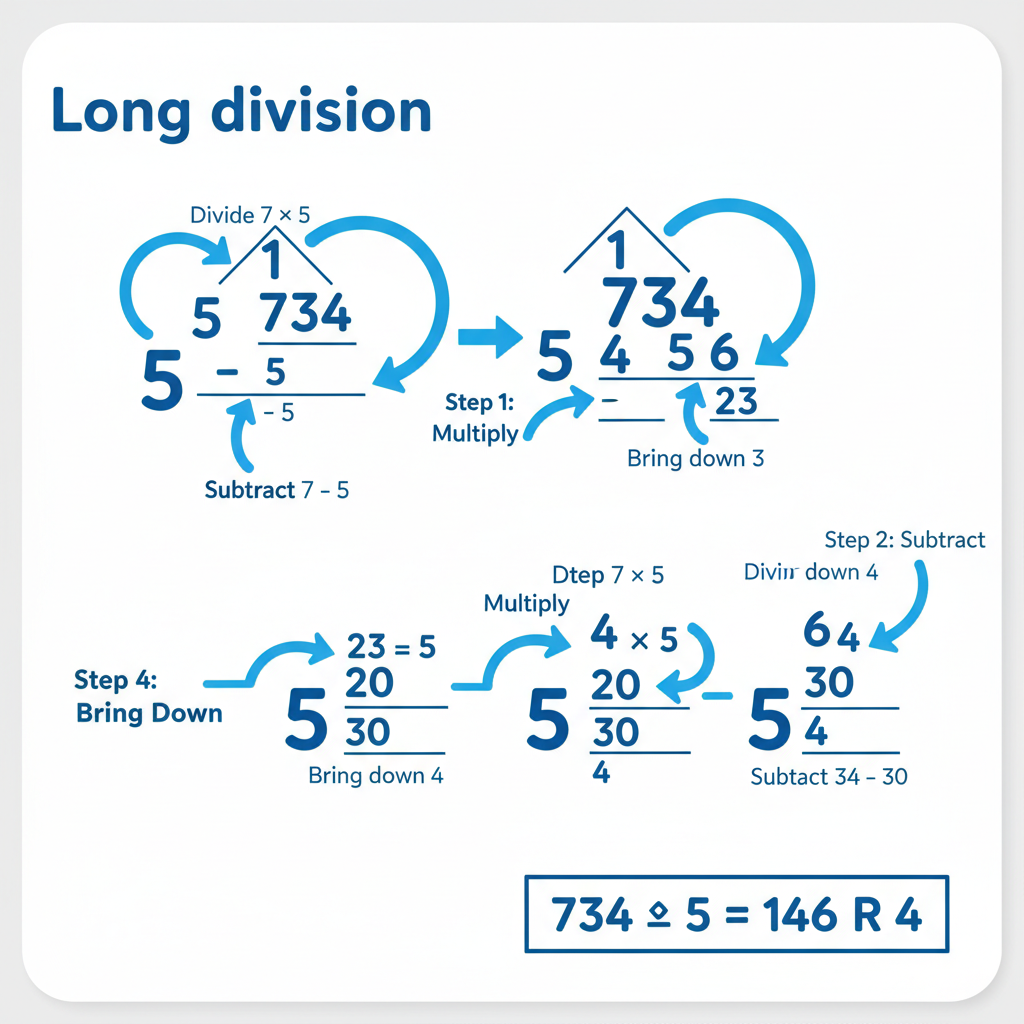 ⚠️ This picture may have spelling mistakes. Trust the words in the lesson.
Keep learning, free
Create a free Syllabax account to unlock practice questions and games for this topic.
Visual Learning Enhanced! 🚀
To help you master this topic, we use Advanced Syllabax AI to generate detailed diagrams and visual models.
Note on Visuals: The AI sometimes makes spelling errors in image labels. Please refer to the lesson text for the correct terminology.