Hardness, solubility, transparency, conductivity[CHEMISTRY]
Watch this topic in 60 seconds
Free preview · Lesson 1
Understanding Hardness, solubility, transparency, conductivity[CHEMISTRY]
Exploring the Properties of Matter: Hardness, Solubility, Transparency, and Conductivity
Welcome, young scientists, to an exciting journey into the world of matter! Everything around us – your desk, the air you breathe, the water you drink – is made of matter. But not all matter is the same! Today, we're going to become detectives and investigate some of the cool properties that make different kinds of matter unique. Think of these properties as the special characteristics that help us identify and understand what things are made of.
What are Properties of Matter?
Imagine you have a box filled with different toys. How would you tell a soft teddy bear apart from a hard wooden block? You might touch them! You might look at them! You might even try to float them in water. The ways you describe and distinguish these toys are like the properties of matter. They are the characteristics that describe how a substance behaves and what it's like.
1. Hardness: How Tough is it?
Have you ever tried to scratch a piece of chalk? It's really easy, right? Now, try to scratch a diamond. That's much harder, and you probably shouldn't even try! This difference in how easily something can be scratched or dented is called hardness. Some things are soft, and others are hard.
Analogy Time! Think about fingernails. Your fingernail is pretty soft. You can scratch a bar of soap with it easily. But if you tried to scratch a metal spoon with your fingernail, nothing would happen! The metal spoon is much harder than the soap.
Scientists have a way to measure hardness using a scale called the Mohs Hardness Scale. On this scale, softer minerals get lower numbers, and harder minerals get higher numbers. Talc, a very soft mineral used in baby powder, is at the bottom (1), while diamond, the hardest natural substance, is at the top (10).
Key Idea: Hardness tells us how resistant a material is to being scratched or worn away.
2. Solubility: Can it Dissolve?
Have you ever made lemonade? You put sugar into water, and after stirring, the sugar seems to disappear! It has dissolved. Solubility is a property that describes whether a substance can dissolve into another substance, usually a liquid like water. The substance that dissolves is called the solute (like the sugar), and the substance it dissolves in is called the solvent (like the water).
Analogy Time! Imagine you have a puzzle. Some puzzle pieces fit together perfectly and disappear into the picture. Those are like soluble things! Other puzzle pieces are too big or the wrong shape, and they just sit there, not fitting in. Those are like insoluble things.
Water is often called the "universal solvent" because so many things can dissolve in it, like salt, sugar, and even some types of metal. However, some things, like sand or oil, don't dissolve in water. We say they are insoluble in water.
Key Idea: Solubility tells us if one substance can mix evenly into another to form a solution.
3. Transparency: Can Light Pass Through?
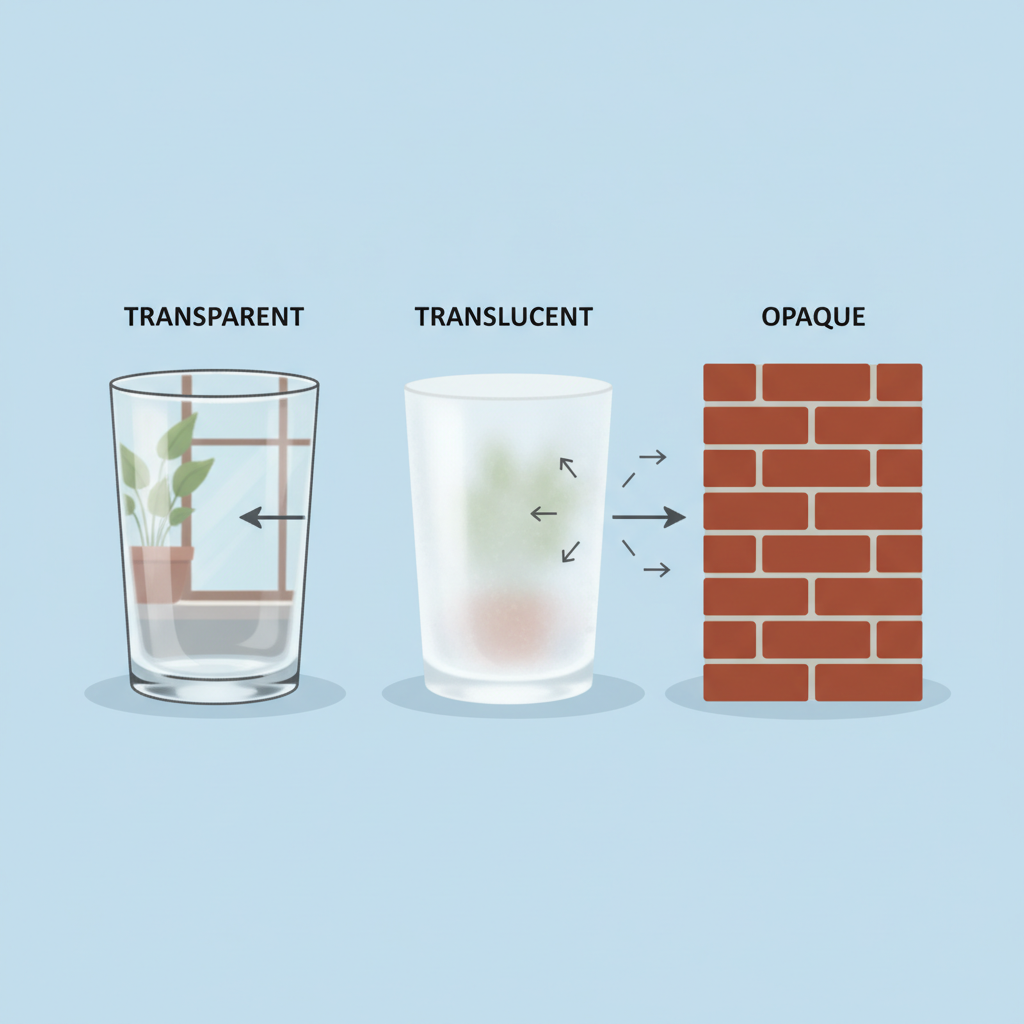
Look around your classroom. You can probably see through the windows, right? That's because windows are usually made of glass, which is transparent. Transparency describes how well light can pass through a material.
There are three main ways materials interact with light:
- Transparent: You can see clearly through them because light passes through easily. Think of clear glass or clean water.
- Translucent: Light can pass through, but it's scattered, so you can't see clearly. It's like looking through frosted glass or a thin piece of paper. You can see light, but not a clear image.
- Opaque: Light cannot pass through at all. It blocks the light completely. Think of a wooden door or a brick wall.
Analogy Time! Imagine different kinds of curtains:
- A sheer, see-through curtain is like a transparent material – you can see everything outside clearly.
- A lace curtain is like a translucent material – you can see that it's bright outside, but you can't make out the details of what's there.
- A thick, dark curtain is like an opaque material – it completely blocks out the light and you can't see anything through it.
Key Idea: Transparency describes how much light can travel through a material.
4. Conductivity: Can it Conduct Heat or Electricity?
Have you ever touched a metal spoon that was left in a hot bowl of soup? Ouch! That spoon gets hot really quickly. This is because metal is a good conductor of heat. Conductivity is a property that tells us how well a material allows heat or electricity to flow through it.
There are two main types of conductors:
- Conductors: Materials that allow heat and electricity to pass through easily. Metals like copper, aluminum, and iron are excellent conductors. That's why electrical wires are often made of copper, and cooking pots often have metal bases.
- Insulators: Materials that do NOT allow heat and electricity to pass through easily. They resist the flow. Examples include wood, plastic, rubber, and glass. This is why the handles of cooking pots are often made of plastic or wood, and electrical wires are coated in plastic.
Analogy Time! Think about water flow:
- A wide, clear pipe is like a conductor – water (heat or electricity) flows through it easily and quickly.
- A pipe filled with rocks and mud is like an insulator – it's very difficult for water to get through.
Key Idea: Conductivity tells us how easily heat or electricity can travel through a material.
Putting It All Together!
We've learned about four important properties of matter: hardness, solubility, transparency, and conductivity. By observing and testing these properties, we can understand and even predict how different materials will behave. Scientists use these properties every day to invent new materials and create amazing things!
Keep learning, free
Create a free Syllabax account to unlock practice questions and games for this topic.
Visual Learning Enhanced! 🚀
To help you master this topic, we use Advanced Syllabax AI to generate detailed diagrams and visual models.
Note on Visuals: The AI sometimes makes spelling errors in image labels. Please refer to the lesson text for the correct terminology.