Learning Journey
Watch this topic in 60 seconds
Free preview · Lesson 1
Understanding Proportion & unitary method [3 Ratio & Proportion]
Understanding Proportion and the Unitary Method (Part 3: Ratio & Proportion)
Welcome back to our journey into the fascinating world of numbers! In this lesson, we're going to build upon what we've learned about ratios and dive deeper into the concept of proportion and a super useful tool called the unitary method. Don't worry, we'll use lots of everyday examples to make sure everything is crystal clear!
What is Proportion?
Imagine you're baking cookies. The recipe calls for 2 cups of flour for every 1 cup of sugar. If you want to make a double batch, you'll need 4 cups of flour and 2 cups of sugar. Notice how the relationship between flour and sugar stays the same? This is the essence of proportion!
Proportion is a mathematical statement that two ratios are equal. Remember, a ratio compares two quantities. So, a proportion compares two ratios.
We can write a proportion like this:
Ratio 1 = Ratio 2
Or using mathematical symbols:
a : b = c : d
This is read as "a is to b as c is to d". It means that the ratio of 'a' to 'b' is the same as the ratio of 'c' to 'd'.
Analogy Time: The Perfect Pizza Slice
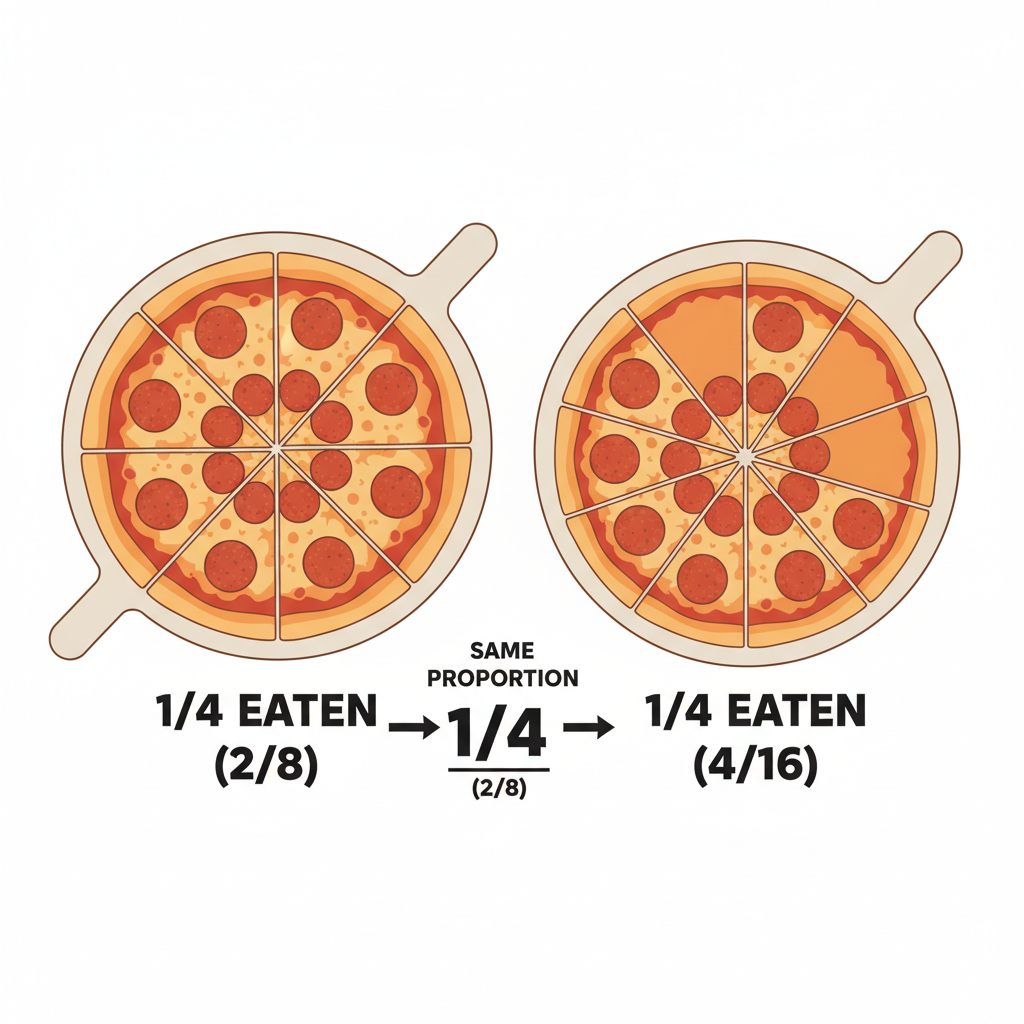
Think about sharing a pizza. If one pizza is cut into 8 slices and you eat 2 slices, your ratio of eaten slices to total slices is 2:8. If your friend eats 4 slices from a pizza cut into 16 slices, their ratio is 4:16. Are these ratios proportional? Let's simplify them!
Your ratio: 2:8 can be simplified to 1:4 (by dividing both by 2).
Your friend's ratio: 4:16 can be simplified to 1:4 (by dividing both by 4).
Since both ratios simplify to 1:4, they are proportional! This means the proportion of pizza eaten is the same for both of you, even though you ate different numbers of slices from differently cut pizzas.
Why are Proportions Useful?
Proportions help us solve many real-world problems:
- Scaling recipes: Doubling or halving ingredients.
- Map reading: Understanding distances on a map compared to real distances.
- Unit conversions: Changing from inches to centimeters, for example.
- Comparing rates: Speed (miles per hour), cost (dollars per pound).
The Unitary Method: Finding the Value of One
Now, let's talk about the unitary method. This is a powerful technique where we first find the value of a single unit, and then use that to find the value of any number of units.
The word "unitary" comes from "unit," meaning one.
Analogy Time: Buying Apples at the Market
Imagine you go to the market and see a sign that says:
"5 apples for $10"
You want to know how much one apple costs. Using the unitary method, you would:
- Find the value of one unit (one apple): Divide the total cost by the number of apples.
So, the value of one unit (one apple) is $2.
Now, let's say you want to buy 3 apples. How much will they cost?
- Find the value of the desired number of units (3 apples): Multiply the value of one unit by the number of units you want.
See? The unitary method helped us easily figure out the cost of 3 apples by first finding the cost of just one!
More Unitary Method Examples:
Example 1: Cost of Pens
If 6 pens cost $12, how much do 9 pens cost?
- Step 1: Find the cost of 1 pen.
- Cost of 1 pen = Total cost / Number of pens
- Cost of 1 pen =
- Step 2: Find the cost of 9 pens.
- Cost of 9 pens = Cost of 1 pen * Number of pens
- Cost of 9 pens =
So, 9 pens will cost $18.
Example 2: Distance Travelled
If a car travels 150 kilometers in 3 hours, how far will it travel in 5 hours (assuming it travels at a constant speed)?
- Step 1: Find the distance travelled in 1 hour.
- Distance in 1 hour = Total distance / Total hours
- Distance in 1 hour = 150 km / 3 hours = 50 km per hour.
- Step 2: Find the distance travelled in 5 hours.
- Distance in 5 hours = Distance in 1 hour * Number of hours
- Distance in 5 hours = 50 km/hour * 5 hours = 250 km.
The car will travel 250 kilometers in 5 hours.
Connecting Proportions and the Unitary Method
The unitary method is a fantastic way to solve problems involving proportions. When we find the value of one unit, we are essentially establishing a baseline ratio that we can then use to find other equivalent ratios.
Let's revisit the apples example:
We know 5 apples cost $10. We want to find the cost of 3 apples.
We can set up a proportion:
Cost of apples : Number of apples
Using the unitary method, we found that 1 apple costs
Now we want to find the cost (let's call it 'x') for 3 apples:
$2 : 1 = x : 3
This proportion states that the ratio of cost to apples is constant. Using the unitary method, we already know that if 1 apple costs
2/1 = x/3
To solve for x, we can cross-multiply or simply multiply both sides by 3:
2 * 3 = x
6 = x
So, 3 apples cost $6. The unitary method makes finding that 'x' value very straightforward!
Key Takeaways
Remember these important points:
- Proportion means that two ratios are equal. It shows that the relationship between quantities remains the same.
- The unitary method helps us find the value of a single unit first, then use it to find the value of multiple units.
- The unitary method is a key tool for solving proportion problems in everyday life, from recipes to shopping.
Keep learning, free
Create a free Syllabax account to unlock practice questions and games for this topic.
Visual Learning Enhanced! 🚀
To help you master this topic, we use Advanced Syllabax AI to generate detailed diagrams and visual models.
Note on Visuals: The AI sometimes makes spelling errors in image labels. Please refer to the lesson text for the correct terminology.