Simple linear expressions [1 Introduction to Algebra]
Watch this topic in 60 seconds
Free preview · Lesson 1
Understanding Simple linear expressions [1 Introduction to Algebra]
Welcome to the Magical World of Simple Linear Expressions!
Have you ever wondered how to describe things that can change or are unknown? Think about a surprise party! You know you're getting presents, but you don't know *exactly* how many you'll get until the day of the party. Algebra helps us talk about these "unknowns" and things that can "vary." Let's dive into the exciting world of simple linear expressions!
What is an Expression? Think of it like a Recipe!
Imagine you're baking cookies. Your recipe tells you what ingredients you need and how to combine them. An expression in math is a bit like a recipe. It's a combination of numbers, symbols, and mathematical operations (like addition, subtraction, multiplication, and division) that we use to represent a value.
Example: If you have a bag of apples and you add 3 more apples, you can write this as an expression: apples + 3. Here:
- 'apples' is like an unknown ingredient. We don't know the exact number yet.
- '+' is the operation – we are adding.
- '3' is a known number.
This combination 'apples + 3' is our expression. It tells us a story about what's happening with the apples.
Introducing Variables: The Mysterious Boxes!
In our cookie recipe, we might have "flour," "sugar," and "eggs." In math expressions, we use letters, usually from the end of the alphabet (like x, y, z), to stand for unknown numbers or quantities. These letters are called variables.
Think of a variable as a mysterious box. Inside the box, there's a number, but we don't know what it is yet. We use the letter (like 'x') to represent whatever number is inside the box.
Analogy: Let's say you're saving money. You already have
- 'w' is our variable. It represents the number of weeks.
- '$10' is a constant (we'll get to that next!).
- '$5' is also a constant, but it's attached to our variable.
- '+' and '*' are operations.
Constants: The Fixed Amounts
Just like how a recipe might call for a specific amount of sugar (say, 2 cups), constants in math expressions are numbers that have a fixed value. They don't change.
In our money-saving example, $10 and $5 are constants. They are fixed amounts.
Analogy: Imagine you're going on a field trip. The bus costs a fixed amount, say
Terms: The Building Blocks of Expressions
Expressions are made up of parts called terms. Terms are separated by addition (+) or subtraction (-) signs.
In the expression
- '100' is a term.
- '$5 * s' is another term. Notice that multiplication and division don't separate terms; it's only addition and subtraction.
Let's look at another example: 7x - 3 + 2y
- The terms are: '7x', '-3', and '+2y'.
Each term can be made up of a number and a variable (like '7x'), or just a number (like '-3').
Coefficients: The Partners of Variables
When a number is multiplied by a variable, that number is called the coefficient. It's like the number that's paired up with our mysterious box (the variable).
In the expression 7x - 3 + 2y:
- The coefficient of 'x' is 7. This means we have 7 of the 'x' boxes.
- The coefficient of 'y' is 2. This means we have 2 of the 'y' boxes.
If you see just a variable, like 'x', the coefficient is understood to be 1 (because 1*x is just x).
Putting It All Together: Simple Linear Expressions
A simple linear expression is an expression where:
- The variables have exponents of only 1 (meaning you won't see things like x², y³, etc.).
- There are no variables in the denominator of a fraction.
- There are no variables multiplied by other variables.
Essentially, they are straightforward combinations of constants and variables multiplied by coefficients, added or subtracted together.
Analogy: Think of building with LEGO bricks. A simple linear expression is like building a simple tower with basic bricks. You can use different colors (variables) and different numbers of bricks (coefficients), and you can stack them or place them side-by-side (addition/subtraction), but you can't do anything too complicated like building curved walls or making the bricks themselves glow (which would be like higher exponents or more complex operations).
Example: 5x + 8 is a simple linear expression.
- 'x' is the variable (exponent is 1).
- '5' is the coefficient.
- '8' is the constant.
Example: y - 12 is a simple linear expression.
- 'y' is the variable (exponent is 1).
- The coefficient of 'y' is 1 (unwritten).
- '-12' is the constant.
Non-Example: 3x² + 2y is NOT a simple linear expression because 'x' has an exponent of 2.
Non-Example: 4/x + y is NOT a simple linear expression because 'x' is in the denominator.
Non-Example: xy - 5 is NOT a simple linear expression because 'x' and 'y' are multiplied together.
Why Are They Important?
Simple linear expressions are the building blocks of algebra! They help us solve problems in many areas, from calculating the cost of items to figuring out distances and speeds, and even in computer programming. They provide a powerful way to represent and understand relationships between quantities.
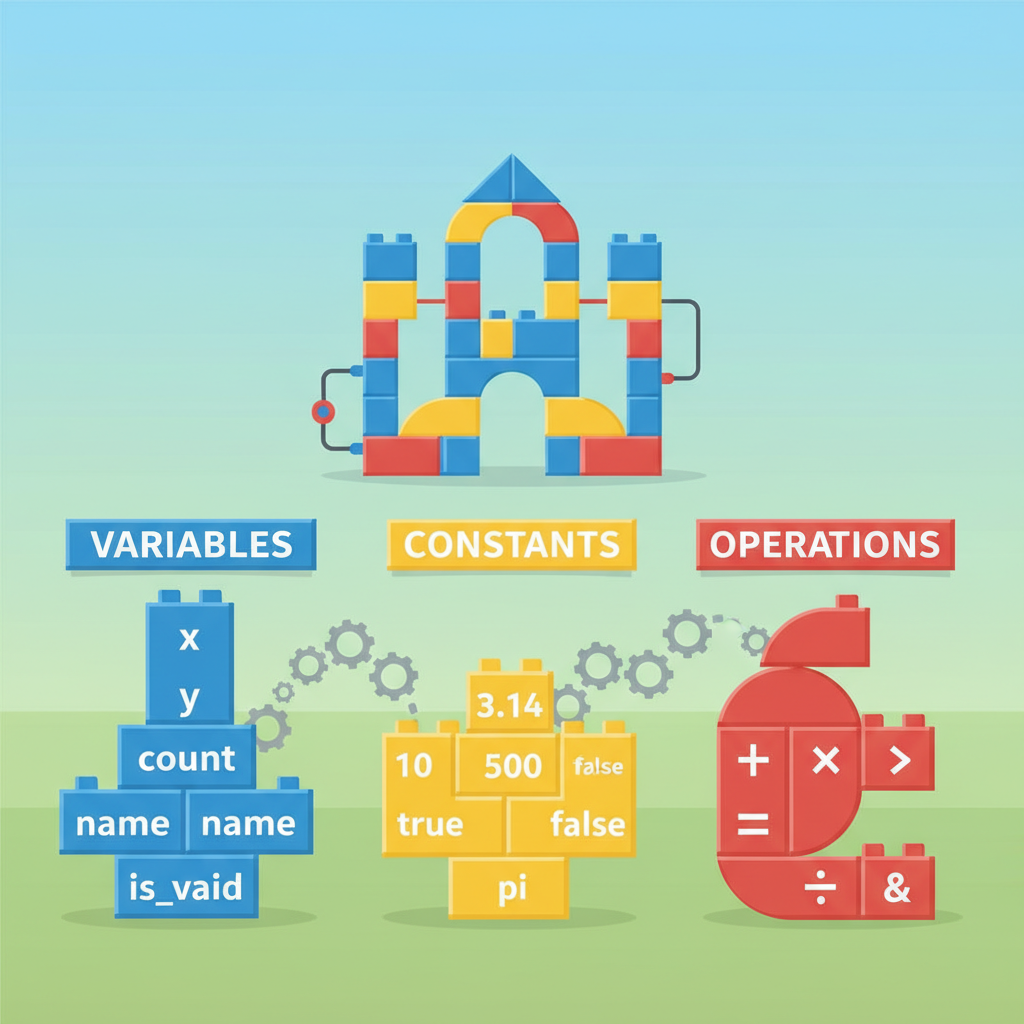 ⚠️ This picture may have spelling mistakes. Trust the words in the lesson.
Summary
Today, we learned about:
- Expressions: Mathematical phrases with numbers, variables, and operations.
- Variables: Letters representing unknown values (like mystery boxes).
- Constants: Numbers with fixed values.
- Terms: Parts of an expression separated by + or -.
- Coefficients: Numbers multiplied by variables.
- Simple Linear Expressions: Basic expressions without complex exponents or variable combinations.
Keep practicing, and you'll become an algebra superstar in no time!
Keep learning, free
Create a free Syllabax account to unlock practice questions and games for this topic.
Visual Learning Enhanced! 🚀
To help you master this topic, we use Advanced Syllabax AI to generate detailed diagrams and visual models.
Note on Visuals: The AI sometimes makes spelling errors in image labels. Please refer to the lesson text for the correct terminology.