Place value of decimals [Decimals]
Watch this topic in 60 seconds
Free preview · Lesson 1
Understanding Place value of decimals [Decimals]
Understanding Place Value of Decimals
Welcome to the exciting world of decimals! Decimals are a way to represent numbers that are less than one whole, or parts of a whole. Think of them like sharing a pizza or a cake. When you cut a pizza into slices, each slice is a part of the whole pizza. Decimals help us name and work with those parts precisely!
What is Place Value?
Before we dive into decimals, let's quickly remember what place value means for whole numbers. In a number like 123, each digit has a special job based on its position:
- The 3 is in the ones place. It represents 3 individual things.
- The 2 is in the tens place. It represents 2 groups of ten, or 20 things.
- The 1 is in the hundreds place. It represents 1 group of a hundred, or 100 things.
So, 123 means 1 hundred, 2 tens, and 3 ones.
Introducing the Decimal Point
The decimal point (.) is like a tiny, but super important, separator. It tells us where the whole numbers end and the decimal (or fractional) parts begin.
Imagine a number line. Whole numbers are like mile markers: 0, 1, 2, 3, and so on. The decimal point lets us talk about all the tiny steps between those mile markers!
The Decimal Side: Parts of a Whole
To the right of the decimal point, we have places that represent fractions of a whole. These places get smaller and smaller as you move away from the decimal point. Let's explore them:
The Tenths Place
The first place to the right of the decimal point is the tenths place. This represents one-tenth (1/10) of a whole.
Analogy: If you have one whole candy bar and you break it into 10 equal pieces, each piece is one-tenth of the candy bar. If you have 3 of those pieces, you have 3 tenths, which we write as 0.3.
In the number 0.3, the '3' is in the tenths place.
The Hundredths Place
The next place to the right is the hundredths place. This represents one-hundredth (1/100) of a whole.
Analogy: Remember our candy bar broken into 10 pieces? Now imagine breaking *each* of those 10 pieces into 10 smaller pieces. That means the original candy bar is now broken into 100 tiny, equal pieces! Each tiny piece is one-hundredth of the whole candy bar. If you have 7 of these tiny pieces, you have 7 hundredths, which we write as 0.07.
In the number 0.07, the '7' is in the hundredths place.
Notice the zero before the 7. This zero is important! It tells us we have 0 tenths and only 7 hundredths. Without it (0.7), it would mean 7 tenths, which is much larger!
The Thousandths Place
Moving further right, we have the thousandths place. This represents one-thousandth (1/1000) of a whole.
Analogy: Imagine our 100 tiny candy bar pieces from before. Now, break each of *those* pieces into 10 even smaller pieces. Now the whole candy bar is divided into 1000 super-tiny, equal pieces! Each one is one-thousandth of the original bar. If you have 5 of these, you have 5 thousandths, written as 0.005.
In the number 0.005, the '5' is in the thousandths place. The zeros before it are crucial to show we have 0 tenths and 0 hundredths.
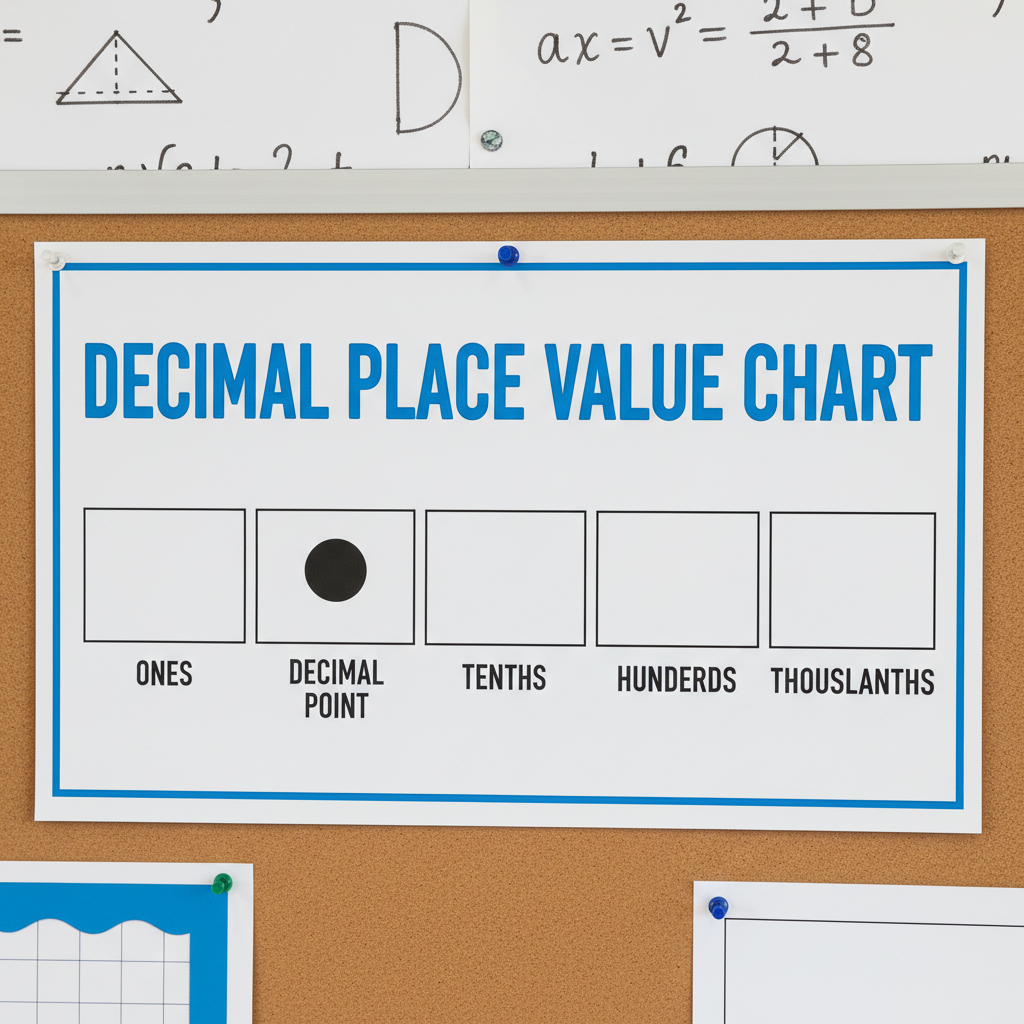
Putting It All Together: The Decimal Place Value Chart
We can use a chart to visualize all these places:
 ⚠️ This picture may have spelling mistakes. Trust the words in the lesson.
Let's look at a number like 12.345:
- The 12 to the left of the decimal point are whole numbers. The '2' is in the ones place, and the '1' is in the tens place.
- The . is the decimal point.
- The 3 to the right of the decimal point is in the tenths place. It means 3 tenths (3/10).
- The 4 is in the hundredths place. It means 4 hundredths (4/100).
- The 5 is in the thousandths place. It means 5 thousandths (5/1000).
So, 12.345 means 1 ten, 2 ones, 3 tenths, 4 hundredths, and 5 thousandths.
Key Ideas to Remember:
- The decimal point separates whole numbers from parts of a whole.
- Places to the right of the decimal represent fractions: tenths, hundredths, thousandths, etc.
- Each place to the right is 10 times smaller than the place to its left. (A tenth is 10 times bigger than a hundredth, and a hundredth is 10 times bigger than a thousandth).
- Zeros after the decimal point but before the first non-zero digit are important for showing the correct place value.
Understanding place value with decimals is like having a precise measuring tape for numbers. It helps us compare numbers, add them, subtract them, and much more!
Keep learning, free
Create a free Syllabax account to unlock practice questions and games for this topic.
Visual Learning Enhanced! 🚀
To help you master this topic, we use Advanced Syllabax AI to generate detailed diagrams and visual models.
Note on Visuals: The AI sometimes makes spelling errors in image labels. Please refer to the lesson text for the correct terminology.