Learning Journey
Free preview · Lesson 1
Understanding Loudness and pitch (PHYSICS)
Understanding Sound: How Loud Is It? How High or Low Is It?
Have you ever wondered about the amazing world of sound? Sounds are everywhere! They help us communicate, enjoy music, and even warn us of danger. Today, we're going to explore two important qualities of sound: loudness and pitch.
What is Sound?
Before we dive into loudness and pitch, let's quickly remember what sound is. Sound is made by vibrations! When something vibrates, it shakes back and forth very quickly. These vibrations travel through the air (or other things like water or solids) as waves, and when these waves reach our ears, we hear them as sound.
Think of a drum. When you hit a drum, the surface of the drum vibrates. This vibration makes the air particles around it vibrate, and those vibrations travel to your ears, so you hear the drum sound.
Investigating Loudness: How Strong is the Sound?
Have you ever noticed that some sounds are very quiet, like a whisper, while others are very loud, like a thunderclap? That difference is called loudness. Loudness tells us how much energy a sound wave has.
What Makes a Sound Loud or Quiet?
Loudness is related to how big the vibrations are. When something vibrates with a bigger movement, it pushes and pulls the air particles with more force. This creates sound waves with bigger 'hills' and 'valleys' (these are called amplitude). The bigger the amplitude of the sound wave, the louder the sound will be.
Imagine dropping a pebble into a pond. If you drop it gently, it makes small ripples. If you throw it in with a lot of force, it makes big splashes and much larger ripples. The larger ripples are like a louder sound wave, and the smaller ripples are like a quieter sound wave.
Another way to think about it is pushing a swing. A small push makes the swing go back and forth a little. A big push makes the swing go much higher and further. The big push creates a bigger movement, just like a loud sound has a bigger vibration.
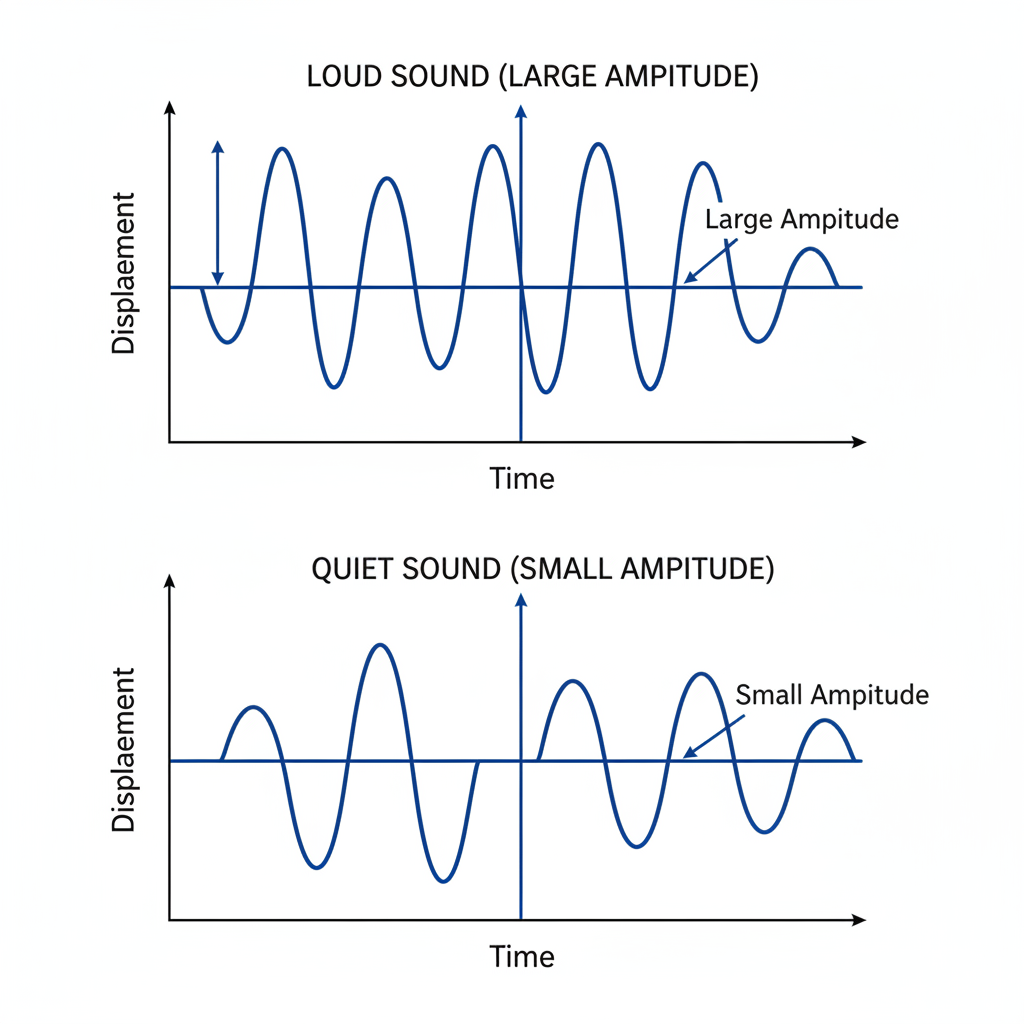 ⚠️ This picture may have spelling mistakes. Trust the words in the lesson.
Measuring Loudness
Scientists use a special unit to measure loudness called decibels (dB). A whisper might be around 30 dB, normal conversation is around 60 dB, and a rock concert can be over 100 dB!
Key Points about Loudness:
- Loudness is how strong or weak a sound is.
- It's caused by the size (amplitude) of the vibrations.
- Bigger vibrations = Louder sound.
- Smaller vibrations = Quieter sound.
Exploring Pitch: How High or Low Is the Sound?
Now let's talk about pitch. Have you ever noticed that a tiny mouse squeaks with a high-pitched sound, while a big bear growls with a low-pitched sound? Pitch is what makes sounds seem high or low.
What Makes a Sound High or Low?
Pitch is related to how fast something is vibrating. When something vibrates very quickly, it creates sound waves that are close together. This results in a high-pitched sound. When something vibrates slowly, it creates sound waves that are farther apart. This results in a low-pitched sound.
Think about a rubber band. If you stretch it and pluck it, it makes a sound. If you pluck a thick, loose rubber band, it makes a low sound. If you pluck a thin, tight rubber band, it makes a high sound. The thin, tight rubber band vibrates much faster than the thick, loose one.
Another example is musical instruments. A small, thin guitar string vibrates very quickly when plucked, making a high note. A big, thick bass guitar string vibrates more slowly, making a low note.
Imagine a racecar engine. When it's revving high, the engine sounds like it's going very fast and makes a high-pitched roar. When it's idling slowly, the engine sounds deeper and lower.
Measuring Pitch
Pitch is measured by something called frequency, which is how many waves there are in a certain amount of time. The unit for frequency is Hertz (Hz). A higher frequency means a higher pitch, and a lower frequency means a lower pitch.
Key Points about Pitch:
- Pitch is how high or low a sound is.
- It's caused by how fast the object vibrates.
- Fast vibrations = High pitch.
- Slow vibrations = Low pitch.
Putting It All Together
So, we have two main ways to describe sounds: loudness and pitch.
- Loudness is about the strength of the sound, determined by how big the vibrations are.
- Pitch is about whether the sound is high or low, determined by how fast the vibrations are.
The next time you hear a sound, try to think about its loudness and its pitch! Is it loud or quiet? Is it high or low?
Keep learning, free
Create a free Syllabax account to unlock practice questions and games for this topic.
Visual Learning Enhanced! 🚀
To help you master this topic, we use Advanced Syllabax AI to generate detailed diagrams and visual models.
Note on Visuals: The AI sometimes makes spelling errors in image labels. Please refer to the lesson text for the correct terminology.