Hierarchical taxonomy[BIOLOGY]
Watch this topic in 60 seconds
Free preview · Lesson 1
Understanding Hierarchical taxonomy[BIOLOGY]
Understanding Hierarchical Taxonomy in Biology
Welcome to the fascinating world of biological classification! Have you ever wondered how scientists keep track of all the millions of different living things on Earth? It's like trying to organize a giant library with books on every subject imaginable. To make sense of this incredible diversity, biologists use a system called hierarchical taxonomy. Think of it as a set of nested boxes, where each box contains smaller boxes, and so on, until you get to the tiniest, most specific groups.
What is Taxonomy?
Taxonomy is the science of naming, describing, and classifying organisms. It's about putting living things into groups based on their shared characteristics. Imagine you're sorting your LEGO bricks. You might group them by color, then by shape, then by size. Taxonomy does something similar, but with living organisms.
Why Hierarchical?
The "hierarchical" part means the system is organized in levels, from very broad categories to very specific ones. It's like a pyramid or an upside-down tree, with the most general groups at the top and the most specific groups at the bottom. Each level, or rank, is a category that includes other categories below it.
The Levels of Classification (The Linnaean System)
The most common system of hierarchical taxonomy used today was developed by Carl Linnaeus in the 18th century. It has several levels, but we usually focus on the main ones. Let's explore them from broadest to most specific:
1. Domain (The Biggest Box)
This is the highest and most inclusive level. It's like the largest shipping container that holds many smaller containers. There are three main Domains:
- Bacteria: Single-celled organisms without a nucleus. Think of them as tiny, simple workers in the biological world.
- Archaea: Also single-celled organisms without a nucleus, but they often live in extreme environments (like hot springs or deep-sea vents). They are like the super-tough, specialized workers.
- Eukarya: Organisms that have cells with a nucleus. This is the group we belong to! It includes plants, animals, fungi, and protists. These are like the more complex factories with organized departments (the nucleus).
Imagine your entire toy collection. The "Domain" is like deciding if you're sorting toys, books, or clothes. Bacteria, Archaea, and Eukarya are like saying "only toys" or "only books."
2. Kingdom (A Large Room within the Container)
Below each Domain are Kingdoms. This is like a large room inside your shipping container, holding different types of items within that category. For Eukarya, there are typically six Kingdoms (though classifications can vary slightly):
- Animalia (Animals): Multicellular organisms that eat other organisms. Think of your pets, insects, and even fish!
- Plantae (Plants): Multicellular organisms that make their own food using sunlight. Trees, flowers, and grass are all in this Kingdom.
- Fungi (Fungi): Organisms like mushrooms and yeasts. They get nutrients by absorbing them from their surroundings.
- Protista (Protists): A diverse group of mostly single-celled eukaryotes. This is a bit like a 'catch-all' for eukaryotes that don't fit neatly into the other kingdoms. Algae and amoebas are examples.
- (Within Bacteria and Archaea, there are also corresponding Kingdoms.)
Continuing the toy analogy: If "Domain" was "Toys," "Kingdom" might be "Action Figures," "Building Blocks," or "Stuffed Animals." All are toys, but they are very different types.
3. Phylum (A Section within the Room)
Phylum is the next level down. Within a Kingdom, organisms are grouped into Phyla based on more specific body plans or structures. For example, within the Animalia Kingdom, there's a Phylum called Chordata, which includes animals with a backbone (like us!). Another Phylum is Arthropoda, which includes insects, spiders, and crustaceans – all having an exoskeleton.
Analogy: If "Kingdom" was "Action Figures," "Phylum" might be "Superheroes" (with capes and powers) or "Robots" (with mechanical parts). They are both action figures, but have distinct features.
4. Class (A Shelf within the Section)
A Class is a group within a Phylum. For instance, within the Phylum Chordata, we have the Class Mammalia (mammals), which are animals that have fur or hair and feed milk to their young. Other classes in Chordata include Aves (birds), Reptilia (reptiles), Amphibia (amphibians), and various classes of fish.
Back to action figures: If "Phylum" was "Superheroes," "Class" could be "Flying Superheroes" (like Superman) or "Superheroes with Super Strength" (like Hulk). They are both superheroes, but have different key abilities.
5. Order (A Box on the Shelf)
Orders group similar Classes together. In the Class Mammalia, there is an Order called Primates, which includes monkeys, apes, and humans. Another Order is Carnivora, which includes animals like dogs, cats, and bears.
Continuing the analogy: If "Class" was "Flying Superheroes," "Order" could be "Heroes who fly using wings" (like some angels in fiction) or "Heroes who fly using technology" (like Iron Man). They both fly, but the mechanism differs.
6. Family (A Small Container within the Box)
Families are groups of related Genera. Within the Order Primates, there is the Family Hominidae, which includes humans, chimpanzees, gorillas, and orangutans. These are our closest relatives!
Analogy: If "Order" was "Heroes who fly using technology," "Family" might be "Heroes in powered suits" (like Iron Man) or "Heroes who fly personal aircraft" (like Batman's Batwing). They both use technology to fly, but the specific tech varies.
7. Genus (A Specific Type of Container)
A Genus is a group of very closely related species. For example, the genus Homo contains modern humans (Homo sapiens) and our extinct relatives like Homo erectus and Homo neanderthalensis.
Analogy: If "Family" was "Heroes in powered suits," "Genus" could be "Heroes in red and gold suits" (like specific Iron Man armors) or "Heroes in stealth suits" (like other specific Iron Man armors). They are very similar types of powered suit heroes.
8. Species (The Most Specific Item)
This is the most specific level. A species is a group of organisms that can interbreed and produce fertile offspring. For example, Homo sapiens is our species. A dog (Canis familiaris) is a different species from a wolf (Canis lupus), even though they are in the same Genus (Canis) and Family (Canidae).
Analogy: If "Genus" was "Heroes in red and gold suits," "Species" would be a particular hero within that group, like "Tony Stark in Mark XLII armor" or "Tony Stark in Mark LXXXV armor." They are distinct versions, but still the same core hero type.
Binomial Nomenclature: The Scientific Name
Carl Linnaeus also developed a system for giving each species a unique two-part scientific name, called binomial nomenclature. The first part is the Genus name (always capitalized), and the second part is the specific epithet (always lowercase). Both are usually italicized. For example, our scientific name is Homo sapiens. This system ensures that scientists worldwide use the same name for the same organism, avoiding confusion.
Why is This System Important?
Hierarchical taxonomy is crucial for several reasons:
- Organization: It helps us organize the vast diversity of life.
- Communication: It provides a universal language for scientists to discuss organisms.
- Understanding Relationships: It helps us understand the evolutionary relationships between different organisms. Organisms in the same genus are more closely related than organisms in the same family, and so on.
- Identification: It provides a framework for identifying new or unknown organisms.
Putting It All Together: An Example
Let's look at a common pet, the domestic dog:
- Domain: Eukarya
- Kingdom: Animalia
- Phylum: Chordata
- Class: Mammalia
- Order: Carnivora
- Family: Canidae
- Genus: Canis
- Species: Canis familiaris
Notice how each level gets more specific. All Eukaryotes are incredibly diverse, but dogs are specifically animals. All animals are diverse, but dogs are specifically Chordates (they have a backbone). This continues all the way down to the species, Canis familiaris, which is uniquely our domestic dog.
A Visual Summary
Imagine a set of Russian nesting dolls. The largest doll is the Domain. Inside it is a smaller doll, the Kingdom. Inside that is the Phylum, then the Class, Order, Family, Genus, and finally, the smallest doll is the Species. Each doll fits perfectly inside the one before it, showing the nested, hierarchical structure.
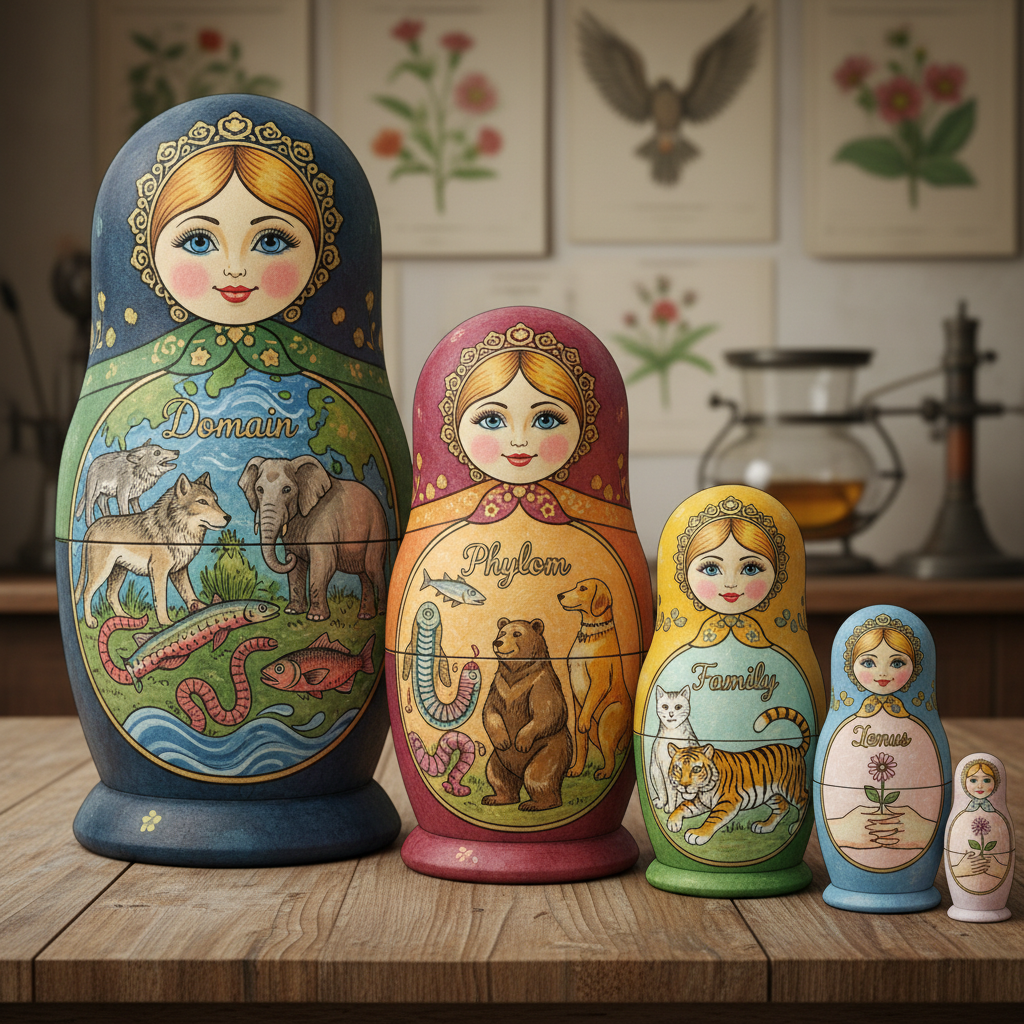 ⚠️ This picture may have spelling mistakes. Trust the words in the lesson.
Understanding this hierarchical system is fundamental to biology. It's the map that helps us navigate the incredible tree of life!
Keep learning, free
Create a free Syllabax account to unlock practice questions and games for this topic.
Visual Learning Enhanced! 🚀
To help you master this topic, we use Advanced Syllabax AI to generate detailed diagrams and visual models.
Note on Visuals: The AI sometimes makes spelling errors in image labels. Please refer to the lesson text for the correct terminology.