Addition & subtraction of like fractions [Fractions]
Watch this topic in 60 seconds
Free preview · Lesson 1
Understanding Addition & subtraction of like fractions [Fractions]
Addition and Subtraction of Like Fractions
Welcome, young mathematicians! Today, we're going on an exciting journey into the world of fractions. Think of fractions as slices of a delicious pizza or pieces of a yummy cake. They represent parts of a whole. We've already learned what fractions are, but today, we're going to learn how to put them together (add them) and take them apart (subtract them) when they are like fractions.
What are Like Fractions?
Imagine you have a pizza cut into 8 equal slices. If you eat 2 slices, you've eaten 2/8 of the pizza. If your friend eats 3 slices, they've eaten 3/8 of the pizza. Both of your slices are parts of a pizza that was cut into 8 equal pieces. Fractions that have the same denominator are called like fractions. The denominator is the bottom number in a fraction, and it tells us how many equal parts the whole is divided into. So, 2/8 and 3/8 are like fractions because they both have 8 as the denominator.
Let's use another analogy: Building blocks! Imagine you have a big box of LEGOs. If you have 5 red blocks and 3 red blocks, you can easily count them together because they are all red. Fractions with the same denominator are like these red blocks – they are the same 'color' or 'size' of piece, making it easy to combine or separate them.
Here are some examples of like fractions:
- 1/4 and 3/4
- 2/7 and 5/7
- 7/10 and 3/10
And here are some examples of fractions that are NOT like fractions (they are called unlike fractions):
- 1/2 and 1/3 (denominators are 2 and 3)
- 3/5 and 4/6 (denominators are 5 and 6)
Adding Like Fractions
Adding like fractions is like adding your red LEGO blocks together. If you have 2 red blocks and you get 3 more red blocks, how many red blocks do you have in total? You just count them up! 2 + 3 = 5 red blocks.
With fractions, it works the same way. When adding like fractions, we keep the denominator (the 'color' or 'size' of the piece) the same and simply add the numerators (the number of pieces we have). The numerator is the top number in a fraction, and it tells us how many parts we have.
Let's go back to our pizza. If you ate 2/8 of the pizza and your friend ate 3/8 of the pizza, how much pizza did you eat altogether?
- You ate: 2/8
- Your friend ate: 3/8
- Total eaten: 2/8 + 3/8
Since the denominators are the same (both are 8), we keep the 8 and add the numerators (2 + 3):
2/8 + 3/8 = (2 + 3) / 8 = 5/8
So, together you ate 5/8 of the pizza! It's like having 2 slices of an 8-slice pizza and adding 3 more slices of the same 8-slice pizza. You end up with 5 slices from that 8-slice pizza.
Rule for Adding Like Fractions:
- Make sure the denominators are the same.
- Add the numerators.
- Keep the denominator the same.
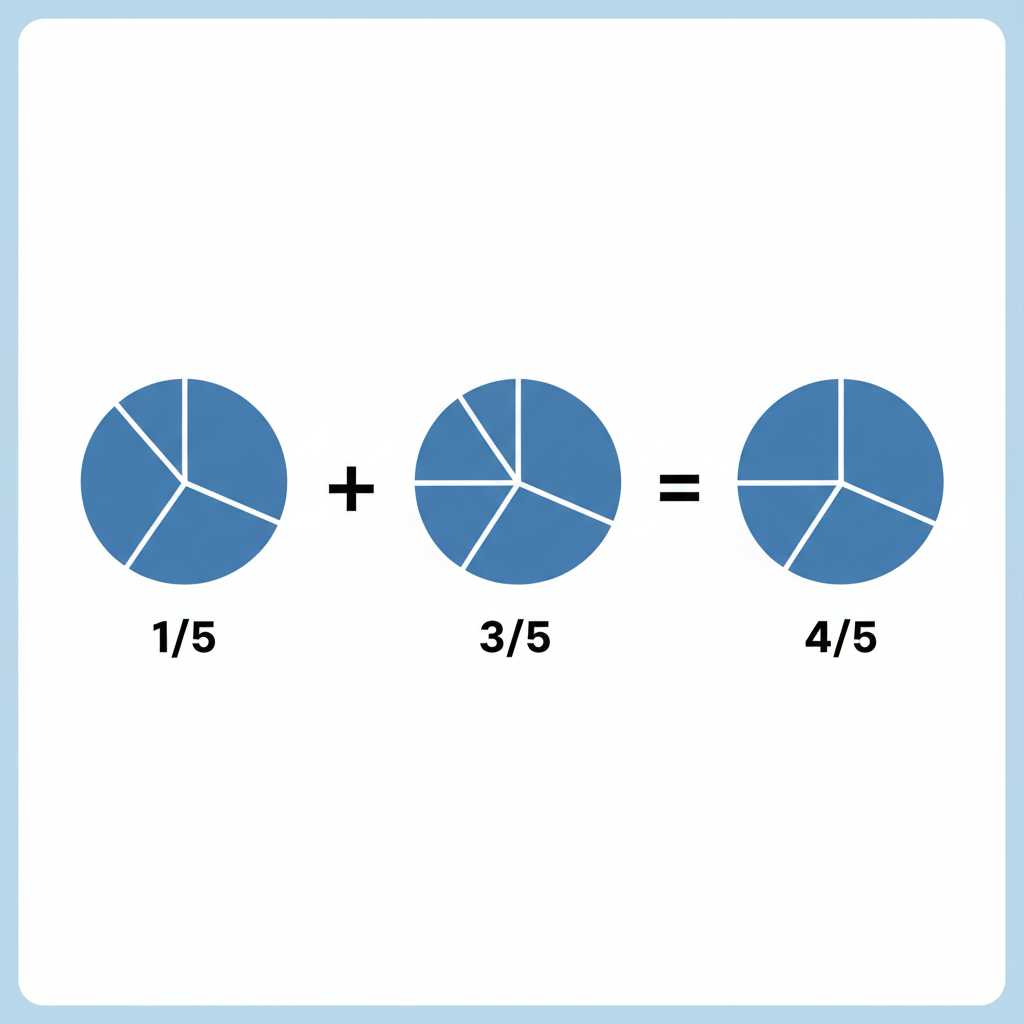
Let's try another example: 1/5 + 3/5
- Denominators are the same (5).
- Add the numerators: 1 + 3 = 4.
- Keep the denominator: 5.
- So, 1/5 + 3/5 = 4/5.
Imagine 5 equally sized chocolate squares making up one bar. If you have 1 square (1/5) and someone gives you 3 more squares (3/5), you now have 4 squares (4/5) of that chocolate bar.
 ⚠️ This picture may have spelling mistakes. Trust the words in the lesson.
Subtracting Like Fractions
Subtracting like fractions is very similar to adding them. It's like taking away some of your red LEGO blocks. If you had 5 red blocks and gave away 2 red blocks, how many do you have left? 5 - 2 = 3 red blocks.
With fractions, when we subtract like fractions, we keep the denominator the same and subtract the numerators.
Let's go back to our pizza again. Suppose there was a whole pizza cut into 8 slices (8/8). If 3 slices were eaten (3/8), how much pizza is left?
- Starting pizza: 8/8
- Slices eaten: 3/8
- Pizza left: 8/8 - 3/8
Since the denominators are the same (both are 8), we keep the 8 and subtract the numerators (8 - 3):
8/8 - 3/8 = (8 - 3) / 8 = 5/8
So, there are 5/8 of the pizza left. It's like starting with 8 slices of an 8-slice pizza and taking away 3 slices. You're left with 5 slices from that original 8-slice pizza.
Rule for Subtracting Like Fractions:
- Make sure the denominators are the same.
- Subtract the numerators.
- Keep the denominator the same.
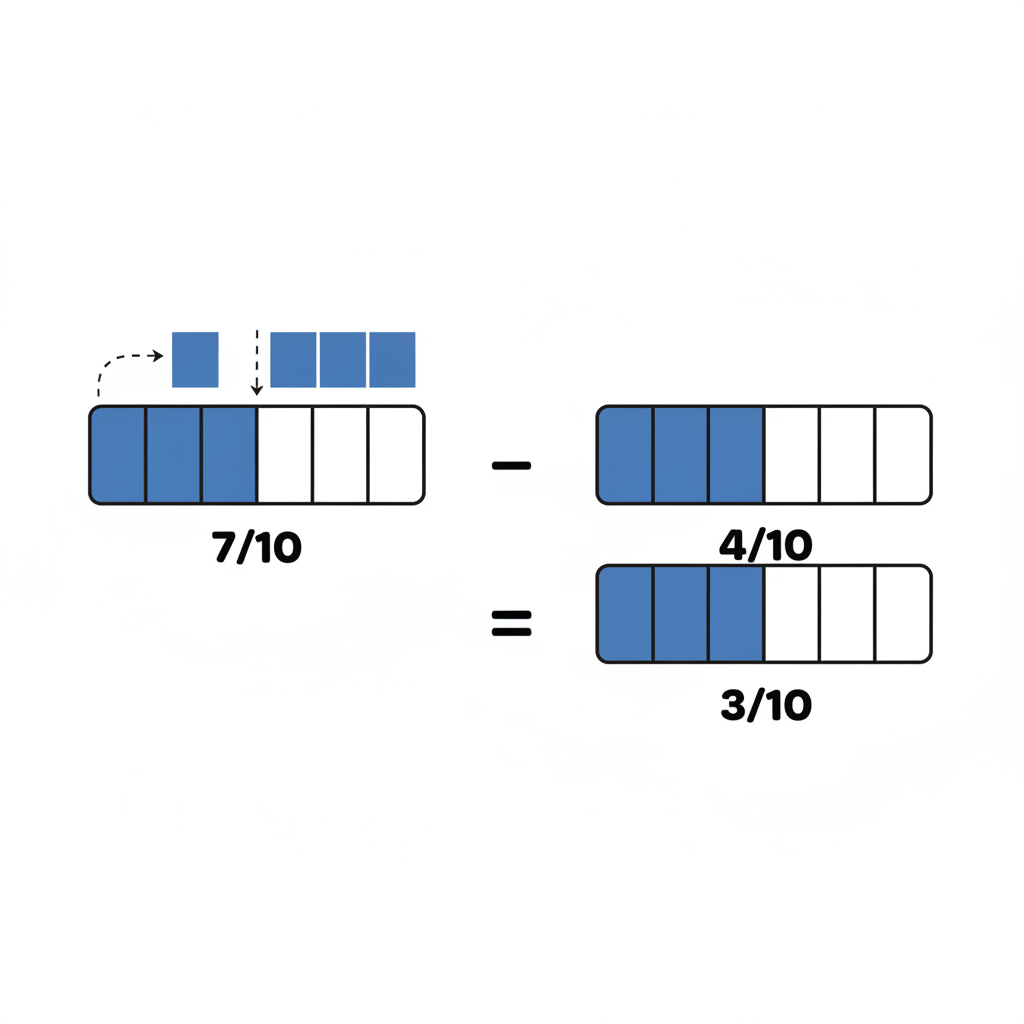
Let's try another example: 7/10 - 4/10
- Denominators are the same (10).
- Subtract the numerators: 7 - 4 = 3.
- Keep the denominator: 10.
- So, 7/10 - 4/10 = 3/10.
Imagine a bookshelf with 10 shelves. If 7 shelves are filled with books and you remove the books from 4 of those shelves, you'll have 3 shelves still filled with books (3/10). The total number of shelves (10) remains the same.
 ⚠️ This picture may have spelling mistakes. Trust the words in the lesson.
Putting It All Together
Remember, the key to adding and subtracting like fractions is that the 'pieces' must be the same size. If the denominators are the same, the pieces are the same size, and you can easily add or subtract the number of pieces (the numerators). If the denominators are different, you have to do more work to make them the same size before you can add or subtract, but that's a lesson for another day!
Think of it like this: You can easily add 3 apples and 2 apples to get 5 apples. But if you try to add 3 apples and 2 oranges, you can't just say you have 5 'apple-oranges'. You have 3 apples AND 2 oranges. Fractions are similar – only pieces of the same size (same denominator) can be combined or taken apart directly.
Keep practicing, and you'll become a fraction expert in no time!
Keep learning, free
Create a free Syllabax account to unlock practice questions and games for this topic.
Visual Learning Enhanced! 🚀
To help you master this topic, we use Advanced Syllabax AI to generate detailed diagrams and visual models.
Note on Visuals: The AI sometimes makes spelling errors in image labels. Please refer to the lesson text for the correct terminology.