(g, kg), (ml, L) (Length, Weight & Capacity)
Watch this topic in 60 seconds
Free preview · Lesson 1
Understanding (g, kg), (ml, L) (Length, Weight & Capacity)
Measuring Length, Weight, and Capacity: The Metric System for 4th Graders!
Hello amazing learners! Today, we're going on an exciting adventure into the world of measurement! We use measurement all the time, even when we don't realize it. When you ask how tall you've grown, or how much milk you need for your cereal, you're thinking about measurement. We're going to learn about three important types of measurement: length (how long something is), weight (how heavy something is), and capacity (how much something can hold). We'll be using the metric system, which is used by scientists and people all over the world! It's super organized and makes things easy to understand. Think of it like a really neat toolbox with tools that fit together perfectly!
Part 1: Measuring Length - How Long Is It?
Length tells us how far it is from one point to another. Imagine you're walking to the park. Length is the distance you travel. Or think about a long ribbon for a present – its length is how much ribbon you have. In the metric system, the main unit for measuring length is the meter (m).
Meters: The Big Picture
A meter is about the height of a doorknob on a door, or the length of a guitar. It's a good size for measuring things like the length of a room or the height of a person.
Centimeters: The Little Details
Sometimes, meters are too big! That's where centimeters (cm) come in. A centimeter is much smaller than a meter. In fact, there are 100 centimeters in just 1 meter! Think of a centimeter like the width of your pinky finger. It's perfect for measuring small things like the length of a pencil, the width of a book, or how long your fingernail has grown.
Analogy: Imagine you have a big candy bar (that's like a meter). If you break that candy bar into 100 tiny pieces, each tiny piece is like a centimeter. You get lots of small pieces from one big one!
Kilometers: The Super Long Distances
What if you want to measure a really, really long distance, like how far you have to drive to visit your grandparents? Meters are too small for that! For super long distances, we use kilometers (km). The prefix 'kilo' means 1000. So, 1 kilometer is equal to 1000 meters!
Analogy: Think of a meter as one big step. A kilometer is like taking 1000 of those big steps! It's a huge distance, perfect for measuring the distance between cities or the length of a long road.
Putting Length Together:
- Meter (m): For medium-sized things like a doorway or a small table.
- Centimeter (cm): For small things like a crayon or a button. (100 cm = 1 m)
- Kilometer (km): For very long distances like the drive to another town. (1000 m = 1 km)
Part 2: Measuring Weight - How Heavy Is It?
Weight tells us how heavy an object is. When you lift a backpack, you can feel its weight. When you compare your weight to your friend's weight, you're talking about how heavy you both are. In the metric system, the main unit for measuring weight is the gram (g) and the kilogram (kg).
Grams: The Tiny Weights
A gram is a very small unit of weight. Think about a small paperclip – it weighs about 1 gram. A single raisin also weighs about 1 gram. Grams are good for measuring light things.
Kilograms: The Heavier Stuff
When things get heavier, we use kilograms (kg). The prefix 'kilo' again means 1000. So, 1 kilogram is equal to 1000 grams! A kilogram is a much larger unit than a gram. A bag of sugar or a carton of milk usually weighs about 1 kilogram. Your own weight is measured in kilograms!
Analogy: Imagine you have 1000 tiny LEGO bricks. If you put them all together, they might weigh about the same as one larger toy car. The 1000 LEGO bricks together are like 1000 grams, and the toy car is like 1 kilogram. So, 1000 grams = 1 kilogram.
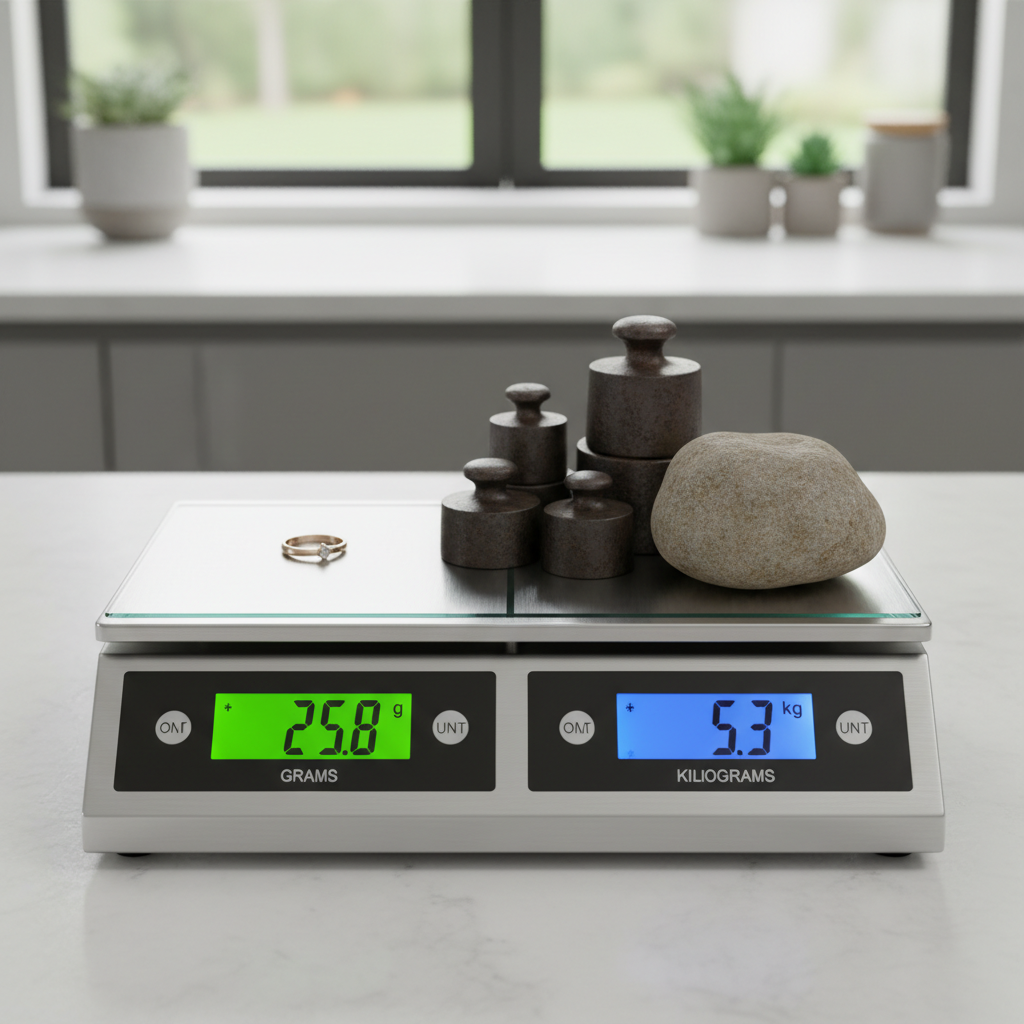
Putting Weight Together:
- Gram (g): For very light things like a feather or a coin.
- Kilogram (kg): For heavier things like a bag of apples or a pet dog. (1000 g = 1 kg)
Part 3: Measuring Capacity - How Much Can It Hold?
Capacity is all about how much liquid a container can hold. Think about a juice box, a swimming pool, or a bathtub. Their capacity is how much juice, water, or bubbles they can fit inside. In the metric system, we use milliliters (ml) and liters (L).
Milliliters: The Small Amounts
A milliliter is a very small amount. Think of a single drop of water – it's about 1 milliliter. A teaspoon of medicine is about 5 milliliters. Milliliters are perfect for measuring small amounts of liquid, like when you're measuring medicine or pouring a small amount of water into a glass.
Liters: The Bigger Amounts
When you have larger amounts of liquid, we use liters (L). A common soda bottle is 2 liters. A jug of milk is often 1 liter. Liters are used for things like the water in a bathtub, the amount of gas in a car, or the capacity of a swimming pool.
Analogy: Imagine a small medicine cup. It might hold about 10 milliliters. Now imagine a big water cooler bottle. It might hold 20 liters! To get from milliliters to liters, you need a LOT of small amounts to make a big amount. In fact, 1000 milliliters make 1 liter!
Putting Capacity Together:
- Milliliter (ml): For small amounts of liquid like medicine or a few drops of water.
- Liter (L): For larger amounts of liquid like juice in a carton or water in a bathtub. (1000 ml = 1 L)
Quick Review!
We learned about three ways to measure things using the metric system:
- Length: Meters (m), centimeters (cm), and kilometers (km).
- Weight: Grams (g) and kilograms (kg).
- Capacity: Milliliters (ml) and liters (L).
Keep learning, free
Create a free Syllabax account to unlock practice questions and games for this topic.
Visual Learning Enhanced! 🚀
To help you master this topic, we use Advanced Syllabax AI to generate detailed diagrams and visual models.
Note on Visuals: The AI sometimes makes spelling errors in image labels. Please refer to the lesson text for the correct terminology.