Learning Journey
Watch this topic in 60 seconds
Free preview · Lesson 1
Understanding How Many Fewer? (Comparing)
How Many Fewer? (Comparing Numbers)
Hello, young mathematicians! Today we're going on an exciting adventure to learn about 'comparing' numbers and finding 'how many fewer'. It's like being a detective, looking closely at two groups of things to see which one has less and by how much!
What Does 'Fewer' Mean?
Imagine you have two bowls of yummy candies. In one bowl, you have 5 candies. In the other bowl, you have 3 candies. Which bowl has less candy? The bowl with 3 candies, right? When we say a group has 'fewer' items, it means it has a smaller amount compared to another group.
Think of it like this: If you have a taller building and a shorter building, the shorter building is 'less tall'. If you have more toys and your friend has less toys, your friend has 'fewer' toys than you. 'Fewer' just means a smaller number or amount.
Why Do We Compare?
We compare numbers all the time without even thinking about it! When you decide if you have enough cookies for everyone, or if your tower of blocks is taller than your friend's, you're comparing. Comparing helps us understand which group is bigger, smaller, or if they are the same.
Let's look at an example to understand 'how many fewer'.
Example 1: The Apple Orchard
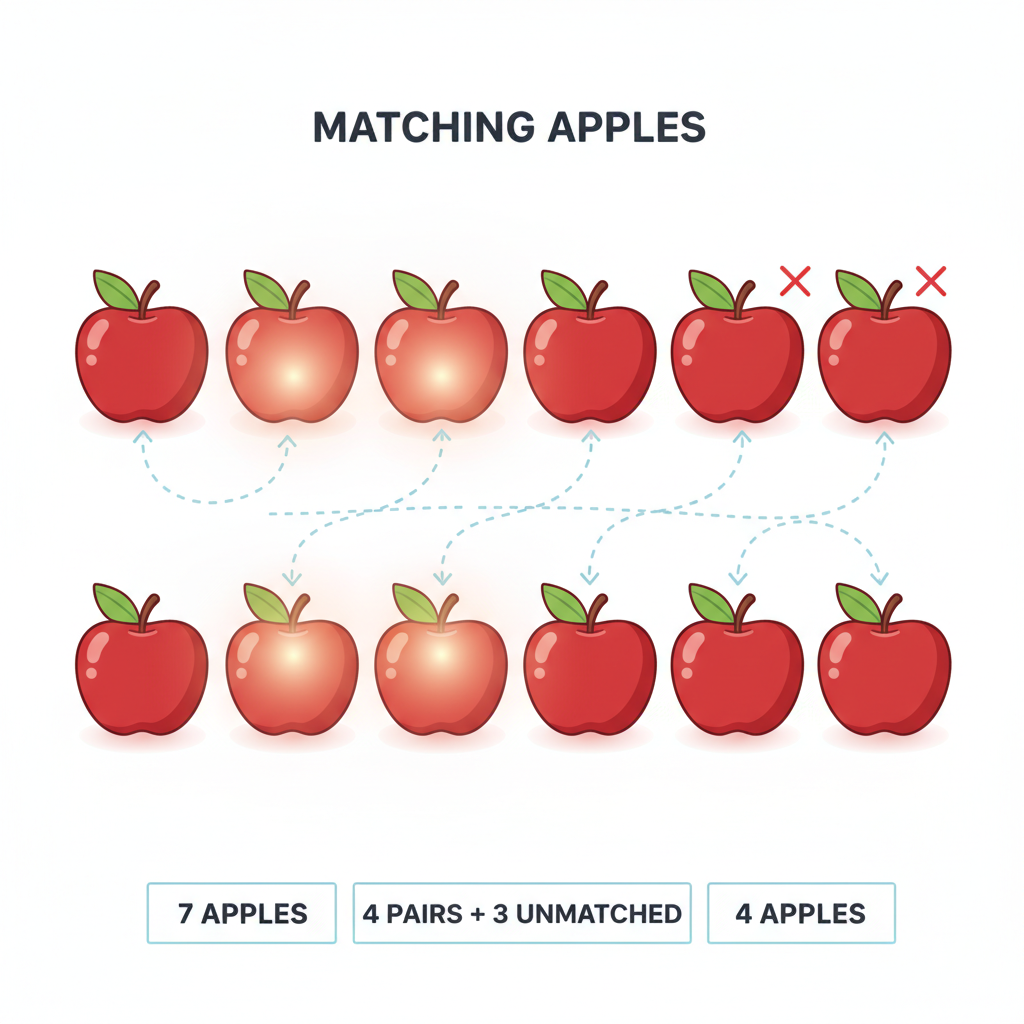
Imagine your friend, Lily, went to an apple orchard and picked 7 shiny red apples. You went too, and you picked 4 shiny red apples.
- Lily has: 🍎🍎🍎🍎🍎🍎🍎 (7 apples)
- You have: 🍎🍎🍎🍎 (4 apples)
Clearly, Lily has more apples than you. But the big question is: 'How many fewer apples do you have than Lily?'
To find 'how many fewer', we need to find the difference between Lily's apples and your apples. It's like we are trying to make the number of apples equal, and we want to know how many more apples you would need to catch up to Lily.
Here's a trick! You can line them up and see what's left over:
- Lily: 🍎🍎🍎🍎🍎🍎🍎
- You: 🍎🍎🍎🍎
If you match up your apples with Lily's, one by one:
- Lily: 🍎 🍎 🍎 🍎 🍎 🍎 🍎
- You: 🍎 🍎 🍎 🍎
You can see that Lily has 3 apples left over that don't have a match with your apples. So, you have 3 fewer apples than Lily!
Using Subtraction to Find 'How Many Fewer'
That lining-up trick is great, but there's a super-fast way to find 'how many fewer'! We use subtraction.
When you hear the question 'How many fewer...?' or 'What is the difference...?', it's a big clue that you need to subtract!
Here's how it works:
- Find the bigger number. (This is the group that has more items).
- Find the smaller number. (This is the group that has fewer items).
- Subtract the smaller number from the bigger number. The answer is 'how many fewer'!
Let's go back to the apples:
- Lily has 7 apples (bigger number).
- You have 4 apples (smaller number).
So, we do: 7 - 4 = 3
This means you have 3 fewer apples than Lily.
Example 2: Toy Cars
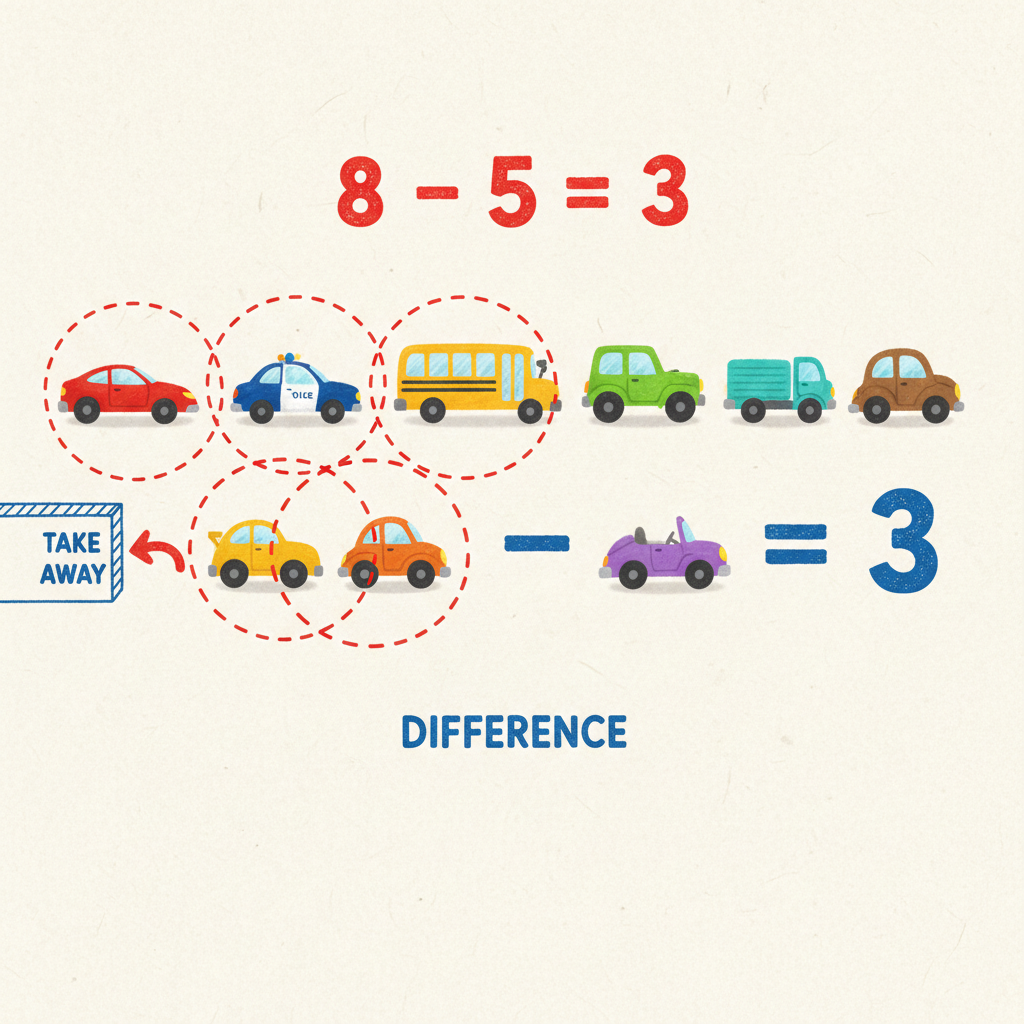
Liam has 8 toy cars. His friend Mia has 5 toy cars.
Question: How many fewer toy cars does Mia have than Liam?
Let's use our subtraction detective skills!
- Bigger number: Liam has 8 cars.
- Smaller number: Mia has 5 cars.
- Subtract: 8 - 5 = ?
If you count back from 8 (7, 6, 5, 4, 3) or use your fingers, you'll find that 8 - 5 = 3.
So, Mia has 3 fewer toy cars than Liam.
Important Tips to Remember:
- 'Fewer' means less, or a smaller amount.
- When you compare two numbers and want to know 'how many fewer', you are looking for the difference between them.
- To find the difference (or 'how many fewer'), always subtract the smaller number from the bigger number.
Practicing with different objects and numbers will make you a super expert at finding 'how many fewer'! Keep looking for those clues in word problems!
Keep learning, free
Create a free Syllabax account to unlock practice questions and games for this topic.
Visual Learning Enhanced! 🚀
To help you master this topic, we use Advanced Syllabax AI to generate detailed diagrams and visual models.
Note on Visuals: The AI sometimes makes spelling errors in image labels. Please refer to the lesson text for the correct terminology.