Introduction to Combinations
Watch this topic in 60 seconds
Free preview · Lesson 1
Understanding Introduction to Combinations
Introduction to Combinations: When Order Doesn't Matter!
Welcome to the exciting world of combinations! In mathematics, especially in an area called combinatorics, we often deal with counting how many ways things can happen. Sometimes the order in which we pick things matters, and sometimes it doesn't. Today, we're going to focus on those situations where the order is completely unimportant – these are called combinations.
What Exactly Are Combinations?
Imagine you have a basket of different fruits: an apple, a banana, and a cherry. You want to make a small fruit salad with just two fruits.
- If you pick the apple first, then the banana, you get a salad with apple and banana.
- If you pick the banana first, then the apple, what do you get? Still a salad with apple and banana!
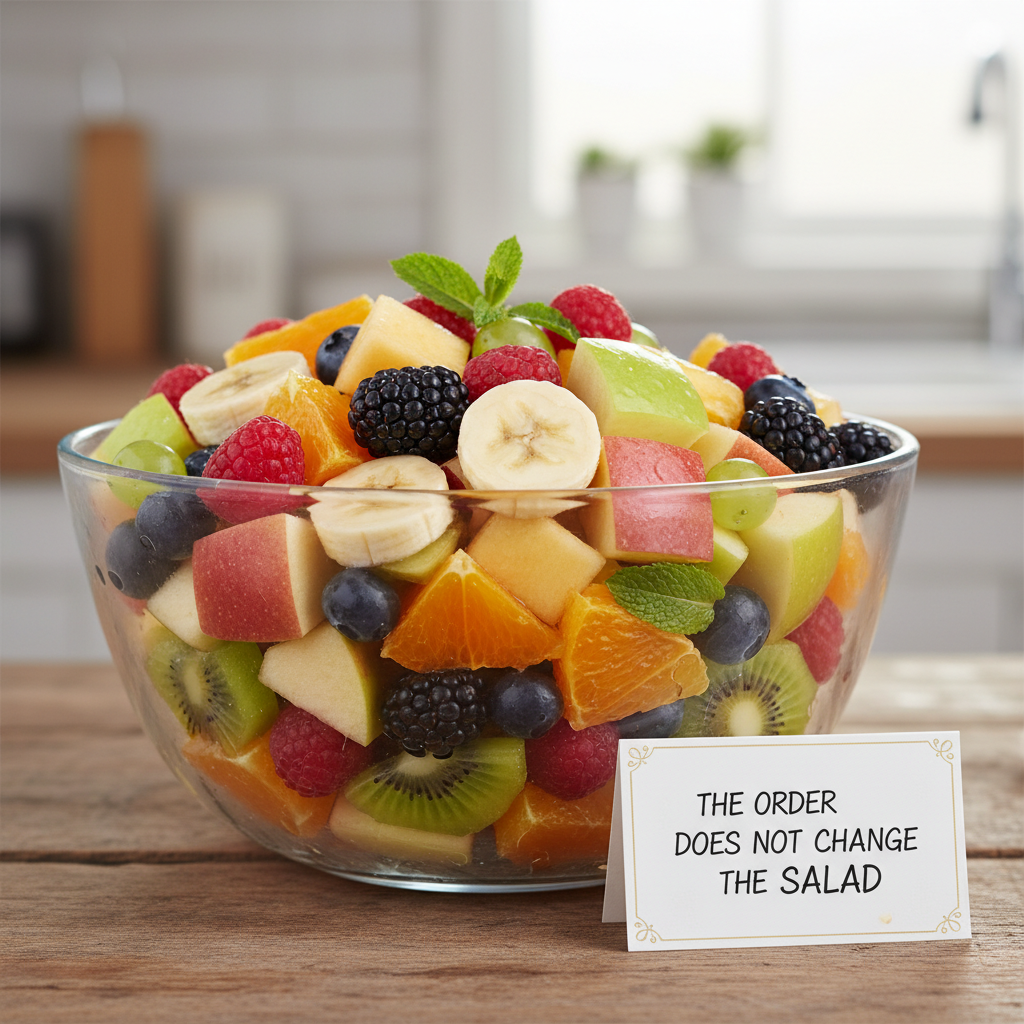
In this scenario, the order in which you picked the fruits didn't change the final salad. This is the core idea behind combinations: a combination is a selection of items where the order of selection does not matter.
Analogy 1: The Fruit Salad vs. A Smoothie Recipe
Think about our fruit example again:
Fruit Salad (Combination): You're choosing fruits for a salad. If you put apples and then bananas in, it's the same salad as putting bananas and then apples in. The final mix is what counts, not the sequence you added them.
Smoothie Recipe (Permutation – where order DOES matter): Now, imagine you're following a specific smoothie recipe: "First, blend the apple, then add the banana, then the cherry." If you changed the order – say, blended the banana first, then the apple – it might change the texture, or how the flavors combine, or even just the instructions you're following. Here, the order of steps is crucial. (We'll talk more about these 'order matters' situations, called permutations, another time!)
The key takeaway is this: for combinations, if you rearrange the chosen items, you still have the same group or set. It's like choosing a hand of cards in poker – it doesn't matter if you got the Ace of Spades first or last, as long as it's in your hand.
Analogy 2: Choosing a Team vs. Lining Up for a Photo
Let's say you have three friends: Alex, Ben, and Chloe. You need to pick two of them for a special project.
- Choosing a Team (Combination): If you pick Alex and Ben, it's the same team as picking Ben and Alex. The pair is what matters, not who you named first. The possible teams are {Alex, Ben}, {Alex, Chloe}, {Ben, Chloe}. There are 3 possible teams.
- Lining Up for a Photo (Permutation): Now, if you're lining Alex and Ben up for a photo, "Alex then Ben" is different from "Ben then Alex" because their positions are different. Here, order matters.
When Do We Use Combinations in Real Life?
Combinations are everywhere! Here are a few examples:
- Lottery Numbers: In many lotteries, you pick a set of numbers, and the order in which those numbers are drawn or you mark them doesn't matter. As long as your ticket has the winning set of numbers, you win!
- Pizza Toppings: If you order a pizza with pepperoni and mushrooms, it's the same pizza as one with mushrooms and pepperoni. The combination of toppings is what you care about.
- Selecting a Committee: When a teacher selects three students from a class to be on a school committee, the order in which they are chosen doesn't change who is on the committee. It's the group of students that forms the committee.
- Drawing Cards: When you're dealt a hand of cards in a game, the order in which you receive the cards doesn't usually matter for what your hand is. It's the collection of cards that defines your hand.
How Do We Figure Out Combinations? (The Basic Idea)
For very small numbers, we can often just list out the possibilities. Let's go back to our fruit salad example: choosing 2 fruits from Apple (A), Banana (B), and Cherry (C).
If order did matter (like for a smoothie recipe), the possibilities would be:
- AB (Apple then Banana)
- BA (Banana then Apple)
- AC (Apple then Cherry)
- CA (Cherry then Apple)
- BC (Banana then Cherry)
- CB (Cherry then Banana)
That's 6 different ordered pairs. But we know for a fruit salad, AB is the same as BA. So, we need to get rid of the duplicates caused by just re-ordering the same items.
For a group of 2 items, there are 2 ways to order them (like AB and BA). So, we can take the 6 ordered pairs and divide by 2 to find the unique combinations:
6 / 2 = 3 unique combinations!
These unique combinations are:
- {A, B} (Apple and Banana)
- {A, C} (Apple and Cherry)
- {B, C} (Banana and Cherry)
This is the fundamental principle: we count all the ways if order mattered, and then divide by the number of ways we can arrange the chosen items, because those arrangements are considered the same combination.
Summary
Combinations are a powerful tool for counting groups or sets of items where the sequence or order of selection doesn't change the final group. Always ask yourself: "If I rearrange the items I've picked, is it still considered the same outcome?" If the answer is yes, you're dealing with a combination!
Keep learning, free
Create a free Syllabax account to unlock practice questions and games for this topic.
Visual Learning Enhanced! 🚀
To help you master this topic, we use Advanced Syllabax AI to generate detailed diagrams and visual models.
Note on Visuals: The AI sometimes makes spelling errors in image labels. Please refer to the lesson text for the correct terminology.