Sorting shapes (2D Shapes)
Watch this topic in 60 seconds
Free preview · Lesson 1
Understanding Sorting shapes (2D Shapes)
Sorting Shapes: A Fun Adventure with 2D Shapes!
Hello Super Sharers! Today, we're going on an exciting adventure to explore the world of shapes! Imagine you have a big box filled with all sorts of toys. Some are cars, some are dolls, and some are building blocks. How would you organize them so you can easily find what you want to play with? You might put all the cars together, all the dolls together, and all the blocks together, right? That's exactly what sorting is! We're going to learn how to sort 2D shapes.
What are 2D Shapes?
2D shapes are like drawings of shapes on a flat piece of paper. They have a front and a back, but they don't have any thickness. Think of them as flat drawings. They are everywhere around us!
Let's meet some of our flat shape friends:
The Circle Family
The first shape we'll meet is the Circle. A circle is round and has no corners. It's like a perfectly round pizza or a shiny coin! If you try to find a pointy spot on a circle, you won't find any. It just keeps going round and round!
The Triangle Tribe
Next, we have the Triangle. A triangle is a shape with three straight sides and three pointy corners, called vertices. Imagine a slice of pizza cut into three pieces – that's a triangle! Or maybe a party hat? That's a triangle too! It's like a little mountain peak.
The Square Squad
Now, let's meet the Square! A square is a very special shape with four equal straight sides and four square corners. All its sides are the same length, like the sides of a perfectly cut sandwich or a window pane. Each corner is like a little square angle.
The Rectangle Rangers
Close cousins to the square are the Rectangles! Rectangles also have four straight sides and four square corners. But, unlike squares, rectangles have two longer sides and two shorter sides. Think of a door, a book, or a crayon box – these are all rectangles! They are like a stretched-out square.
The Oval Orbiters
We also have the Oval. An oval looks like a squished circle. It's roundish but longer in one direction. Think of an egg or a rugby ball – those are ovals! They don't have any corners, just a smooth, curvy shape.
Why Do We Sort Shapes?
Sorting shapes helps us understand them better. When we sort, we put similar things together. This makes it easier to count them, compare them, and even learn new things about them! It's like tidying up your toy box – once everything is in its place, it's much easier to play!
How to Sort 2D Shapes
We can sort shapes in many ways! Here are some ideas:
1. Sorting by the Number of Sides
Let's look at the sides of our shapes. A side is one of the straight lines that make up the shape.
- Circle: Has 0 straight sides.
- Triangle: Has 3 straight sides.
- Square: Has 4 straight sides.
- Rectangle: Has 4 straight sides.
- Oval: Has 0 straight sides.
So, we could put all the shapes with 0 sides (circles and ovals) in one group, and all the shapes with 3 sides (triangles) in another, and all the shapes with 4 sides (squares and rectangles) in a third group!
2. Sorting by the Number of Corners (Vertices)
Corners, also called vertices, are the pointy parts where two sides meet.
- Circle: Has 0 corners.
- Triangle: Has 3 corners.
- Square: Has 4 corners.
- Rectangle: Has 4 corners.
- Oval: Has 0 corners.
We can group shapes that have the same number of corners. Circles and ovals have zero corners, triangles have three, and squares and rectangles have four!
3. Sorting by Shape Name
This is the easiest way to sort! We can just put all the circles together, all the triangles together, all the squares together, and so on. It's like putting all your red toys in one bin and all your blue toys in another bin.
Let's imagine we have a big pile of mixed-up shapes. How would we sort them?
First, we could pick out all the circles. They are round and have no corners. We'll put them in a special circle pile.
Next, we look for triangles. They have three sides and three corners. They look like little pointy hats! Into the triangle pile they go.
Then, we find the squares. They have four sides that are all the same length and four square corners. They look like little boxes. The square pile grows!
After that, we can look for rectangles. They also have four sides and four corners, but two sides are longer than the other two. They look like doors or windows. The rectangle pile gets bigger!
Finally, we might find some ovals. They look like squished circles or eggs. They have no corners. They go into the oval pile.
Now, our big messy pile of shapes is all sorted! We can see how many of each shape we have. This is super helpful!
Sorting shapes helps us become shape detectives! We learn to look closely at the properties of each shape – like how many sides or corners they have – to decide where they belong.
Look around your classroom or your house. Can you find examples of these 2D shapes? How many circles do you see? How many rectangles? Can you sort them in your mind?
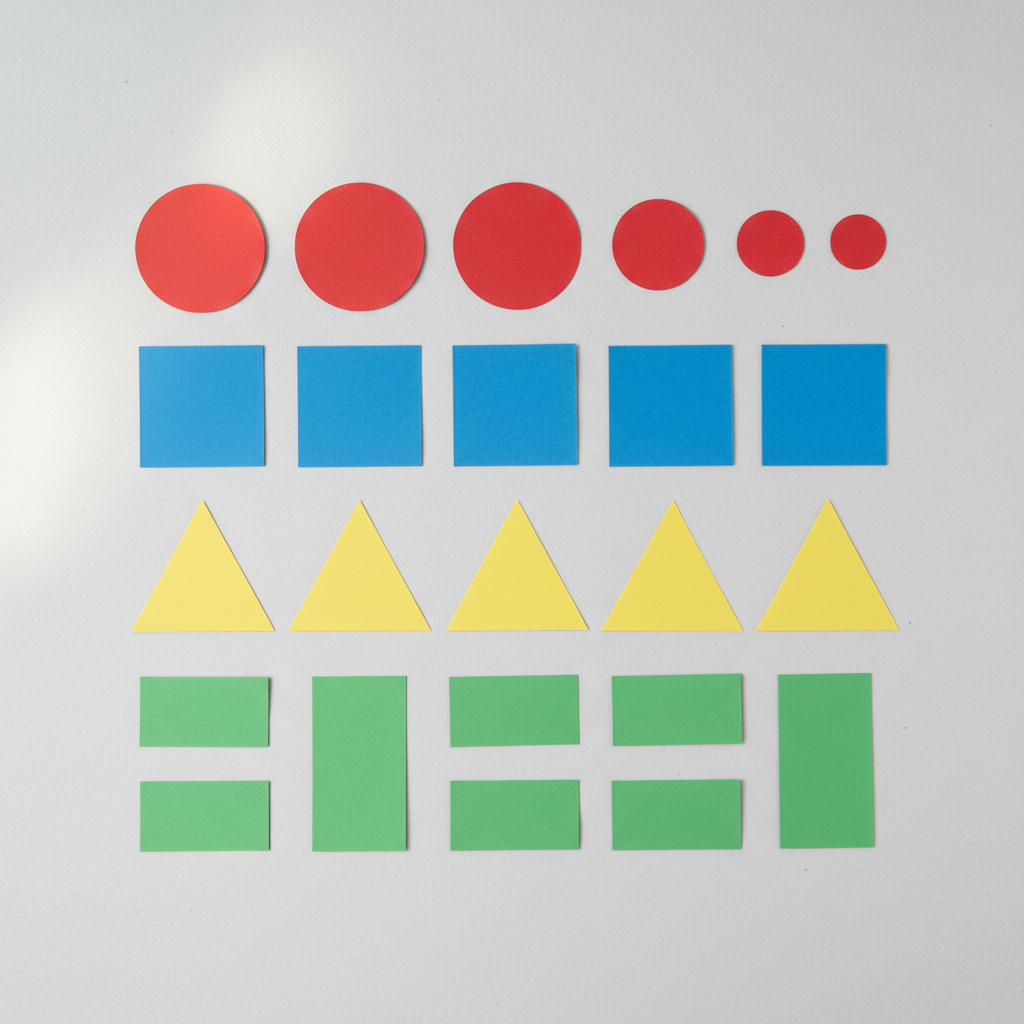
Remember, sorting is all about finding ways to group things that are alike. For shapes, we can group them by their number of sides, their number of corners, or simply by their name. It’s like organizing your crayons by color so you can easily pick the one you need!
Let's try to be shape sorters ourselves! Imagine you have a bag of play-doh. You can make lots of shapes. You can make a circle, a square, a triangle, and a rectangle. If you put all your circle creations on one side of the table and all your square creations on the other, you are sorting!
It's like being a librarian for shapes! You put all the books about animals on one shelf, all the books about space on another, and all the books about fairy tales on a third. Each shelf is a different category for the books.
Think about building with blocks. If you have different shaped blocks, you might put all the cube-shaped blocks together, all the rectangular prism blocks together, and so on. That's sorting!

So, the next time you see a shape, try to describe it. How many sides does it have? How many corners? Is it round? Is it flat? By answering these questions, you're already practicing how to sort and understand shapes better!
Let's Recap Our Shape Sorting Adventure!
We learned about 2D shapes like circles, triangles, squares, rectangles, and ovals. We discovered that sorting helps us organize and understand things better. We can sort shapes by their number of sides, their number of corners, or their names. Keep practicing your shape sorting skills, and you'll become a shape expert in no time!
Keep learning, free
Create a free Syllabax account to unlock practice questions and games for this topic.
Visual Learning Enhanced! 🚀
To help you master this topic, we use Advanced Syllabax AI to generate detailed diagrams and visual models.
Note on Visuals: The AI sometimes makes spelling errors in image labels. Please refer to the lesson text for the correct terminology.