Finding the Median Value
Watch this topic in 60 seconds
Free preview · Lesson 1
Understanding Finding the Median Value
Unlocking the Middle Ground: Finding the Median Value (Grade 7)
Welcome, young data explorers! Today, we're going on an exciting adventure to find something very special hidden inside a list of numbers: the Median. Think of the median as the ultimate 'middle child' of a number family, or the exact middle seat on a bus. It's a way to understand what's typical or central in a group of numbers without being pulled too much by really big or really small numbers.
What is the Median, Anyway?
Imagine you have a group of friends, and you line them up from shortest to tallest. The person standing exactly in the middle of that line? That's your median height! In math, the median is simply the middle value in a list of numbers that has been arranged in order from smallest to largest (or largest to smallest). It splits your data set right down the middle, so half the numbers are smaller than the median and half are larger.
Why is the Median Important? (And Why Not Just Use Average?)
You might be thinking, "Wait, isn't that what the average (mean) does?" Not quite! The average is like everyone getting an equal share. But sometimes, one super-rich person can make the 'average' wealth seem much higher than what most people actually have. The median, on the other hand, isn't easily tricked by these extreme values. It's a true 'middle ground' that gives a better sense of what's typical for the majority.
Think of it like this: if you have scores of 1, 2, 3, 4, and 100. The average would be (1+2+3+4+100)/5 = 110/5 = 22. But does 22 truly represent the typical score when most scores are very low? Not really! The median, as we'll soon see, would be 3. Three feels much more like the 'middle' here, doesn't it?
Finding the Median: Two Simple Paths
Finding the median depends on whether you have an odd or even number of items in your list. Don't worry, both paths are easy!
Path 1: When You Have an ODD Number of Values
This is the easiest path! When you have an odd number of items, there will always be just one number sitting perfectly in the middle.
Steps:
- Order Them Up! The very first and most crucial step is to arrange all your numbers in order, either from smallest to largest or largest to smallest. It doesn't matter which direction, as long as they are ordered!
- Find the Middle Child! Once your numbers are neatly lined up, simply count in from both ends until you find the single number that has an equal number of values on either side of it. This is your median!
Let's Try an Example!
Imagine you have these numbers representing the number of goals scored by a soccer team in 5 games: 3, 1, 5, 2, 4
- Order Them Up: Let's arrange them from smallest to largest:
1, 2, 3, 4, 5 - Find the Middle Child: Now, let's find the middle. You can gently cross off numbers from both ends until you hit the middle:
1,2, 3,4,5
The number 3 is right in the middle! It has two numbers smaller than it (1, 2) and two numbers larger than it (4, 5).
So, the median number of goals scored is 3.
Path 2: When You Have an EVEN Number of Values
Ah, the even path! When you have an even number of items, you won't have a single 'middle child.' Instead, you'll have two numbers sharing the middle spot. Think of them as two best friends who always sit together in the middle. To find the median, you need to find the 'average' of these two best friends.
Steps:
- Order Them Up! Just like before, the first step is to arrange all your numbers in order from smallest to largest.
- Find the Two Middle Friends! Count in from both ends until you find the two numbers that are sharing the middle spot.
- Average the Middle Friends! Add these two middle numbers together and then divide their sum by 2. This result is your median!
Let's Try an Example!
Suppose you have these numbers representing the ages of 6 students in a club: 10, 12, 9, 11, 13, 8
- Order Them Up: Arrange them from smallest to largest:
8, 9, 10, 11, 12, 13 - Find the Two Middle Friends: Let's cross them off from both ends:
8,9, 10, 11,12,13
Our two middle numbers are 10 and 11. - Average the Middle Friends: Add them together and divide by 2:
(10 + 11) / 2 = 21 / 2 = 10.5
So, the median age of the students is 10.5. Notice how the median doesn't have to be one of the original numbers in your list, especially when you have an even count!
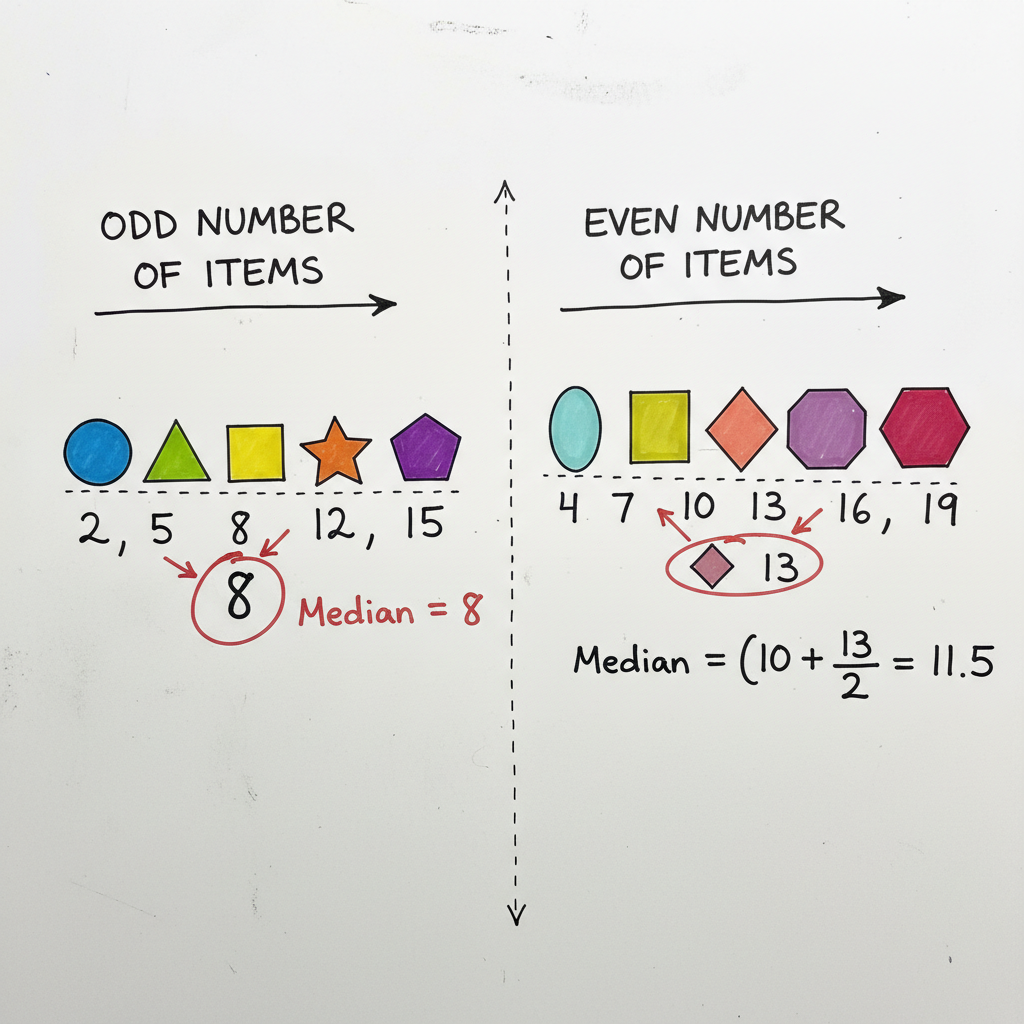
Key Reminders for Median Mastery:
- Always Order First: This is the golden rule! If you don't order your numbers, you won't find the true middle.
- Odd = One Middle Number: Easy peasy, just find it!
- Even = Two Middle Numbers (then Average!): Don't forget to add them up and divide by two.
- Median vs. Mean: The median is often a better measure of 'typical' when you have numbers that are much larger or smaller than the rest (outliers).
Congratulations, you're now a median expert! With practice, finding that middle ground will become second nature. Keep exploring data, and you'll uncover even more hidden insights!
Keep learning, free
Create a free Syllabax account to unlock practice questions and games for this topic.
Visual Learning Enhanced! 🚀
To help you master this topic, we use Advanced Syllabax AI to generate detailed diagrams and visual models.
Note on Visuals: The AI sometimes makes spelling errors in image labels. Please refer to the lesson text for the correct terminology.