Redox (intro) [CHEMISTRY]
Watch this topic in 60 seconds
Free preview · Lesson 1
Understanding Redox (intro) [CHEMISTRY]
Unraveling Redox Reactions: The Great Electron Dance!
Welcome, future chemists! Today, we're diving into one of the most fundamental and fascinating types of chemical reactions: Redox Reactions. The word 'Redox' might sound a bit intimidating, but it's actually a clever combination of two simpler words: Reduction and Oxidation. Think of it as a chemical dance where two partners are always involved, and they can't dance without each other!
What are Redox Reactions? The Core Idea
At their heart, redox reactions are all about the movement of electrons. Electrons, as you know, are tiny, negatively charged particles that orbit the nucleus of an atom. They're the 'currency' of chemical reactions, often exchanged or shared when atoms interact.
In a redox reaction, one atom or molecule loses electrons, and another atom or molecule gains those very same electrons. It's a fundamental process that underpins everything from how batteries work to how our bodies produce energy, and even how metals rust.
Analogy: The Money Transfer
Imagine you have a friend who transfers money to your bank account. You gain money, and your friend loses money. This is exactly what happens with electrons in a redox reaction! One substance 'gives away' electrons (loses them), and another substance 'takes in' electrons (gains them).
Part 1: Oxidation – The Loss!
What is Oxidation?
When a substance undergoes oxidation, it means it loses electrons. It's like an atom going on a diet and shedding some of its electron weight. When an atom loses negative electrons, it becomes more positively charged (or less negatively charged).
Mnemonic Alert!
To remember what oxidation means, use this classic mnemonic:
- Loss of Electrons is Oxidation
- (LEO the lion says GER!)
Another Way to Look at Oxidation (Historical Definition)
Historically, oxidation was first defined as the reaction of a substance with oxygen. Think about iron rusting: iron reacts with oxygen to form iron oxide (rust). In this process, the iron atoms actually lose electrons to the oxygen atoms. So, while 'gain of oxygen' is a good descriptive definition for many cases, the more fundamental modern definition is 'loss of electrons'.
- Oxidation = Loss of Electrons (The modern, most important definition!)
- Oxidation = Gain of Oxygen (The older, but still useful definition for many reactions)
- Oxidation = Loss of Hydrogen (Less common in intro, but good to know!)
The Oxidizing Agent: The Electron Thief!
The substance that causes another substance to be oxidized is called the oxidizing agent. It's the 'electron thief' – it takes electrons from another substance. And here's the cool part: when an oxidizing agent takes electrons, it itself must gain those electrons. And what do we call the gaining of electrons? Reduction! So, the oxidizing agent is always the substance that gets reduced.
Analogy: The Giving Hand
Imagine you're giving away a toy (an electron). You are being oxidized (losing the toy). The person you give the toy to is the 'oxidizing agent' because they caused you to give it away by taking it. While they are the 'oxidizing agent' for you, they themselves are actually gaining the toy, meaning they are being reduced.
Part 2: Reduction – The Gain!
What is Reduction?
When a substance undergoes reduction, it means it gains electrons. It's like an atom bulking up, adding more electrons. When an atom gains negative electrons, it becomes more negatively charged (or less positively charged).
Mnemonic Alert!
To remember what reduction means, use the other half of our mnemonic:
- Gain of Electrons is Reduction
- (LEO the lion says GER!)
Another Way to Look at Reduction (Historical Definition)
Just as oxidation had a historical definition related to oxygen, so does reduction. Reduction was originally defined as the loss of oxygen from a compound. For example, extracting pure iron from iron oxide involves removing oxygen, which is a reduction process for the iron. In this process, the iron atoms gain electrons.
- Reduction = Gain of Electrons (The modern, most important definition!)
- Reduction = Loss of Oxygen (The older, but still useful definition for many reactions)
- Reduction = Gain of Hydrogen (Less common in intro, but good to know!)
The Reducing Agent: The Electron Donor!
The substance that causes another substance to be reduced is called the reducing agent. It's the 'electron donor' – it gives electrons to another substance. And just like with oxidizing agents, when a reducing agent gives away electrons, it itself must lose those electrons. And what do we call the losing of electrons? Oxidation! So, the reducing agent is always the substance that gets oxidized.
Analogy: The Receiving Hand
You are receiving a toy (an electron). You are being reduced (gaining the toy). The person giving you the toy is the 'reducing agent' because they caused you to gain it. While they are the 'reducing agent' for you, they themselves are actually losing the toy, meaning they are being oxidized.
Why are Oxidation and Reduction Always Together? The Redox Dance!
You might have noticed a pattern by now: oxidation and reduction are inseparable! You can't have one without the other. If one atom loses electrons, another atom MUST gain those exact same electrons. Electrons don't just disappear or appear out of nowhere.
Analogy: The Gift Exchange
Think of it like giving and receiving gifts. You can't give a gift unless there's someone to receive it. And someone can't receive a gift unless there's someone to give it. The 'giving' is oxidation, and the 'receiving' is reduction. They are two sides of the same coin, happening simultaneously.
This is why we call them Redox Reactions – they are always coupled! The total number of electrons lost in the oxidation half-reaction must always equal the total number of electrons gained in the reduction half-reaction.
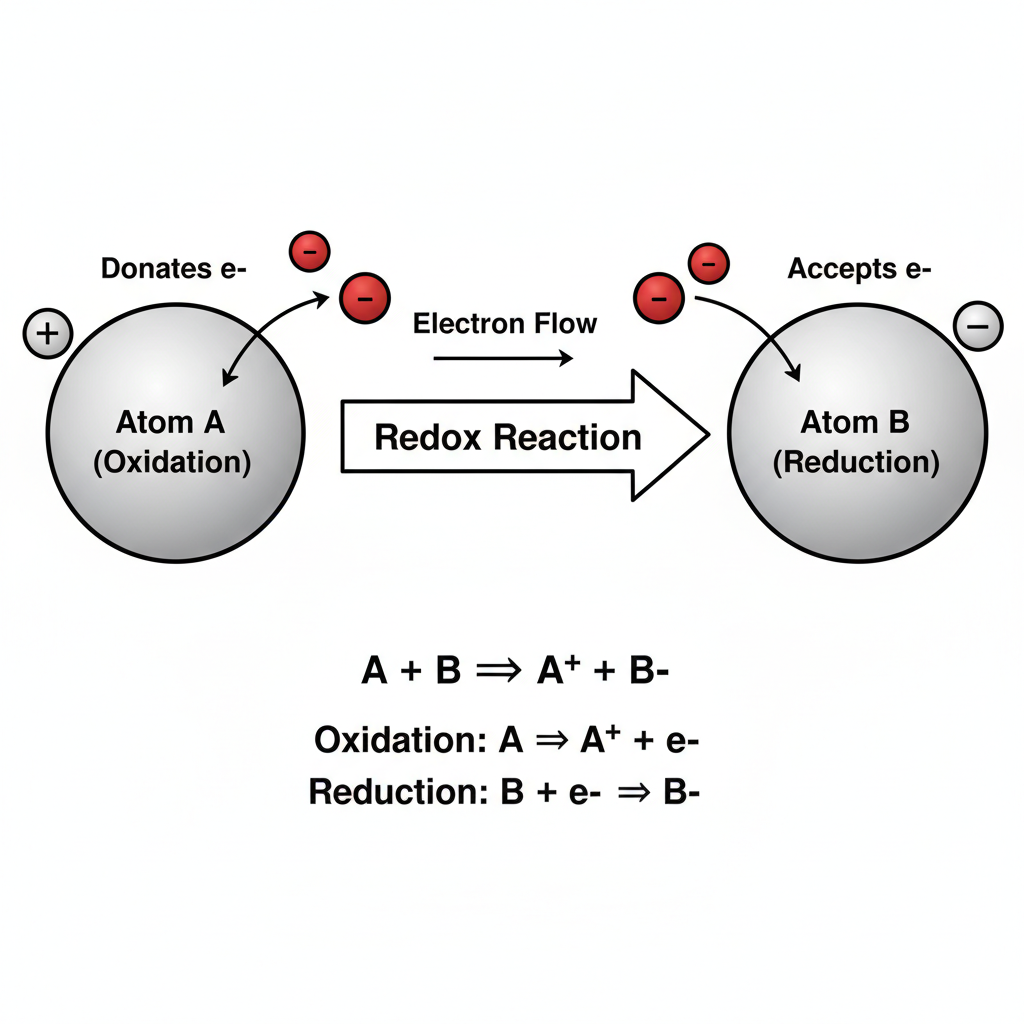
Example: Zinc and Copper Sulfate
When a strip of zinc metal (Zn) is placed in a solution of copper(II) sulfate (CuSO4), a reaction occurs:
Zn(s) + Cu2+(aq) → Zn2+(aq) + Cu(s)
- The zinc atom (Zn) goes from being a neutral atom to a positive ion (Zn2+). To do this, it must have lost two electrons. Therefore, zinc is oxidized. Zinc is the reducing agent.
- The copper ion (Cu2+) goes from being a positive ion to a neutral copper atom (Cu). To do this, it must have gained two electrons. Therefore, copper is reduced. Copper is the oxidizing agent.
Notice how electrons were transferred from zinc to copper. Oxidation and reduction happened at the same time!
Oxidation Numbers: Keeping Score
To make tracking electrons easier, chemists use something called oxidation numbers (also called oxidation states). These are numbers assigned to atoms in compounds or elements that tell us about the 'apparent' charge of an atom if electrons were completely transferred. We won't go into the detailed rules for assigning them now, but the key idea is:
- If an atom's oxidation number increases, it has lost electrons and undergone oxidation.
- If an atom's oxidation number decreases, it has gained electrons and undergone reduction.
Think of it as a scoreboard for electron transfers!
Redox Reactions in Everyday Life
Redox reactions are not just something you learn in a textbook; they are happening all around you, all the time!
- Rusting of Iron: Iron reacts with oxygen (oxidation of iron) to form rust.
- Batteries: All batteries (from the ones in your phone to car batteries) work by using controlled redox reactions to generate electricity. One chemical is oxidized, and another is reduced, creating an electron flow.
- Combustion: Burning fuels (like wood, natural gas, or gasoline) involves rapid oxidation reactions with oxygen, releasing energy (heat and light).
- Metabolism: In our bodies, how we get energy from food involves a series of complex redox reactions. Glucose is oxidized, and oxygen is reduced.
- Bleaching: Bleaches work by oxidizing stains, changing their chemical structure so they become colorless.
Summary: The Key Takeaways
- Redox reactions involve the transfer of electrons between substances.
- Oxidation is the loss of electrons (LEO). It can also be a gain of oxygen or loss of hydrogen.
- Reduction is the gain of electrons (GER). It can also be a loss of oxygen or gain of hydrogen.
- Oxidation and reduction always happen simultaneously – you can't have one without the other.
- The oxidizing agent causes oxidation (it gets reduced).
- The reducing agent causes reduction (it gets oxidized).
You've now taken your first steps into the exciting world of redox chemistry. Keep an eye out for these electron exchanges – they're everywhere once you know what to look for!
Keep learning, free
Create a free Syllabax account to unlock practice questions and games for this topic.
Visual Learning Enhanced! 🚀
To help you master this topic, we use Advanced Syllabax AI to generate detailed diagrams and visual models.
Note on Visuals: The AI sometimes makes spelling errors in image labels. Please refer to the lesson text for the correct terminology.