Straight, curved, parallel & intersecting lines (Lines & Angles)
Watch this topic in 60 seconds
Free preview · Lesson 1
Understanding Straight, curved, parallel & intersecting lines (Lines & Angles)
Learning About Lines and Angles: A 4th Grade Adventure!
Hello, young mathematicians! Today, we're going on an exciting adventure to explore the world of shapes and how they are made. We'll be focusing on a very important building block of everything around us: lines! Lines are everywhere, from the edges of your books to the paths cars take on the road. Let's dive in and learn about different types of lines!
What is a Line?
Imagine you have a piece of string and you stretch it out as far as you can in both directions, without any kinks or bends. That's pretty much what a line is! In math, a line is a straight path that goes on forever and ever in both directions. It has no beginning and no end. We often draw a small arrow on both ends of a line to show that it keeps going.
Types of Lines: Our First Discoveries!
Now, let's meet some special kinds of lines. We'll learn about straight lines, curved lines, parallel lines, and intersecting lines.
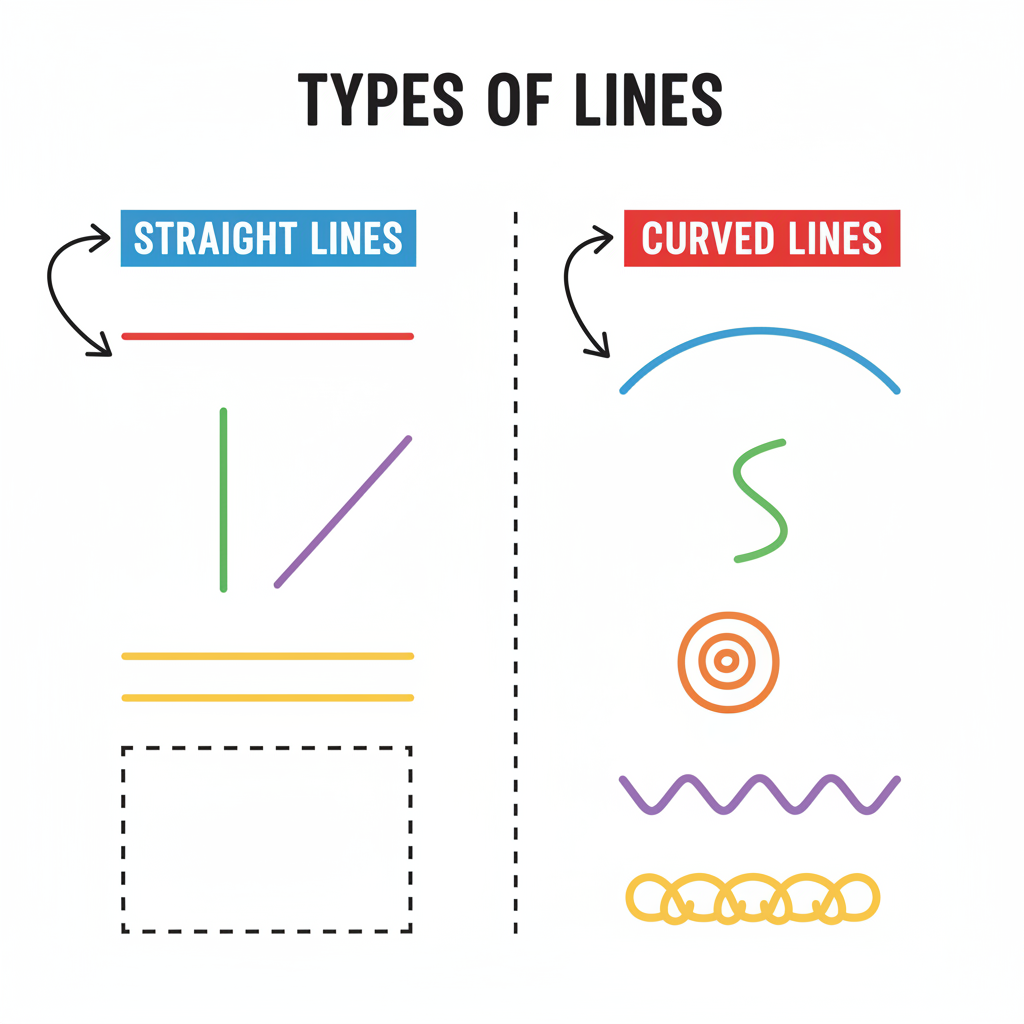
1. Straight Lines: The Superhighway of Shapes
A straight line is exactly what it sounds like – it's perfectly straight! Think about the edge of a ruler. It doesn't bend or wiggle, it just goes in one direction. Or imagine looking down a very long, straight road that disappears into the distance. That road is like a straight line!
Analogy: A straight line is like a perfectly built train track. It goes directly from one place to another without any turns.
Another example is the edge of a table. It's a straight line that helps form the shape of the table.
2. Curved Lines: The Winding Path
Unlike straight lines, curved lines are not straight at all! They bend and turn and don't follow a direct path. Think about a rainbow stretching across the sky after the rain. It's a beautiful curved line! Or imagine drawing a smiley face – the smile itself is a curved line.
Analogy: A curved line is like a river flowing through the land. It twists and turns and doesn't go in a straight shot.
Other examples include the path of a ball thrown in the air (it makes a curve!) or the shape of a circle.
3. Parallel Lines: The Never-Meet Friends
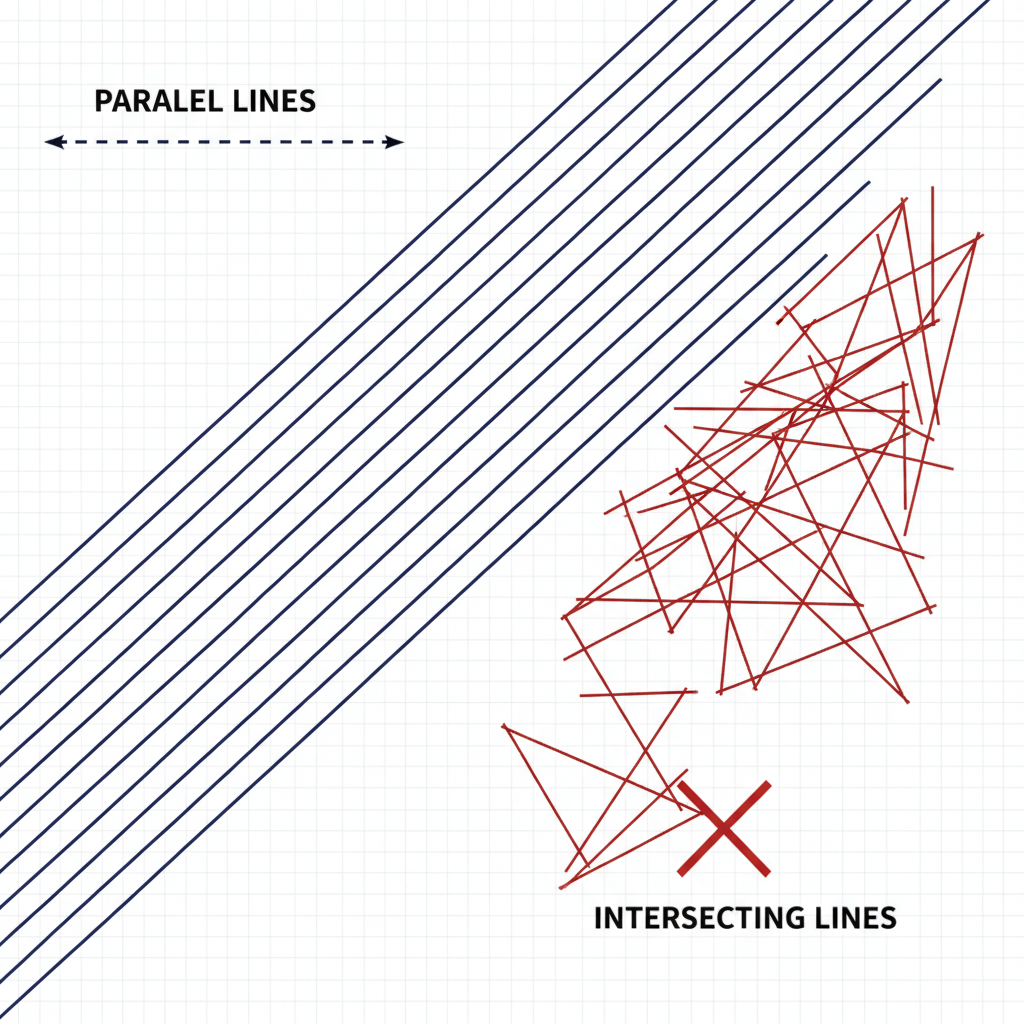
Now, let's talk about lines that have a special relationship. Parallel lines are two or more straight lines that run next to each other and never, ever cross or touch, no matter how far they go. Think of them as best friends walking side-by-side, always the same distance apart.
Analogy: Parallel lines are like the two rails of a train track. They run side-by-side and are always the same distance apart, but they never cross each other.
Look around your classroom. The opposite sides of a rectangular clock on the wall are parallel. The lines on notebook paper are also parallel.
4. Intersecting Lines: The Meeting Place
Intersecting lines are straight lines that cross each other at one point. Think of them as two roads that meet at an intersection. Where they meet, they cross paths. This crossing point is very important!
Analogy: Intersecting lines are like scissors. The two blades cross each other to make a cutting point.
When two lines intersect, they form different shapes at the point where they meet. For example, the letter 'X' is made of two intersecting lines. The hands on an analog clock (like the hour and minute hands) are often intersecting lines when they point in different directions.
Putting It All Together!
Let's review what we've learned today:
- Straight lines go on forever in a straight path.
- Curved lines bend and turn.
- Parallel lines are straight lines that never meet, always staying the same distance apart.
- Intersecting lines are straight lines that cross each other at a single point.
Understanding these basic types of lines helps us describe and understand all sorts of shapes and objects in the world around us. Keep an eye out for these lines in your everyday life – you'll be surprised how many you can find!
Keep learning, free
Create a free Syllabax account to unlock practice questions and games for this topic.
Visual Learning Enhanced! 🚀
To help you master this topic, we use Advanced Syllabax AI to generate detailed diagrams and visual models.
Note on Visuals: The AI sometimes makes spelling errors in image labels. Please refer to the lesson text for the correct terminology.