Equivalent fractions (intro) (Fractions)
Watch this topic in 60 seconds
Free preview · Lesson 1
Understanding Equivalent fractions (intro) (Fractions)
Understanding Equivalent Fractions: The Same Amount, Different Pieces!
Hello, young mathematicians! Today, we're going on a delicious adventure to explore something super important in math called equivalent fractions. Don't let the fancy name scare you! It just means fractions that look different but actually represent the exact same amount. Think of it like having a whole pizza. You can cut it into two big slices, or you can cut it into four smaller slices. If you eat one of the two big slices, you've eaten half the pizza. If you eat two of the four smaller slices, you've also eaten half the pizza! See? Same pizza, same amount eaten, but different numbers of slices.
What is a Fraction Anyway?
Before we dive into equivalent fractions, let's quickly remember what a fraction is. A fraction is a way to represent a part of a whole. It has two main parts:
- Numerator: This is the top number. It tells us how many pieces we have.
- Denominator: This is the bottom number. It tells us how many equal pieces the whole is divided into.
For example, in the fraction 1/2, the '1' is the numerator (we have 1 piece), and the '2' is the denominator (the whole thing is cut into 2 equal pieces).
Why Are Equivalent Fractions Important?
Equivalent fractions are like secret twins in the world of numbers! They look different, but they are twins because they represent the same value. Knowing about them helps us:
- Compare fractions easily: Sometimes comparing fractions can be tricky if they are cut into different sized pieces. Equivalent fractions help us make them have the same sized pieces so we can compare them fairly.
- Add and subtract fractions: To add or subtract fractions, they usually need to be equivalent (we'll learn more about this later!).
- Understand fractions better: Seeing fractions in different ways helps our brains understand them more deeply.
Let's Use Pictures and Analogies!
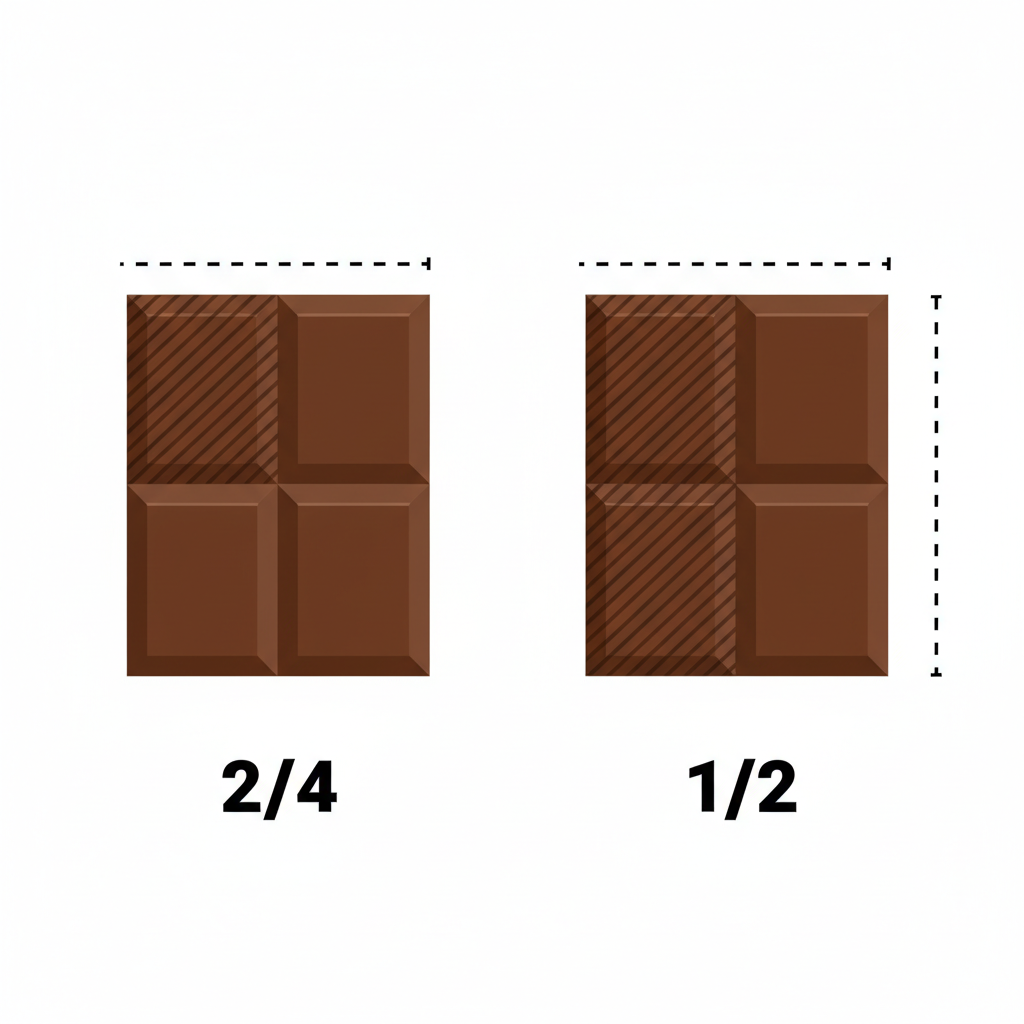
Imagine you have a chocolate bar. This chocolate bar is our whole. Let's say it has 4 squares.
Scenario 1: You eat 1 square of the chocolate bar. You ate 1 out of 4 equal squares. We write this as the fraction 1/4.
Scenario 2: Now, imagine you have another, identical chocolate bar (also with 4 squares). But this time, you break it in half first, right down the middle. So now you have two big pieces. Each big piece has 2 squares in it. If you eat one of these big pieces, how much chocolate did you eat?
This is where it gets interesting! If you eat one of the two big pieces, you have eaten 1/2 of the chocolate bar. But wait! Look back at Scenario 1. You ate 1 square out of 4. In Scenario 2, you ate one big piece, which is made of 2 squares. So you ate 2 squares out of a total of 4 squares.
So, eating 1/4 of the chocolate bar (Scenario 1) is the same as eating 2/4 of the chocolate bar (Scenario 2, if you think of it in terms of the original 4 squares). And eating 1/2 of the chocolate bar (Scenario 2, the big piece) is the same as eating 2/4 of the chocolate bar. Therefore, 1/2 is equivalent to 2/4.
Let's try another analogy: cutting a cake!
Imagine you have a round cake. This is our whole cake.
Situation A: You cut the cake into 2 equal slices. You eat 1 of those slices. You have eaten 1/2 of the cake.
Situation B: Now, imagine you take another identical cake. This time, you cut it into 4 equal slices. You eat 2 of those slices. You have eaten 2/4 of the cake.
If you look at the amount of cake you ate in Situation A and Situation B, they are exactly the same! You ate half the cake in both cases. So, 1/2 and 2/4 are equivalent fractions.
We can even cut the cake into 8 equal slices. If you eat 4 of those slices, you have eaten 4/8 of the cake. And guess what? 4/8 is also equivalent to 1/2 and 2/4! They all represent the same amount of cake.
How Do We Find Equivalent Fractions?
There's a super simple trick to find equivalent fractions. Remember our chocolate bar? To go from 1/2 to 2/4, we:
- Took the fraction 1/2.
- Multiplied the numerator (1) by 2 to get 2.
- Multiplied the denominator (2) by 2 to get 4.
So, 1/2 becomes (1 × 2) / (2 × 2) = 2/4.
You can also divide the numerator and denominator by the same number to find an equivalent fraction. Let's say you have 6/8. You can divide both the top and bottom by 2:
- 6 divided by 2 is 3.
- 8 divided by 2 is 4.
So, 6/8 is equivalent to 3/4!
The golden rule is: Whatever you do to the top number (numerator), you MUST do the exact same thing to the bottom number (denominator). It's like a secret handshake for fractions!
Key Idea Recap
Equivalent fractions are fractions that look different but represent the same amount. Think of cutting a pizza or a cake into different numbers of equal slices. If you get the same amount of cake, the fractions are equivalent!
Keep learning, free
Create a free Syllabax account to unlock practice questions and games for this topic.
Visual Learning Enhanced! 🚀
To help you master this topic, we use Advanced Syllabax AI to generate detailed diagrams and visual models.
Note on Visuals: The AI sometimes makes spelling errors in image labels. Please refer to the lesson text for the correct terminology.