Uses of materials (Materials)
Watch this topic in 60 seconds
Free preview · Lesson 1
Understanding Uses of materials (Materials)
Understanding the Wonderful World of Materials!
Hello, young explorers! Have you ever wondered what makes your toy car roll, your window clear, or your clothes comfy? It's all thanks to something super important called materials! Just like a chef needs different ingredients to bake a cake, engineers and builders need different materials to make all the amazing things around us.
What ARE Materials?
Imagine you're building with LEGOs. Each LEGO brick is a material – often plastic! Materials are simply the 'stuff' that objects are made from. Think of anything around you: your desk, your clothes, your spoon, the walls of your house. Every single one of them is made from one or more materials.
Some common materials you see every day are:
- Wood: Comes from trees! Think of a wooden chair or a pencil.
- Metal: Shiny and strong! Like a spoon, a bike, or a car.
- Plastic: Can be bendy or hard! Many toys, bottles, and containers are plastic.
- Glass: See-through and smooth! Windows, drinking glasses, and mirrors are made of glass.
- Fabric: Soft and flexible! Your clothes, blankets, and towels are made of fabric (like cotton or wool).
- Rubber: Stretchy and bouncy! Tires on cars and rubber bands are good examples.
Look around your room right now. Can you name at least three different materials you see?
 ⚠️ This picture may have spelling mistakes. Trust the words in the lesson.
Why Do Materials Matter? Properties, Properties, Properties!
Not all materials are the same, right? A pillow is soft, but a rock is hard. A window lets you see through it, but a wall doesn't. These differences are called properties. Properties are like the special superpowers or characteristics of each material. We choose materials for different jobs because of their unique properties.
Let's look at some important properties:
-
Strong vs. Weak
Imagine a superhero! A superhero is strong, meaning they can hold heavy things without breaking. Materials like metal (think of a steel beam in a building) and strong wood are used when we need something to hold a lot of weight or withstand pushes and pulls. A wet paper towel, on the other hand, is quite weak; it tears easily.
Example: We use strong metal to build bridges because they need to hold up many cars and trucks.
-
Hard vs. Soft
Have you ever tried to scratch a rock? It's really hard! Hard materials resist being scratched or dented. Diamonds are one of the hardest materials on Earth! Now, think about a fluffy pillow – that's soft. Soft materials are easy to squish, bend, or scratch.
Example: We use hard wood for tabletops so they don't get scratched easily, and soft cotton for clothes to be comfortable against our skin.
-
Flexible vs. Rigid
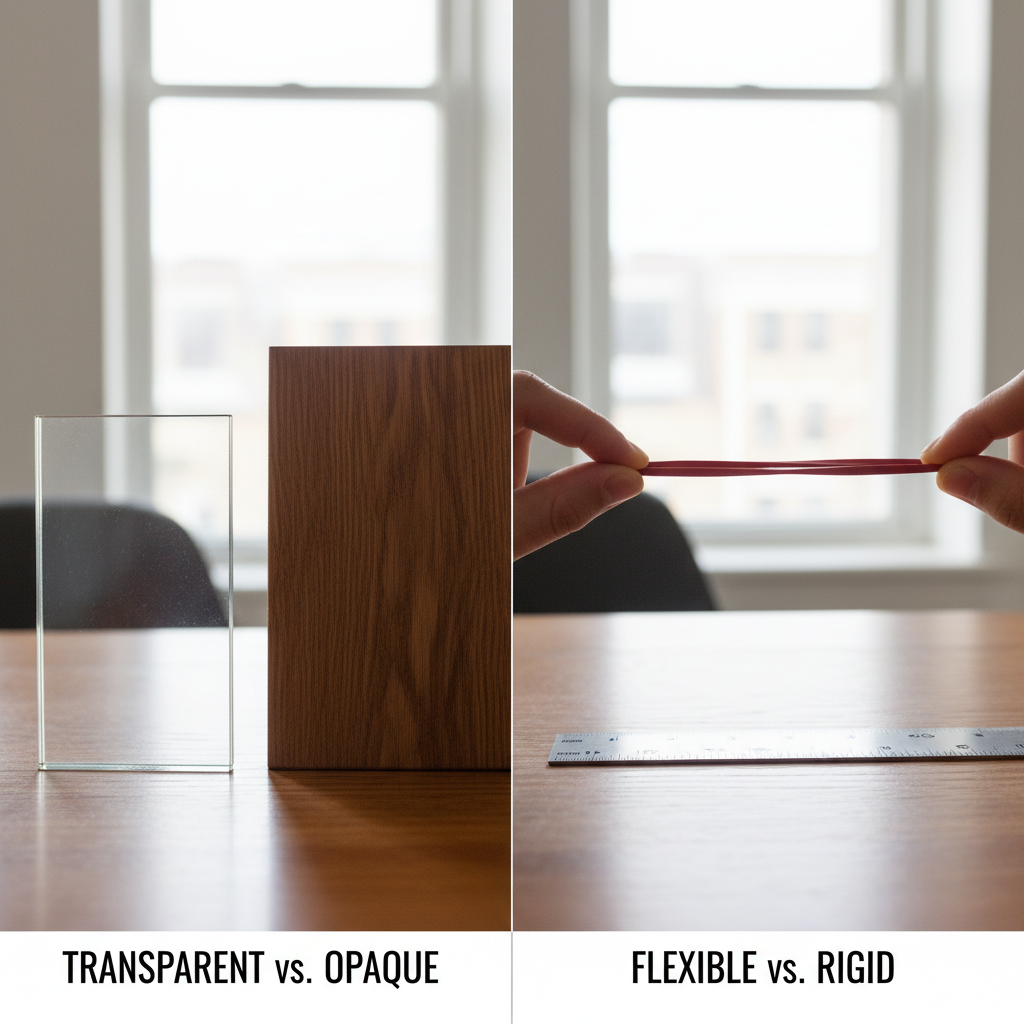
Can you bend a rubber band? Yes, it's very flexible! Flexible materials can bend and change shape without breaking. Now try bending a wooden ruler. It's rigid, meaning it stays in one shape and doesn't bend easily (or it might snap!).
Example: Rubber is used for car tires because its flexibility helps them absorb bumps. Metal beams in buildings are rigid to provide stability.
-
Waterproof vs. Absorbent
What happens if you spill water on a raincoat? The water just rolls off, right? That's because a raincoat is waterproof! Waterproof materials do not let water pass through them. What about if you spill water on a sponge or a cloth towel? It soaks it right up! That's because they are absorbent.
Example: Plastic is excellent for water bottles and raincoats because it's waterproof. Towels are made of absorbent fabric to dry things.
-
Transparent vs. Opaque
Can you see through a window? Yes! That's because glass is transparent. Transparent materials let light pass through them so you can see what's on the other side. Can you see through a brick wall? No! A brick wall is opaque. Opaque materials block light, so you cannot see through them.
Example: Glass is transparent for windows so we can see outside. Wood for a door is opaque to give us privacy.
-
Heavy vs. Light
Imagine picking up a big rock – it feels very heavy! Now imagine picking up a feather – it feels very light. Materials have different weights. We choose lighter materials for things we want to move easily, and heavier materials for things that need to stay put.
Example: Airplanes are made with light but strong metals (like aluminum) so they can fly easily. Anchors for boats are made of heavy metal to keep the boat in place.
Choosing the Right Material for the Job
Now you know about properties, you can understand why we choose certain materials for certain things!
- Why is a spoon usually made of metal? Because metal is strong and hard, perfect for scooping and stirring without bending or breaking. It's also easy to clean!
- Why are windows made of glass? Because glass is transparent, so we can see outside, and it's waterproof to keep rain out.
- Why are raincoats made of plastic or special fabric? Because they are waterproof and flexible, keeping you dry and letting you move easily.
- Why are houses often made with wood, bricks, and metal? Wood and bricks are strong and rigid to form the structure, and metal adds extra strength in places like the roof or frame.
- Why are your clothes made of fabric? Because fabric is soft, flexible, and comfortable to wear, and it can keep you warm or cool.
Thinking About Our Planet
Materials are super useful, but we need to use them wisely. Sometimes, when we're finished with something, like a plastic bottle or a newspaper, we can recycle it. Recycling means taking old materials and turning them into new things. This helps us save natural resources and keeps our Earth clean!
Time to Explore!
Now you are a material detective! Next time you pick up an object, try to guess what material it's made from and why that material was chosen. What are its properties? Is it strong or weak? Hard or soft? Transparent or opaque? The world is full of amazing materials, each with a special job to do!
Keep learning, free
Create a free Syllabax account to unlock practice questions and games for this topic.
Visual Learning Enhanced! 🚀
To help you master this topic, we use Advanced Syllabax AI to generate detailed diagrams and visual models.
Note on Visuals: The AI sometimes makes spelling errors in image labels. Please refer to the lesson text for the correct terminology.